
Tower of controversy
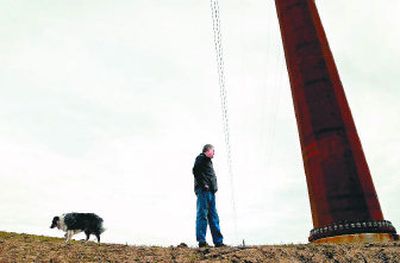
COLFAX – Martin Marler squinted and pointed a finger to a wire running far above a new high-voltage line strung by Avista Utilities near his wheat farm.
“I don’t like it. Not one bit,” he said. “I told them: ‘You’re putting up a fence that’s affecting my farming.’ “
That wire is called a lightning shield wire, and, as the name suggests, is designed to protect Avista’s new $45 million transmission project that upgrades electricity service in the Pullman and Colfax area as well as helping Avista meld into the national power grid.
The new line, however, makes it unsafe for crop-dusters to fly about 50 acres of his prime wheat ground, Marler contended. And without crop-dusters, he said, growing wheat just isn’t profitable.
So he decided to fight Avista, and today his actions have turned into a legal skirmish pitting a farmer against a billion-dollar company he accuses of trampling property rights to make a profit. The dispute underscores the difficulties and competing interests Avista must handle to accomplish an ambitious upgrade of an obtrusive transmission system that often raises the ire of neighbors.
Marler contends that Avista is misusing an easement the company bought for $75 in 1922, one of many the company negotiated that helped bring electricity to rural Whitman County. Avista relies on easements to fulfill its obligation of providing reliable, safe and affordable power to residents in its service territory.
The problems began about four years ago when Avista announced its Palouse transmission project that would extend from a substation near Plummer, Idaho, west to Rosalia, and then travel south through Colfax to another substation.
The transmission upgrade came on the heels of a regional study that concluded Avista needed to improve its capabilities as power companies increasingly depend on one another for moving large quantities of electricity. Avista decided to replace its old, wooden, 60-foot-high poles with steel poles 120 feet tall. In the hilly Palouse, this means some of the top wires can run about 250 feet above a valley floor. That’s higher than Spokane’s tallest building and poses a problem for crop-dusters who need to fly relatively low to ensure chemicals for one field don’t drift onto a neighboring field, Marler said.
Initially, concern came from neighbors who didn’t want Avista stretching transmission lines west to Rosalia. Then, when Marler read company handouts and studied the project that cut diagonally across some of his property, he decided to protest. Avista crews have moved ahead with work on Marler’s property off Shawnee Road, despite the dispute.
Though Avista is confident of its legal rights, the company last May filed a pre-emptive legal action against Marler, seeking a judgment affirming its rights against the Colfax farmer.
The utility sought the court’s assurance that its use of the easement was proper. If the court decided otherwise, the utility sought to ensure that it retained the power of eminent domain to seize the property as a last resort.
Whitman County Superior Court Judge David Frazier ruled that Avista does have the power of eminent domain, but left open the question of whether Avista’s use of the 85-year-old easements was proper.
If he rules that the easements don’t encompass Avista’s modern-day activities, and that the company must use the power of eminent domain, it could have broad financial consequences. Eminent domain requires just compensation for seized land, and prime cropland in Whitman County won’t come cheap.
In a court hearing two weeks ago, Marler’s attorney, Tim Esser, argued that Avista’s real motivation for upgrading the transmission lines is to enable the company to route electricity from its large Cabinet Gorge and Noxon Rapids dams east of Sandpoint on the Clark Fork River of Idaho and Montana, and sell it into lucrative markets such as California.
“These easements were granted for the public good, for rural electrification,” Esser said. “Now, Avista wants to abuse those easements by exporting power. It’s all making huge profits for shareholders … not benefiting Whitman County, nor the company’s ratepayers.”
Marler, whose family began farming the land in 1930, said he understands now why people get exercised when Avista or other power companies build transmission projects.
Standing outside a modest farm house with his Australian shepherd and two pudgy cats, Marler said some neighbors applaud his stance that Avista’s gain shouldn’t come at the expense of farmers. Marler is well-known around Colfax, serves on the local hospital board, and isn’t afraid to voice an opinion.
“Farmers don’t often make a lot of noise,” he said, “but I think this is important.”
He notes that the 230-kilovolt transmission line carries enough electricity to light 325,000 homes – far more than what’s needed for Whitman County. “Should you be able to take a farmer’s land to make money for yourself and shareholders?” Esser asked.
Avista disputes that scenario.
The utility buys more electricity from other power companies than it sells, according to attorney James Sloane.
The utility is so heavily regulated that there’s no way it could simply sell off its power to the highest bidder and pocket the profits at the expense of ratepayers, added spokesman Hugh Imhof.
Avista likens its transmission systems to public highways: They are part of a national power grid that demands reliability, safety and future planning.
The Palouse line upgrade will provide those benefits and is built to meet the needs of the next 50 years, said Avista transmission design manager David James.
“The intent of the line is to serve WSU, Colfax and Pullman,” he said, likening the line before the upgrade to a one-way street where a single power failure could mean everything in the region goes dark. “There’s little tolerance for that.”
The new line will provide an alternative source of power for the area. Right now the Pullman-Colfax area is served by a single 230-kV transmission line that runs like a spur out of a power hub in the Lewiston-Clarkston area.
To make it work, Avista needed to uproot the old wooden poles along the route that carried far less electricity and replace them with tall steel poles bolted to concrete pilings.
Marler argues that the easements were worded in such a way that permitted Avista to build and maintain the sort of transmission line originally built – not give the company carte blanche to build “an electricity superhighway.”
Avista argues that the easements give it the right to operate a transmission system that’s in the public interest. Across the region, Avista operates 600 miles of high-voltage lines.
James said every utility across the country is upgrading transmission lines and spending billions of dollars.
“We think we have the right to do this,” he said, “but if we’re wrong, we’ll have to invoke our powers of condemnation.”
The transmission upgrades, he said, are important to the local economy. And it’s something that Avista must do to comply with state regulations, James said.
“We’re not just meeting our needs for today, but we’re looking ahead 50 years,” he said.
Judge Frazier said he would make a decision soon. “This is the type of issue for reasonable minds and judges to differ on,” he said.