
Toyota seeks more clout
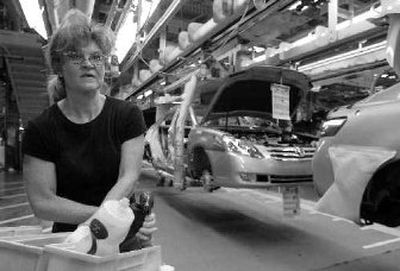
WASHINGTON — Toyota’s decision to build a new plant in Mississippi reflects a desire to significantly expand its U.S. operations at the same time it seeks greater political influence.
Toyota will use that clout to team with its rivals in Detroit on some issues. On others, the company will use its expanded Capitol Hill lobbying power to widen its competitive lead over General Motors, Ford and DaimlerChrysler.
“We don’t agree with them on everything,” said Josephine Cooper, vice president of government relations for Toyota Motor North America. “But our goal is to work together because it’s usually better to be on the same page.”
Cooper heads an in-house lobbying office of seven people in Washington. Toyota also has hired some of the city’s top lobbying firms.
Toyota still lags behind domestic automakers in money spent on lobbying, but the Japanese company is narrowing the gap.
Toyota spent about $2.4 million on lobbying in 2004. In 2005, its lobbying investment increased to $3.4 million, and last year it jumped again, to $4.6 million.
By comparison, General Motors spent $8.7 million and Ford spent $9.1 million last year to influence policy and legislation in Washington.
For the first time, Toyota also is considering creating a political action committee. Last year, General Motor’s PAC spent more than $1 million and Ford’s spent more than $845,000 to influence lawmakers in Washington.
One factor behind Toyota’s pursuit of greater political clout may be the possibility that the Big Three, stunned by slumping sales, will ask Congress for subsidies or even a bailout, said Joan Claybrook, president of the Public Citizen watchdog group in Washington.
She also said Toyota’s growing presence in the United States will force it to become more involved in politics.
“They just realize they need to be more tuned in,” Claybrook said.
This year’s top issues for Toyota and American automakers include whether to raise mileage standards for cars and trucks. Another key issue: whether carbon emissions should be capped to combat global warming.
On both issues, Toyota has the edge.
Toyota agrees with U.S. automakers that the administration, not Congress, should determine fuel economy standards. But Toyota embraced President Bush’s proposal last year to change how fuel economy is determined when U.S. automakers opposed it.
Bush wants to toss the existing system of setting fuel economy standards based on fleet averages and instead base the standards on vehicle sizes.
Toyota also is better positioned than U.S. companies to deal with possible moves in Congress to tighten regulation of carbon dioxide emissions, with use of hybrid fuel technology in some models.
Last week, the Union of Concerned Scientists ranked Toyota a close second to Honda as the world’s “greenest” automaker based on fuel efficiency and anti-pollution technology. U.S. automakers ranked dead last.
The Big Three are losing sales as well, but Toyota’s sales are growing.
The Japanese company is No. 3 in vehicle sales in the United States — behind GM and Ford — after overtaking DaimlerChrysler. Toyota sold more than 2.5 million cars and trucks in the United States last year.
But nearly half of those vehicles were imported from Japan, fueling arguments by U.S. automakers that Toyota benefits from unfair trade practices that hurt American workers and the U.S. economy.
“They leave the impression they’re building everything here, but it’s not the full picture,” said Stephen Collins, president of the Automotive Trade Policy Council, which represents the Big Three.