
Complaints fly as planes sit idle
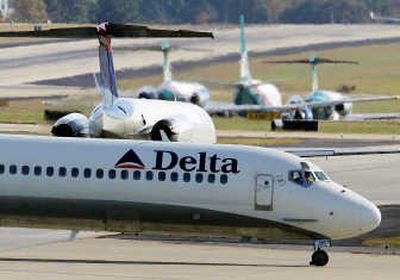
When Peter Burkholder and his wife boarded a Continental Airlines flight to Minneapolis last month, they endured a predicament that’s becoming a trademark of the busy summer flying season: Their plane never left the ground.
Instead, they sat on the tarmac at Newark Liberty International Airport for eight hours — five hours longer than the flight itself — waiting for weather and air traffic congestion to clear. In the end, Flight 370 was canceled shortly after midnight, according to details provided by Burkholder and Continental.
“We just kept thinking, this is going to end,” said Burkholder, of Morristown, N.J., who was flying to a friend’s wedding. “If I could, I would never fly again.”
Flight 370 is an extreme example of one of the latest and most aggravating headaches for air travelers — and one of the airline industry’s fastest-growing public relations problems: planes stranded on the tarmac for hours.
The major carriers, operating with crowded planes and crammed flying schedules, have precious little wiggle room to accommodate passengers when bad weather or computer glitches wreak havoc on their operations. JetBlue learned this the hard way when a Valentine’s Day ice storm left six flights stranded on the tarmac at John F. Kennedy International Airport for more than five hours.
Airline industry experts say the busy summer travel season could turn out to be even worse.
The U.S. Department of Transportation, which this year began tracking tarmac delays of five hours or more, has yet to issue its report for June. But according to Flightstats.com, more than a third of Newark Airport’s departures in June were at least 15 minutes late, and more than half of those — 4,509 flights — were more than 45 minutes late.
The anger of passengers left waiting on tarmacs is fueling a movement to impose a three-hour limit on tarmac delays and to provide more money for federal regulators to investigate customer complaints. A group called the Coalition for Airline Passengers’ Bill of Rights is lobbying Congress to legislate the changes, but the industry opposes a government-mandated passenger rights bill.
“Congress cannot legislate good weather or the best way to respond to bad weather because every situation is unique,” James May, president and chief executive of the Air Transport Association, said earlier this year. “Airlines need the flexibility to deal with each delay individually to help ensure that the fewest people are inconvenienced.”
In aviation parlance, June 8 was a severe weather day. A storm system aggravated delays that had begun early in the day when a computer failure prevented flight plans from being processed for air-traffic controllers.
And yet when Burkholder and his wife, Martha Hill, reached their gate at Newark Airport for a 4:05 p.m. departure, the status read: “On time.”
Minutes after the plane pulled away from the gate, however, it became clear Flight 370 would not escape the rippling effect of the massive air traffic tie-up.
The pilot told passengers the control tower had decided to hold the flight. Instead of taxiing to the runway, the plane headed to an area outside Terminal C known as “the ballpark.” Once an actual baseball field, the space serves as a holding area when flights start backing up.
During the wait, a ground crew refueled the plane, and twice a van drove up to retrieve a few passengers who wanted to leave and to re-supply dwindling snacks and ice. Then, eight hours after the scheduled departure, the pilot broke the news to his weary passengers: Continental had canceled the flight.
While Flight 370 sat idling, passengers said they received limited information from the airline about when the flight would depart and what their options were for later flights. Afterwards, they were left scrambling to salvage vacations and business trips, and to fight for compensation from the airline.
Peter Martin described the ordeal as the “flight from hell.”
“Look, there are people dying in Iraq,” Martin said, struggling for some perspective, “but we weren’t getting clear information. It was distressing.”
Once he got off the plane, Martin had another problem: Continental could not unload baggage from the plane, so he was left without clothing, golf gear and toiletries for his weekend business trip. He caught a flight the next day, but his luggage, he said, arrived in Minneapolis the next night.
Continental acknowledged an air-traffic control computer malfunction, coupled with severe weather, posed serious challenges on June 8.
“Given those challenges, flights were operating at Newark and we were expecting to get clearance for Flight 370 to depart,” spokeswoman Mary Clark said in an e- mail. “Ultimately, crew scheduling issues caused the cancellation of the flight.”
“Continental has a formal plan in place to manage flights experiencing extensive tarmac delays,” she continued. “The process includes senior operations management closely monitoring the status of these flights and the length of time the customers are kept on board.”
Even before the JetBlue fiasco in February, momentum was building for Congress to tackle the thorny issue of airline customer service with a passenger bill of rights.
The Coalition for Airline Passengers’ Bill of Rights was started by California real estate agent Kate Hanni after an American Airlines flight carrying her and her family to Dallas-Fort Worth in December diverted to Austin, Texas, because of stormy weather. Hanni’s family spent nine hours in the parked plane and were bumped from another flight the next day.
By the time they reached their final destination in Point Clear, Ala., Hanni’s family had lost three vacation days and were forced to take lesser hotel accommodations.
“There were a lot of consequences,” she said.
Hanni eventually received four $500 vouchers from American Airlines, but only after some national media attention and a strongly worded letter from her congressman.
Burkholder and his wife received far less for their inconvenience. The couple received two $25 vouchers from Continental after lodging a complaint with the Better Business Bureau.