
Under their bosses’ skin
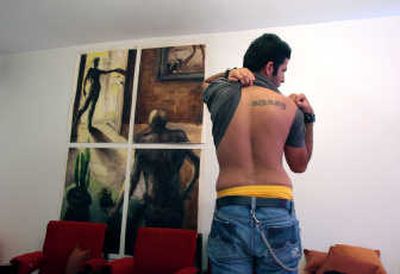
When Tiffany Roberts got her first tattoo in high school at 17, she was the coolest kid in class, she said.
The cross located on her lower back drew all kinds of attention.
When the political science major at Jacksonville State in Alabama got a rubber ducky tattooed on her left shoulder a few years later, the fascination was no longer there.
“It wasn’t original anymore,” said the 21-year-old. “Everyone I know has one. We are the generation where most all of us have tattoos.”
Actually two generations, X and Y, have been inked with growing regularity. A recent poll taken by the Pew Research Center found that 36 percent of 18- to 25-year-olds and 40 percent of 26- to 40-year-olds have at least one tattoo. Thirty percent and 22 percent of those age groups are pierced somewhere other than their ears.
Comparatively, only 10 percent of people 41 to 64 have at least one tattoo.
Despite the growing numbers of tattoos, employers and career counselors caution that the practice is not widely accepted at the workplace, even if a prospective boss has one hidden under a shirt.
Nearly 85 percent of respondents to a Vault.com survey this month said that tattoos and body piercings impede one’s chances of finding a job. About 16 percent of employers have established some kind of body art policy, according to Vault, a media company that focuses on careers and offers surveys and information from more than 4,500 employers. It returns to the topic of tattoos and body piercings about every five years.
And the message from poll respondents has not changed.
“Regardless of who the real person may be, stereotypes associated with piercings and tattoos can and do affect others,” said one survey respondent. “In general, individuals with tattoos and body piercings are often viewed as rougher or less-educated.”
Candler Boyd, vice president of operations for Highmark Solutions, a professional job placement agency in Birmingham, Ala., said the attitude from their clients is the same.
“It is definitely frowned upon by our clients, as far as visible tattoos and piercings,” he said. “It is not wanted in a professional setting. Sometimes these clients will have their own clients into the office for meetings. They want a professional image.”
Even tattoo artists will try to persuade some clients to consider smaller, more discreet body art, said Aaron Hamilton, a Birmingham tattoo artist.
“A lot of young people come in wanting something really big or visible, and we will talk them into something smaller,” he said. “Even though we know it is not a bad thing, you still run into people who do.”
Hamilton would know that.
Before becoming a tattoo artist, he worked in an office where shorts were acceptable. After he wore them a few times, revealing tattoos on his leg, the policy was changed.
“We weren’t allowed to wear shorts anymore,” Hamilton said.
Still, the tattoo and piercing industry is booming, he said. Any new trend from someone famous will send young adults scrambling to get the same look, he said.
And the current trend with tattoos is to make them more visible, like a small one located on the wrist, Hamilton said.
That alerted Gayle Howell, a senior career consultant for business students at the University of Alabama, that some employer attitudes were changing. She was surprised during a recent flight to notice a wrist tattoo on the flight attendant. Howell had always viewed the airline industry as one of the strictest when it came to appearance.
“There were a lot of raised eyebrows,” she said. “When she handed us a drink, the woman next to me looked at me, and I looked at her. I did not know that was allowed.”
But that does not mean body art is widely accepted in the business world, Howell said.
“I think that as young people of today take over the positions that my generation has, of course they will be more tolerant, they have them (tattoos and piercings),” she said. “But until my generation moves out of the workplace, you are not going to see that open-mindedness or accepting attitude. I talk to students about all kinds of issues preparing for a job search. If they have a visible tattoo or piercing, I do suggest they conceal it one way or another for the job search.”
As the war for talent heats up with baby boomers retiring, some places are becoming more accepting of personal expression, said Suzanne Scott-Trammell, director of Career Services at the University of Alabama at Birmingham.
But for her students, that could mean relocating to Silicon Valley, San Francisco or larger cities, she said. The South is still the South.
“We are typically more traditional,” she said. “In the South you have a lot more to lose than gain by openly exhibiting a tattoo. Of course some fields are much more liberal. Companies are looking for a `fit.’ It is important that you fit their environment.”
Her own employer, UAB, has no policy prohibiting employees from displaying body art in both the university and its hospital.
When Karri Henning, owner of Cloud Nine Tattoo and Body Piercing Studio, was in an accident a few years ago, she noticed that both of her emergency room doctors had visible tattoos.
“I thought that has to be a sign that times are changing,” she said. “We have young adults, young professionals, doctors, nurses, teachers, lawyers. We have so many professionals coming in to get tattooed. Tattoos have come a long way.”