
A Call for help
NEW DELHI – The job came with a good salary, and good perks.
But, 26-year-old Vaibhav Vats will tell you, it was doing him no good. His weight had grown to 265 pounds and he was missing out on social life as he worked long overnight hours at a call center. Eventually, he quit.
“You are making nice money. But the tradeoff is also big,” said Vats, who spent nearly two years at IBM Corp.’s call center arm in India, answering customer calls from the United States.
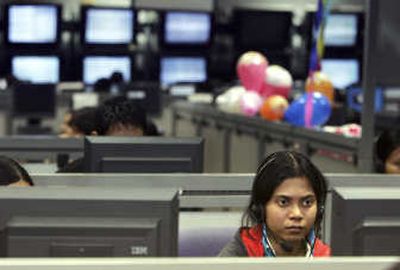
Call centers and other outsourced businesses such as software writing, medical transcription and back-office work employ more than 1.6 million young men and women in India, mostly in their 20s and 30s, who make much more than their contemporaries in most other professions.
They are, however, facing sleep disorders, heart disease, depression and family discord, according to doctors and several industry surveys.
Experts warn the brewing crisis could undermine the success of India’s hugely profitable outsourcing industry that earns billions in dollars annually and has shaped much of the country’s transformation into an emerging economic power.
Heart disease, strokes and diabetes cost India an estimated $9 billion in lost productivity in 2005. But the losses could grow to a staggering $200 billion over the next 10 years if corrective action is not taken quickly, said a study by New Delhi-based Indian Council for Research on International Economic Relations.
The outsourcing industry would be hardest hit, it warned.
Reliable estimates on the number of people affected are hard to come by, but government officials and experts agree that it is a growing problem. Health Minister Anbumani Ramadoss wants to enforce a special health policy for employees in the information technology industry.
“After working, they party for the rest of the time … (They) have bad diet, excessive smoking and drinking,” he said at a public meeting last month. “We don’t want these young people to burn out.”
The minister’s comments have since infuriated the technology sector, which says it has been unfairly singled out for problems that also exist in other professions.
The outsourcing industry has come under fire because the sedentary lifestyle of its employees combined with often stressful working conditions makes them more vulnerable to heart disease, digestive problems and weight gain than others. Some complain of psychological distress.
Most call center jobs involve responding to phone calls through the night from customers in the United States and Europe – some of whom can be angry and rude. It is monotonous and there is little meaningful personal interaction among co-workers. That can also be true of other jobs such as software writing and back-office work.
“There are times when the stress is so overwhelming that they fail to cope with it. Then they come to us,” said Archana Bisht who set up a counseling company, 1to1help.net, in Bangalore six years ago.
Her clientele has since grown to 25 companies – seven of them were added in the past two months – including such names as Intel Corp., IBM Corp., Hewlett Packard Co. and Mindtree Consulting Ltd.
Each day, about 60 to 70 employees at these companies seek counseling from 1to1help.net. Marital incompatibility and relationship issues top the complaint list, Bisht said, often because the hours means couples don’t have much time together.
The industry is getting sensitive to these problems.
The National Association of Software Services Companies, the main trade body of the outsourcing industry, said many of its member firms are already providing facilities like advice on health, gyms and money for regular checkups.
Companies like Infosys Technologies Ltd. have set up 24-hour helplines for counseling by psychologists, while others have tied up with companies like 1to1help.net. Some like HCL Technologies Ltd. have built daycare centers for children and routinely sponsor group outings by their employees.
But the industry says it won’t impose any lifestyle on its employees.
“We do not think it is for companies or for the government to interfere in the personal life of adult Indians,” NASSCOM said.
Vats’ weight has dropped to 214 pounds since leaving IBM Daksh two years ago. He’s still overweight for his 5 feet 9 inch frame, but is much happier now working with a law firm for a much lower salary.