
NCAA bracketology not an exact science
INDIANAPOLIS – Intent on setting the record straight for its selection process for the NCAA men’s basketball tournament, the NCAA invited 20 members of the U.S. Basketball Writers Association to select, seed and bracket a 65-team mock field Wednesday, following the principles used by its 10-member selection committee.
The NCAA’s goal was to demystify the selection and seeding process, said David Worlock, associate director of the Division I Men’s Basketball Championship. “We’re trying to make it more transparent.”
Each year the selection committee inevitably faces scrutiny for some selections, omissions, seedings and geographic placement of teams.
Conspiracy theories sometimes evolve – accusations from the public and some media members – ranging from allegations of influence by network heavyweight CBS, bracket manipulation to sell tickets or to accommodate powerhouse teams or an intent by the committee to build marquee matchups.
Additionally, there is a belief the committee keeps a running total of berths various conferences receive in the selection process, thus establishing quotas.
None of those claims held true Wednesday, when USBWA members went through an abbreviated version of the process used by the selection committee.
Among the revelations:
“During the selection and seeding process, there is no discussion or tally of the number of berths for a conference. Conference affiliation is important relative to its strength in the Ratings Percentage Index and when configuring the bracket. Teams from the same conference, for the most part, aren’t permitted to meet until the regional final, and the top three teams from a league must be placed in separate regions.
“RPI is only one tool used by the committee, but it’s vital to compare teams’ strength of schedule. Teams’ victories and losses are broken down by opponents’ RPI within ranges of 1 to 50, 51 to 100, etc. Other tools used by the committee include head-to-head results, personal observations and hours of discussion among committee members.
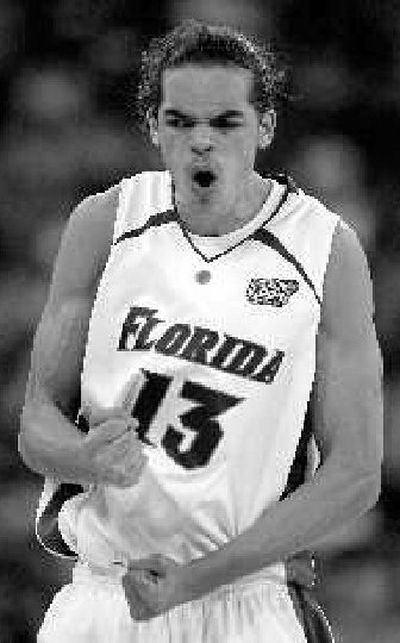
“Last year’s results don’t mean anything. Florida, the defending national champion, is the nation’s top-ranked team but is the No. 3 overall seed behind UCLA and North Carolina as determined by the writers (at least at this point in the season).
“The committee wants a balanced bracket as well as geographical convenience for teams, but balance is the overriding principle. In Wednesday’s exercise, for example, North Carolina initially was placed in the East Regional with Ohio State (deemed the best of the No. 2 seeds and thus the fifth-highest seed overall). The mock committee determined the East was too loaded at the top and moved Ohio State to the South.
“Intriguing matchups are bound to surface by accident, not intent. The mock committee inadvertently set up a potential second-round game between Michigan State, coached by Tom Izzo, and Marquette, coached by former Izzo assistant Tom Crean.
The committee is sensitive to rotating the opening-round game between the 64th and 65th seeds among conferences, said Greg Shaheen, NCAA senior vice president for basketball and business strategies. The committee has been criticized for placing the champion of a historically black conference in the opening-round game for five straight years.
The opening-round game is an opportunity for exposure as one of the nine nationally televised NCAA tournament games and should be spread among the conferences, Shaheen said.
Logistics
The committee meets in private in a secured wing of a downtown Indianapolis hotel. Confidentiality allows members to speak openly and vote without outside pressures, Shaheen said.
Athletics directors or conference commissioners whose teams are being discussed must leave the room during discussion of those specific teams.
The NIT selection committee meets in a nearby hotel, but its computers are linked to the NCAA’s. Once the NCAA committee makes its selections, the NIT computers automatically omit those teams from consideration.
This year the committee will begin its formal selection meeting Wednesday, March 7, a day earlier, and will finish with little time to spare before the “Selection Sunday” show airs at 3 p.m. PST March 11 on CBS. What the selection committee will take five days to do, the USBWA contingent spent 12 hours and 15 minutes trying to imitate.
But the committee has spent all season working on the bracket to an extent. Each committee member is assigned specific conferences to monitor and speak on behalf of during deliberations.
On Selection Sunday, the committee sometimes has less than an hour to complete the bracket, Shaheen said. Conference tournaments ending that day, such as the Big Ten’s, create a state of flux.
Tom Jernstedt, NCAA executive vice president, recalled the committee selecting the 1973 field in a six-hour teleconference. The committee had six members then. That number increased to nine members in 1980 and to 10 in 1998.
The tournament field has grown significantly since the 1970s. In 1975, the field grew to 32 teams from as many as 25. Forty teams advanced in 1979, 48 in 1982, 52 in 1983, 53 in 1984, 64 in 1985 and 65 in 2001.
When the selection is done, the committee’s work is not. Members are assigned to oversee various regional sites. All attend the Final Four. And then a month or so later, they meet to assess their work.