
Bert Caldwell: Hybrid plug-in cars generate hope for future

A yet-to-be published study by three Battelle researchers should light a fire under the automotive industry, utilities, environmentalists and everyone else who covets cleaner vehicles that reduce U.S. dependence on imported oil.
The United States, they conclude, already has enough available electricity generating capacity to charge 84 percent of all the automobiles, pickups, and SUVs on the road if they were hybrid plug-in vehicles, like the ones that have received so much attention this week at the North American International Auto Show in Detroit.
The nation’s generating plants and transmission grid were built to handle peak demand for electricity, plus a 5 percent reserve. All those plants and wires are pushed to the maximum for maybe 100 hours a year. Depending on the time of year and hour of the day, as much as 60 percent of that infrastructure may be idle or underutilized.
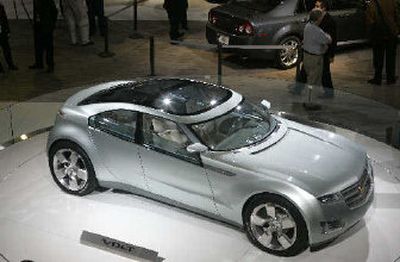
Plug-in vehicles connected to smart chargers could take advantage of that slack time. Owners could plug their vans or trucks in at night and drive them away in the morning with batteries good for 40 miles. For most drivers, who travel about 33 miles per day, that would be more than enough. Add a small gasoline engine, and they might run for hundreds of miles on a tank. The Volt, shown at the Detroit show by General Motors, can reportedly go 640 miles with fully charged batteries and a full 12-gallon tank.
That’s Seattle and back on a small fill-up, including the usual search for parking. No wonder hybrids are already popular with consumers.
Lower electricity bills might add to the savings. If utilities are using the same equipment but selling more juice, the cost per kilowatt-hour could go down, depending on potential increases in fuel costs.
For the nation, the result could be the slashing of oil imports by more than half. And, according to lead researcher Michael Kintner-Meyer, and colleagues Kevin Schneider and Robert Pratt, conversion to plug-in vehicles would also produce a net reduction in most air contaminants despite the combustion of more coal. Kintner-Meyer says that is based on an analysis of all emissions from oil wellhead to automobile tailpipe for gasoline, and from mine to tailpipe for coal.
The exceptions are particulate and sculpture dioxide — thanks to coal — for which there would be significant increases. But, because the emissions would come from generating plants instead of cars, cities would experience less pollution.
Sadly, the Northwest would gain the least from conversion to plug-ins. We already squeeze all the electricity we can from the region’s hydropower system given the environmental constraints, and we capture every wind-generated kilowatt we can. There is only enough available slack generation to charge 18 percent of vehicles in the region, compared with more than 100 percent in areas like the Midwest.
Doesn’t seem fair, given the environmental ethos in the Northwest, and Battelle’s location at Richland, but there it is. Adding to the frustration — Kinter-Meyer says conversion to plug-ins makes sense when gas sells for $2.50 a gallon or more, and electricity for seven cents per kilowatt-hour or less. Conversion would pencil out for almost every household in the region right now.
But Kintner-Meyer notes some technical questions remain unanswered.
The chargers, for example, must be able to detect trouble out on the grid, perhaps overloads because too many cars are plugged in at once.
The other major unknowns are how transmission grids would handle the stress of carrying high loads all the time, and how wholesale electricity markets would behave when there is 24-hour demand for much or all of available generating capacity.
Kintner-Meyer says those are the issues Battelle would like to study next. They will have some time.
The average life of a vehicle in the U.S. is 13 years, Kintner-Meyer says. It would take 15 to 20 years to put enough plug-in hybrids on the road to realize the kind of benefits the Battelle study suggests are out there for the country.
Still, the research could not have come at a better time. Almost all the technology necessary to achieve widespread adoption of plug-in motoring already exists. So do the generating plants. Little need be added about the staggering financial, military and political damage caused by our dependence on imported oil.
The technical challenges seem small compared to the potential benefits.