
Tough fights ahead
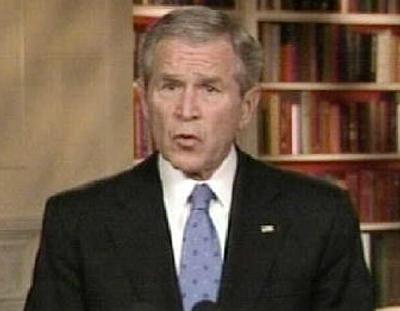
WASHINGTON – The plan for Iraq that President Bush unveiled Wednesday night faces obstacles that have defied solution since the United States invaded Iraq.
What the White House calls a “New Way Forward” relies on Iraqi Prime Minister Nouri al-Maliki’s Shiite Muslim-dominated government to crack down on its allies in the country’s Shiite militias, which it has so far refused to do.
It calls for Iraqis to beef up their forces in Baghdad to help quell raging violence there, four months after the Iraqi government failed to contribute four of the six battalions of troops it promised to a similar security effort.
In addition, leaders of the new Democratic-led Congress oppose his proposed troop buildup, as do many influential Republicans. They may try to block it, though they haven’t agreed on a firm plan to do so.
Questions abound: Will an additional 21,500 American troops in Iraq, taken mostly from units to be held longer in Iraq or sent there sooner, be enough to help restore order both in Baghdad and in violent, Sunni-dominated Anbar Province?
Will an additional $1 billion in aid make a dent in the country’s economic problems?
Last, will Bush’s efforts to reassure Saudi Arabia, Jordan, Kuwait and Iraq’s other Sunni Muslim neighbors calm their fears that Shiite power may expand from Iran through Iraq to Lebanon? Bush has sent an aircraft carrier battle group and some Patriot missile defense batteries to the Persian Gulf to calm Sunni Arab nerves. But he has largely ignored recommendations to open talks with Iran and Syria and to revive Israeli-Palestinian peace talks.
The president acknowledged previous failures.
“Where mistakes have been made, the responsibility rests with me,” he said. Past efforts to quell violence in Baghdad failed, he said, because “there were not enough Iraqi and American troops to secure neighborhoods” and “there were too many restrictions on the troops we did have.” He said his plan would remedy such flaws.
He warned of a “bloody and violent” year ahead in the war-torn country, despite his new proposals.
“This new strategy will not yield an immediate end to suicide bombings, assassinations, or IED (improvised explosive device) attacks,” Bush said. “Our enemies in Iraq will make every effort to ensure that our television screens are filled with images of death and suffering.”
Bush appeared to signal a more aggressive policy toward Syria and Iran, saying the U.S. would take unspecified steps to “disrupt” attacks on U.S. troops by terrorists and insurgents who use Iranian and Syrian territory to move in and out of Iraq.
In addition, Bush’s plan appears to abandon a key point of previous U.S. strategy – it no longer emphasizes disarming and disbanding Shiite militias, leaving both to the Iraqi government, which depends on those militia for support.
Bush put Iraq on notice that America won’t stay forever.
“I have made it clear to the prime minister and Iraq’s other leaders that America’s commitment is not open-ended,” Bush said. “If we increase our support at this crucial moment and help the Iraqis break the current cycle of violence, we can hasten the day our troops begin coming home.”
Bush’s immediate audience is a Democratic-controlled Congress already hostile to his plan to increase U.S. troops in Iraq. Democratic House and Senate leaders issued a statement after his speech repeating their opposition.
Both House and Senate Democrats plan floor votes soon on resolutions opposing the president’s troop buildup, but they’ll be nonbinding.
Democratic congressional leaders don’t appear to have an immediate consensus, however, on what, if any, binding legislation they should push or how fast to move. Sen. Edward Kennedy, D-Mass., hopes to pass legislation that would require congressional approval of any increase in troops, but party leaders concede that they lack the votes to make that stick at this time, especially over a Bush veto.
Bush, however, can no longer count on solid Republican support in Congress.
“I refuse to put more American lives on the line in Baghdad without being assured that the Iraqis themselves are willing to do what they need to do to end the violence of Iraqi against Iraqi,” Sen. Norm Coleman, R-Minn., said Wednesday on the Senate floor. “If Iraq is to fulfill its role as a sovereign and democratic state, it must start acting like one.”
Similarly, Sen. Sam Brownback, R-Kan., who’s exploring a bid for the presidency in 2008 as a social-values conservative, said Wednesday he opposed a troop increase.
“I do not believe that sending more troops to Iraq is the answer,” he said while traveling in Iraq. “Iraq requires a political rather than a military solution.”
Many of Bush’s new proposals – a limited increase in U.S. troops, Iraqis taking the lead in security matters, billions in reconstruction aid – have been tried before and failed to reduce violence or quell the insurgency.
Last fall, for example, an Iraqi-led joint U.S.-Iraqi military mission to secure some of Baghdad’s most violent neighborhoods produced complaints from U.S. military commanders about the ineptness of Iraqi forces.
Some top U.S. military officials in Iraq say for Bush’s plan to work, Iraqi officials must go after Sunni and Shiite extremists. U.S. troops have aggressively targeted Sunni areas, conceding they can’t enter Shiite strongholds because of Iraqi political pressure. Shiite support is the backbone of al-Maliki’s government.
Americans have already soured on Iraq. In recent polls, public support for sending more troops to Iraq ranged from 12 percent to 36 percent of Americans, depending on question phrasing.
“This is his last chance to convince the American public that he knows what he’s doing and victory is possible,” said Dennis Goldford, a political science professor at Drake University in Des Moines, Iowa. “He’s tied his whole presidency to this. … This is his last chance at a last chance.”
If it fails, Goldford said, Iraq “could become the all-consuming issue” for the final two years of Bush’s term, crowding other presidential initiatives. “If he’s totally ineffective, he leaves this ravaged sore on the body politic as well as foreign relations.”