
LANDING A NEW HOME
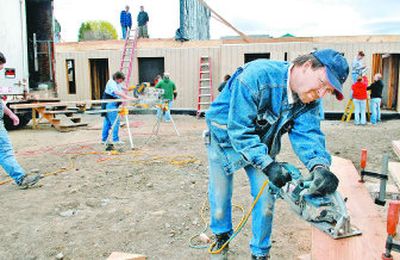
Terra Anderson owns real estate in one of Washington state’s most expensive markets — the city of Redmond, where a median-priced home costs $525,000.
But the single mother of two paid just $107,000 last year for a three-bedroom townhouse. It was built by Habitat for Humanity, which helped lower the cost. But the savings also came from another source: Anderson bought only the house. Habitat retained title to the land underneath it.
On a day-to-day basis, it makes little difference. Anderson has full use of the property. She’s planted rose bushes in the flowerbeds and her kids have run of the yard. But when it comes time to make the mortgage payment, Anderson saves hundreds of dollars each month.
The model is one that local Habitat chapters are considering as they grapple with escalating land costs.
Just a few years ago, Habitat for Humanity-Spokane bought an entire block in the Chief Gary neighborhood for $70,000. And in 2004, Habitat for Humanity of North Idaho paid $10,000 each for a dozen lots in a Post Falls subdivision.
Unfortunately, those days are over. Habitat of North Idaho recently bought four residential lots in Spirit Lake for $140,000. The Spokane affiliate is just starting to shop for more land. They’re both wondering how they’ll build affordable housing after taking the land costs into account.
“We’re trying to serve people who earn 50 percent or less of the median family income,” said Eula Hickman, a retired Realtor who is on the North Idaho Habitat affiliate’s land selection committee.
Donated labor and materials, plus the “sweat-equity” that Habitat clients contribute, helps underwrite the price of Habitat homes. But the purchasers still buy them at cost, making monthly payments on zero-interest loans.
In Kootenai County, that means mortgages must be within the means of families earning roughly $25,000 per year or less. With land costs rising so quickly, it’s a real challenge, said Jim Brannon, executive director for Habitat for Humanity of North Idaho.
“You can obviously see that the price of land has gone up by 3 ½ times,” he said. “If our teachers and firefighters can’t afford homes, how do our Denny’s cooks, our retail clerks, and our dry-cleaning assistants?”
The affordability issue has led Brannon to consider a community land trust.
In a land trust model, the purchaser buys only the house, securing a long-term, renewable lease to the property underneath for a nominal cost. By subtracting the cost of the land from the purchase price, the monthly mortgage payments are reduced substantially.
A land trust would be a radical switch for the North Idaho affiliate, which has built homes on the more traditional model of selling the property with the house. But by mid-next year, the affiliate’s Post Falls subdivision will be full.
“That’s the last of the cheap land,” Brannon said. It might force the affiliate to embrace a new model, he said.
The Habitat affiliate that built Anderson’s home in Redmond adopted a model similar to a land trust eight years ago.
“One of the driving forces was maintaining the affordability of the housing stock for future generations,” said Tom Granger, executive director of Habitat’s East King County affiliate.
The affiliate received several grants to build homes, with the stipulation that the housing prices remain affordable for low-income families for up to 75 years. The only way to ensure that, Granger said, was to put the houses into a program similar to a land trust. In this case, the Habitat affiliate, not a formal land trust, retains title to the property, leasing it to the homeowner for 99 years, with an option to renew.
There’s a downside for the homeowners: They aren’t reaping equity from rising land costs.
“This is not intended to be a windfall for one family, but to help as many families as possible gain stability,” Granger said.
The Silver Valley and Spokane Habitat affiliates also see land trusts in their future.
In Idaho’s Silver Valley, developers are bidding on land for ski condos and resort homes, pushing property costs to prices unimaginable even a few years ago, said Verne Blalack, treasurer for the affiliate. New lots in the city of Osburn are selling for $80,000.
“We couldn’t afford anything like that,” Blalack said. “The highest we’ve ever paid is $5,000 per lot.”
The Silver Valley Habitat affiliate has six properties in its portfolio — including a donated older home to be remodeled — which gives the affiliate time to plan, he said.
As land prices rise, Blalack said, the normal progression for Habitat affiliates is to move from single family homes to duplexes and condos, then land trusts. “Land prices have risen so astronomically that we’re hoping to bypass that middle step,” he said.
The affiliate is working with a fledgling housing agency in Shoshone County that wants to set up a housing land trust. It would be one of the first in Idaho. Last year, the legal framework was created for a housing trust in Ketchum, but that trust doesn’t own any property yet.
“We also talked about land trusts as a possible solution to rising land costs,” said Michone Preston, the executive director of Habitat for Humanity-Spokane.
Since 1992, the Spokane affiliate has built multi-family homes, which was its first effort to address rising land costs. When Kelly Lynch moved into Habitat housing in the Chief Gary neighborhood two years ago, it was a duplex-style condo. She and her husband paid $80,000 for the unit, which they share with their four kids.
The multi-family approach wasn’t a drawback for Lynch. The condo comes with the pride of ownership and the feel of a real home, she said.
“I like just being able to relax in our own home,” Lynch said. “We were in a two-bedroom apartment before. … Even though we were good renters who paid on time, we always worried that we’d get kicked out because we had too many people for the unit.”
Habitat’s mortgage is also lower than their former rent payment, which has allowed Lynch’s husband, David — a pre-school teacher — to pursue a four-year degree at Whitworth College.
The Lynches’ condo is one of 16 on the city block that Habitat bought for $70,000.
“But I know those days are long over,” Preston said. To make future mortgages pencil out for Spokane Habitat families, they may end up in a land trust situation, she said.
To set up a land trust, the property has to be paid off, said the North Idaho affiliate’s Brannon. Since Habitat used loans to buy the Spirit Lake property and another parcel in Coeur d’Alene, the affiliate might not be in a position to create a trust for several years. Meanwhile, he’s begun advertising Habitat’s need for land.
“If someone were to call with a lot to donate,” Brannon said, “I guarantee that I could be there in five minutes.”
Anderson said she’s grateful for the land-trust type arrangement that helped her afford a home. Before she bought the Redmond townhouse, the 29-year-old paid out more than 50 percent of her monthly income in rent. “I could never save for emergencies,” Anderson said.
Even though she doesn’t own the land, Anderson notes that she’s still building equity in her townhouse. That equity could create a down payment if she’s later in a position to buy a market-rate home, which other Habitat owners have gone on to do.