
A swinging century
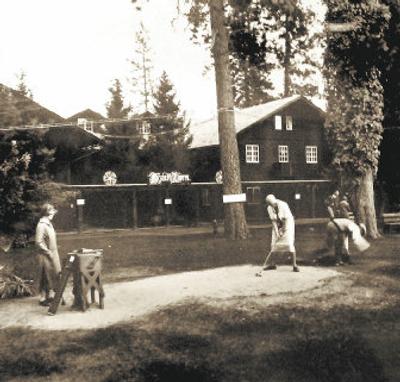
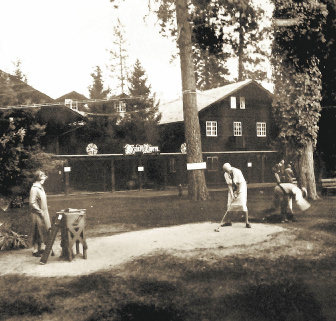
The Hayden Lake Golf and Country Club, the first 18-hole golf course in Idaho, turns 100 this July, and to celebrate that centennial contractors are building a score house that will emulate the style of the original club house.
And to celebrate that new structure and a century of recreation on the lake’s south shore, there’ll be a golf tournament on July 21, and a party the following day.
During those days, members and their families will look back at a hundred years of fun, aided by the large sepia-toned historic photos on the clubhouse walls.
And the person they’ll turn to to interpret the photos and tell tales of the club through the years will probably be Betty Jean “BJ” Rucker Hulteng, once a nationally ranked golfer whose family has been affiliated with the club for 78 years.
The club’s chief executive officer, Les Hintz, calls her the club’s “resident historian.”
To some degree, BJ has come by that historian title by default. Her late husband, John L. Hulteng, a journalist, editor, author and dean of the University of Oregon journalism school, wrote a history of the club in 1986.
It’s been updated and printed twice since then, and the following history is largely taken from Hulteng’s “Meeting Place by the Lake.”
That phrase itself is a translation of the word “Bozanta,” reputedly an Indian term, and half of the resort’s original name, “The Bozanta Tavern.”
An electric rail line connected Spokane with Coeur d’Alene in 1903. Passengers included several owners of cottages clustered on old Indian campgrounds beside Hayden Lake who were presumably influential in supporting the extension of the line to the lake in 1906.
That same year, a group of Spokane businessmen formed the Hayden Improvement Co. and bought a 145-acre tract bordering the lake for $70,000. It included several cottages and a horse race course. There was also room for a hotel and a golf course.
Landscape architect J.C. Olmstead, whose firm had designed New York’s Central Park, laid out the grounds, and Kirtland K. Cutter, Spokane’s leading architect of the day, designed the buildings.
The golf course’s first nine holes opened in 1907, and the full 18 holes were built by 1912. For the first few years, golfers had to contend with the abandoned race course cut across several fairways.
When the hotel was built, it was apart from the kitchen to lessen noise emanating from the latter structure. The original hotel contained guest rooms and a lobby, and that building survives today as the clubhouse. The kitchen and dining rooms were in the building that now contains the golf shop and locker rooms.
The resort formally opened July 20, 1907 with a supper, bonfires, dancing and, the following day, a baseball game.
An early distinguished visitor was President William H. Taft. In September 1909 he was served a sumptuous wild game dinner and, after eating, wrote “I enjoyed it,” on his menu.
In 1919, the Hayden Improvement Co. sold the complex to the Great Northern Railroad. But over the next few years, declining passenger traffic on the electric railroad serving the resort prompted the Great Northern, which had absorbed the small line, to look for a buyer.
In 1928 a group of Coeur d’Alene families, which had been running the golf course as the Coeur d’Alene Golf Club, won the entire complex, which included golf course, tavern, rental cabins and cottages and 135 acres of undeveloped land with a bid of $30,000.
Prior to the purchase, the tavern had been the principal revenue source and golf was just one of its attractions, along with swimming, boating, tennis and croquet, all designed to attract paying customers to rent rooms and eat meals.
Henceforth, the focus would be on the golf course and the resort was given a new name, the Coeur d’Alene Country Club at Hayden Lake. During the next few years, to raise funds the club leased cottages and lots and, after Prohibition ended, sold liquor.
In 1937, a club member started a golf tournament for youngsters with a hand-decorated tin coffee mug as the prize. Thus began the Mug-Hunters Tournament with boys and girls from 6 to 16 in the same bracket, not separated by gender. It’s a yearly contest that continues 70 years later, with 125 competitors in 2006.
During World War II, the club leased its living facilities, first to the builders of the Farragut Naval Base, then to officers and civilians assigned there.
In the 1940s, crooner and Oscar-winning actor Bing Crosby joined the club and, over the years, occupied, for at least part of each year, two shoreside homes. The first was just north of the clubhouse; the second, further down the north shore.
Straitened finances in the 1950s led to the sale of some land northeast of the clubhouse and, late in the decade, that building underwent a major internal remodeling, and a new entryway was built at the main entrance.
Tennis had been played at the club from the earliest years, but by the 1930s, the courts were run down, then abandoned. Recognizing the growing popularity of the game, the club decided in 1973 to build a set of tennis courts.
Boating was another activity growing in popularity in the ‘70s and ‘80s, so additional slips were added to the marina.
By now, members and others familiar with the area were referring to the club as The Hayden Lake Country Club because of its location. So, in 1985, the name was officially changed.
In 1999, the club completed purchase of 31 acres of farm land west of its property and by July of 2003, an additional three holes, complete with lakes and streams, were added to the old course.
Golf remains the principal attraction, with tennis a close second. Other recreational opportunities include boating from the club’s marina and swimming from its beach. And, if you’re a member or guest of a member, you can stay in one of its eight modernized hotel rooms or six bungalows.
As the Hayden Lake Country Club slips into its second century, it boasts some 600 members. And if you hanker to join them, get your name on the list.
CEO Hintz says the wait for golfing members is about 18 months. As a policy, the club doesn’t publish its membership rates.