
Team USA has speed to burn
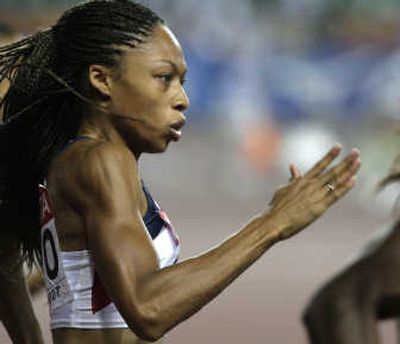
OSAKA, Japan – The power and grace of two young Americans lit up the night at the world track and field championships.
Jeremy Wariner led a U.S. sweep with the fifth-fastest 400 meters in history Friday and Allyson Felix ran the first sub-22-second women’s 200 in eight years – all in the space of an hour of superb competition in near-perfect conditions at Nagai Stadium.
It was the second world title in a row for both runners. Wariner also has an Olympic gold medal, Felix a silver.
There should be many more. Wariner is 23, Felix 21.
“It’s not just me and her,” Wariner said. “LaShawn Merritt was part of it because he broke 44 (seconds) for the first time in his career. Me and him are going to be battling for the rest of our career. The younger we are, the more it’s going to help us out with the sport.”
Chinese world record holder Liu Xiang capped the night with his first world 110 hurdle title. Americans Terrence Trammell and David Payne were second and third.
In all, the United States won six medals, two gold. The Americans lead the medal race with 19, eight of them gold.
Unlike its botched first handoff at the worlds in Helsinki two years ago, the U.S. 400 relay team made it around the track without dropping the baton, qualifying for tonight’s final.
Not everything went well for the United States. Defending decathlon champion Bryan Clay pulled a quadriceps in his right leg in the high jump and had to withdraw from the competition.
Wariner and Felix are lean athletes who dominate with a fluid motion their competitors can’t match.
“I’m still as calm on the track as I am off the track,” Wariner said. “I just stay focused.”
Wariner won in a personal-best 43.45 seconds. Only Michael Johnson and Butch Reynolds have run faster. Merritt was second at 43.96, also his best, and Angelo Taylor third at 44.32.
Felix won in 21.81, the fastest since Inger Miller’s 21.77 at the 1999 worlds in Seville, Spain. Felix’s victory margin of 0.53 seconds over 100 champion Veronica Campbell of Jamaica was the largest in the meet’s history.
In fact, it was also larger than any Olympic victory margin in the 200 since the 1948 Games.