
MOTOWN BLUES
Motor City’s woes extend beyond auto industry
DETROIT — One measure of how tough times are in the Motor City: Some of the offenders in jail don’t want to be released; some who do get out promptly re-offend to head back where there’s heat, health care and three meals a day.
“For the first time, I’m seeing guys make a conscious decision they’ll be better off in prison than in the community, homeless and hungry,” said Joseph Williams of New Creations Community Outreach, which assists ex-offenders. “In prison they’ve got three hots and a cot, so they commit a crime to go back in and come out when times are better.”
For now, better times seem distant. Even with no hurricane to blame, Detroit has, by many measures, replaced New Orleans as America’s most beleaguered city.
The jobless rate has climbed past 21 percent, the embattled school district just fired its superintendent, tens of thousands of homes and stores are abandoned, the ex-mayor is in jail for a text-messaging sex scandal. Even the pro football team is a pathetic joke — the Lions are within two losses of an unprecedented 0-16 season.
And overarching these woes is the near-collapse of the U.S. auto industry, Detroit’s vital source of jobs and status for more than a century.
“We’re the Motor City,” said Scott Alan Davis, who oversees community development projects in one of the worst-hit neighborhoods. “When the basis for that name collapses, that’s started to scare people.”
Among the worried is Warlena McDuell, 81, a retired surgical technician who shares a home with her cancer-stricken daughter. On a recent weekday, she was among hundreds of Detroiters, most of them elderly, filling orange-plastic grocery carts at a food bank run by Focus:HOPE, a local nonprofit.
“It’s a depression — not a recession,” McDuell said, with the authority of someone who has lived through both. “It will get worse before it gets better.”
Behind her in line, stocking up on canned goods, was Benjamin Smith, 77, who once held jobs with Uniroyal and Chrysler. Maneuvering his cart slowly, one hand gripping a cane, he was unable to muster much cheer when someone extended holiday good wishes.
“How are we going to do well?” he replied. “Everything’s busted up.”
The roots of Detroit’s current plight go back decades. Court-ordered school busing and the 12th Street riots of 1967 accelerated an exodus of whites to the suburbs, and many middle-class blacks followed, shrinking the city’s population from a peak of 1.8 million in the 1950s to half that now.
About 83 percent of the current population is African-American. Detroit’s crime, poverty, unemployment and school dropout rates are among the worst of any major U.S. city. Car and home insurance rates are high. Chain grocery stores are absent, forcing many Detroiters to rely on high-priced corner stores.
“There’s always been a real can-do spirit among our people,” said the Rev. Edgar Vann, pastor of Second Ebenezer Church. “That’s being beaten down right now. … These times, unlike others, have sapped a lot of that spirit from them.”
“Somebody needs to hear us before we begin to see a rise of social upheaval,” Vann said. “I hate to say that. It’s a God-forbid reality.”
For Mark Covington, as for many of his neighbors, there are two Detroits. One features swanky casinos, opulent hotels and two new sports stadiums, beckoning high rollers to a relatively vibrant downtown.
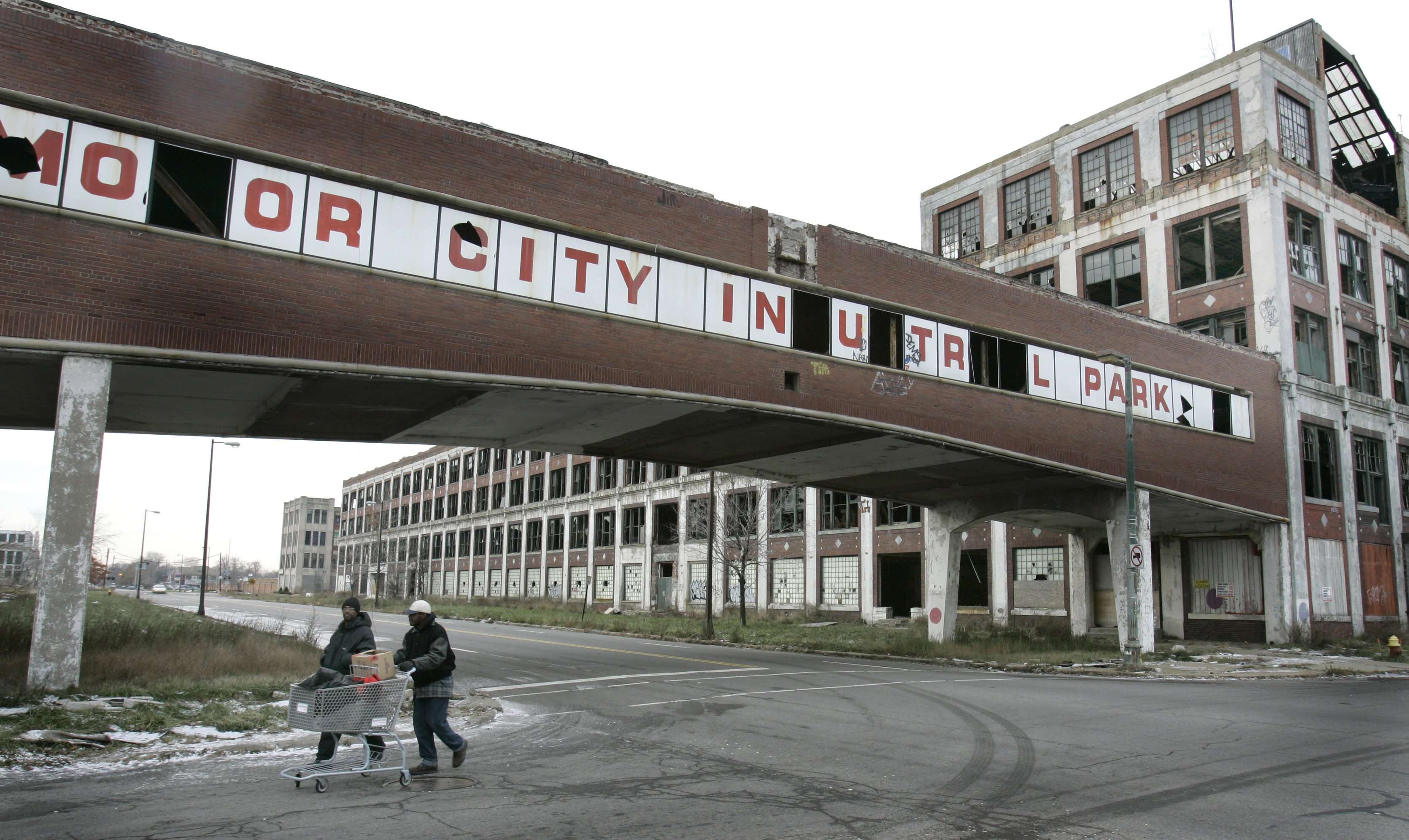
Then there’s the vast Detroit of decaying neighborhoods, trash-strewn lots and burned-out houses.
“It makes me want to leave,” said Covington, 36. “But I figure, if I leave, who else is going to help? … People like me are what’s going to turn Detroit around.”
With no job, Covington has spent the past year working on what he calls the Georgia Street Garden — three empty lots he and his friends have converted into an inner city farm east of downtown.
It’s one of hundreds of vegetable gardens citywide that have taken root on land cleared after the razing of abandoned homes.
Covington and his friends did what the city hadn’t done: moved trash from the lots to the curbs. They planted tomatoes, cabbage, broccoli and other vegetables, as well as a few fruit trees.
“I’m seeing camaraderie around here I haven’t seen since I was a little kid,” Covington said. “It’s actually starting to feel like a village again.”
The challenges are daunting. A City Council fiscal analyst projects that Detroit’s budget deficit could surpass $200 million by June. The public school district faces a deficit exceeding $400 million, prompting the state to declare a financial emergency. The district’s superintendent, Connie Calloway, was just fired. Several dozen schools have been closed in recent years.
The latest FBI statistics show Detroit with the highest violent crime rate of any major city.
Trying to combat blight, the city has applied for $47 million in federal neighborhood stabilization money, with half earmarked to tear down more than 2,300 vacant homes.
But this effort would make only a small dent. About 44,000 of the 67,000 homes that have gone into foreclosure since 2005 remain empty, and it costs about $10,000 to demolish each vacant house, according to city planning officials.
Overall, the residential real estate market is catastrophic, with the Detroit Board of Realtors now pegging the average price of a home at $18,513. Some owners can’t find buyers at any price.
“If you no longer can sell your property, how can you move elsewhere?’ said Robin Boyle an urban planning professor at Wayne State University.