If you can get past how it’s made, haggis proves rewarding
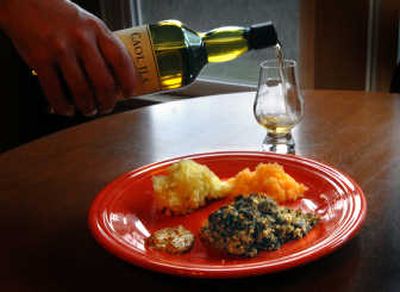
Fair fa’ your honest, sonsie face, Great chieftain o’ the puddin-race! – Robert Burns, “Address to a Haggis”
In the culinary world, there are few dishes more misunderstood than haggis.
Admittedly, the ingredient list for the traditional Scottish sausage doesn’t exactly whet the appetite: Take the heart, liver and lungs of a sheep; combine with onions, oatmeal and fat; stuff it into a sheep’s stomach, then boil for three hours.
For many, this may sound more like a challenge on “Fear Factor” than a main course.
But adventurous eaters who are able to see beyond the offal are rewarded with a dish that is rich, earthy and flavorful; one that holds a place of honor in Scottish culture.
For centuries, fans of poetry and whisky (not necessarily in that order) have dined on haggis with “neeps and tatties” (mashed rutabagas and potatoes) to celebrate the birthday of the poet Robert Burns, which falls on Jan. 25. (In addition to “Address to a Haggis,” Burns is perhaps best known for penning the lyrics to “Auld Lang Syne”).
While traditionally attributed to the Scots, the origins of haggis are murky. But one thing is clear: it is a dish born of necessity.
Charlie Lamb, who runs Lamb Etc., a mail-order haggis operation out of Roseburg, Ore., has spent years studying haggis and perfecting his recipe. Lamb, also an archaeologist and historian, notes that poor, agrarian societies have often developed traditional foods that made use of the last bits of a butchered animal.
“Even among native American Indians, there is something similar to a haggis,” he says.
And the sheep’s stomach? Lamb says it’s an ideal vessel for two reasons. First, it’s just the right size to contain the meat from the other organs, and second, it was a good fit for the pots used by Scottish crofters.
“There are a number of things that have become traditional that are straight out of practical application,” he says.
Ironically, modern abundance means the necessary ingredients for this simple peasant dish are now difficult, if not impossible, to acquire.
The USDA forbids the sale of animal lungs, often listed in recipes as the “lights,” for human consumption, and area grocers and butchers that we talked to were at a loss as to where one might obtain the other organs (sometimes called the “pluck”). The USDA rules also forbid British and Scottish companies from shipping true haggis to the United States.
Bruce Ridley, who throws a Burns bash every year at his South Hill home, has made authentic haggis in the past. He was able to make arrangements with a sheep farm in Federal Way to obtain the hearts, livers and stomachs from slaughtered lambs. Ridley says making haggis is “very intricate” and a bit disgusting. One attempt involved making a “Frankenstein stomach” by stitching together four lamb’s stomachs.
“Remember, this is the beginning of the waste system, and it smells like it,” he says.
Lamb, too, has followed the process from start to finish, even butchering his own sheep in the field to procure the organs. The stomach, he says, can take as long as two weeks to properly cure.
So traditional haggis isn’t something most home cooks are going to attempt. But fortunately, as food sources have evolved, so, too, has the haggis.
“The ingredients vary like chili – everybody’s got their own recipe,” says Donna Graham of the St. Andrew’s Society of the Inland Northwest, which also hosts an annual Burns Supper.
The St. Andrew’s Society, which now gets its haggis from Lamb Etc., has relied in the past on a recipe that takes advantage of more readily-available ingredients. Mary Campbell of Spokane, who for many years helped cook the haggis for the annual event, used beef liver and heart boiled in a lunchmeat casing.
Campbell, who has an aversion to the fibrous texture of beef heart, says for her, haggis was more fun to prepare than to eat. “Most people I know loved it, but I don’t.”
For their Burns party, Ridley and his wife, Susan Ridley, use a recipe that is even more user-friendly. The Ridleys combine ground lamb, chicken livers and chicken gizzards with the traditional suet, oatmeal and spices. Rather than being boiled, the “pot haggis” is wrapped in parchment or cheesecloth and baked in the oven.
For Lamb, though, there’s no substitute for the real thing. His haggis, made with lamb heart and liver and served in an actual sheep’s stomach, is as authentic as you’re likely to find in the United States (minus the forbidden lungs, of course). In addition to the annual event in Spokane, Lamb’s haggis has been served all over the country, even, he says, at New York’s Waldorf-Astoria Hotel.
“I find it almost incredulous that people have such an aversion to haggis, because it really is good food,” he says. “They would be well advised to look at what’s in a hot dog.”
Beef Haggis
Courtesy of Mary Campbell of Spokane.
1/2 pound steel-cut oats
3/4 pound beef suet
2 1/2 pounds beef heart (see note)
2 1/2 pounds beef liver
1 large onion, diced
2 cups beef stock
2 tablespoons ketchup, or to taste
3/4 tablespoon lemon juice
Cayenne pepper to taste
Nutmeg, to taste
Lunch meat casing (see note)
Parboil the heart and liver (Campbell says the boiling liver is “pretty stinky,” she recommends throwing some onions in the pot to cut the smell). Toast the oats in a 300-degree oven until golden brown – this takes about 10 to 15 minutes, but watch carefully.
Let the heart and liver cool, and grind it with the suet using a meat grinder or food processor. Combine the meat with the remaining ingredients in a large bowl (as is often the case with handed-down recipes, Campbell was unsure of the exact amounts of spices used).
Pack the mixture loosely into the lunchmeat casings and tie the ends tight with butcher’s twine. Prick the casing in a couple of places with a pin or ice pick before cooking. The haggis will expand while cooking.
Boil the haggis for at least 1 1/2 hours. Serve with “Neeps and Tatties” and Whisky-Mustard Sauce (see recipes below), or as an appetizer with crackers.
Note: You can get beef heart and lunchmeat casings from some butcher shops, including Egger’s Meats, if you order ahead of time.
Yield: Anywhere from 12 to 50 servings, depending on whether the haggis is eaten as a main course, side or appetizer.
Approximate nutrition per 4-ounce serving: 276 calories, 18 grams fat (9 grams saturated, 59 percent fat calories), 28 grams protein, 9 grams carbohydrate, 196 milligrams cholesterol, 1 gram dietary fiber, 115 milligrams sodium.
Pot Haggis
Courtesy of Susan Ridley of Spokane
1 1/2 cups steel-cut oats
2 1/2 pounds ground lamb
1/2 pound chicken livers
1 pound chicken gizzards
3/4 pound minced beef suet
2 medium onions, finely chopped
1/2 cup chopped parsley
1/4 cup dried chervil (see note)
3/8 cup minced garlic
3/4 cup chicken broth
3/4 tablespoon lemon juice
1 tablespoon crushed red pepper
Salt and pepper, to taste
Preheat the oven to 325 degrees. Toast the oats in the oven on a large cookie sheet, about 10 to 15 minutes.
Run the livers through a food processor until they form a paste, and finely chop the gizzards. Brown the lamb (drain and discard the fat), liver and gizzards in separate pans (the liver will take on a more granular consistency as it is cooked). Mix together all ingredients, adding more broth if needed.
Grease a large casserole dish or Dutch oven, and line with a large piece of parchment paper or cheesecloth. Fill with the meat mixture, and then tie the corners together loosely. Bake the haggis for 3 to 4 hours at 325 degrees with a pan of hot water on the lower shelf of the oven.
Serve with “Neeps and Tatties” and Whisky-Mustard Sauce (see recipes below), or as an appetizer with crackers.
Notes: To “present” the haggis, place a platter upside-down on top of the pot, and turn the pot over so the haggis is on the platter, seam-side down.
Chervil is an herb that you can buy in bulk at Huckleberry’s Natural Market. If you don’t have chervil, Ridley recommends a mix of three parts basil to one part mint.
Yield: Anywhere from 12 to 50 servings, depending on whether the haggis is eaten as a main course, side or appetizer.
Approximate nutrition per 4-ounce serving: 352 calories, 30 grams fat (15 grams saturated, 77 percent fat calories), 13 grams protein, 8 grams carbohydrate, 82 milligrams cholesterol, 1 gram dietary fiber, 193 milligrams sodium.
Neeps and Tatties
3 pounds potatoes, peeled and chopped
2 pounds rutabagas, peeled and chopped
2 tablespoons butter, divided
1/2 cup milk or half-and-half
Salt and pepper, to taste
Boil the potatoes and rutabagas in separate pots until soft (the rutabagas will take longer). Mash the potatoes and rutabagas in separate bowls with butter and half-and-half or milk until the desired consistency is achieved.
Note: “Neeps” refers to the yellow turnip, which we call a rutabaga in the United States. They are not the same as white turnips.
Yield: About 24 servings
Approximate nutrition per 3-ounce serving: 66 calories, 1 gram fat (less than 1 gram saturated, 15 percent fat calories), 1.5 grams protein, 13 grams carbohydrate, 3 milligrams cholesterol, 1.5 grams dietary fiber, 151 milligrams sodium.
Whisky Mustard Sauce
This rich, flavorful sauce also goes well with meatloaf and other dishes.
1 tablespoon butter
2 tablespoons shallots
1/3 cup prepared whole-grain mustard
1/2 cup half-and-half
1 tablespoon good single-malt Scotch whisky
Melt the butter in a pan over medium heat, sauté the shallots until they begin to brown. Deglaze the pan with the Scotch, then stir in the mustard.
Whisk in the half-and-half and cook over medium heat until the sauce thickens. Serve as a condiment alongside the haggis.
Yield: 8 (1-ounce) servings
Approximate nutrition per serving: 48 calories, 3.5 grams fat (2 grams saturated, 67 percent fat calories), 1 gram protein, 1.5 grams carbohydrate, 11 milligrams cholesterol, less than 1 gram dietary fiber, 153 milligrams sodium.