
Kindle opens newest chapter in e-book saga
Many of us love the feel of a good book in our hands. At the same time, a reader’s love of books can easily consume one’s home. Plus, with today’s baggage costs and requirements, taking more than one or two books on a trip can be costly or impractical.
These are some of the problems Amazon’s e-book reader called the Kindle is trying to solve. What the iPod has done to music, Amazon hopes to do to books, magazines and newspapers — deliver them quickly and let you read them in electronic format.
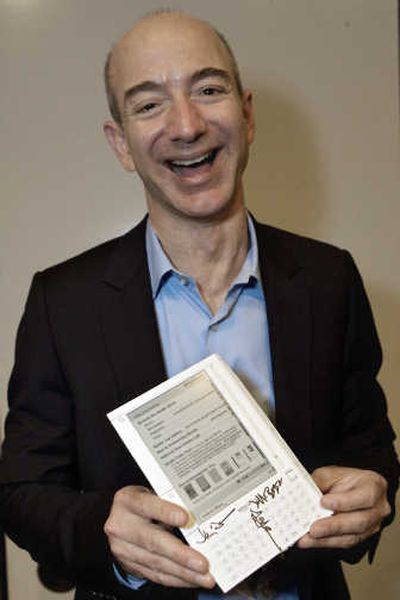
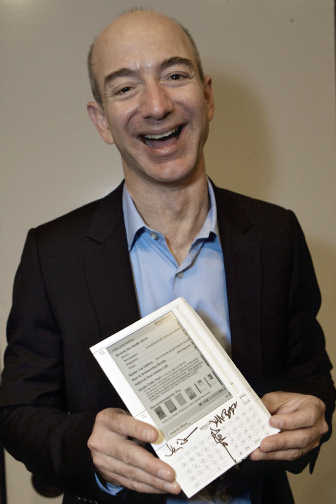
The Kindle ($359 at Amazon.com) is a sturdy white plastic tablet with a 6-inch diagonal grayscale display. About the size of a paperback, the Kindle weighs 10.3 ounces.
While the screen doesn’t display colors, it is sharp and has high-contrast in almost all light. It does an excellent job of simulating a printed page. Included in the package are a case, power adapter and USB cable. (Amazon gets points for marking the power supply as belonging to the Kindle, something other gadget makers should do.)
So what does the Kindle store offer? More than 125,000 books are available, but most are mainly recent titles. New York Times best sellers and new releases cost $9.99, unless marked otherwise.
Foreign and domestic newspapers are available, including The New York Times, The Wall Street Journal, The Washington Post, Le Monde and The Irish Times. Top magazines such as Time and Forbes can be purchased individually or as a subscription.
The Kindle also can feed you more than 300 blogs around the topics of business, technology, sports, entertainment and politics. Most cost $1.99 a month, and like the newspapers, you can get a free 14-day trial.
Amazon is not the first to do an e-book reader. Sony has been a player in this market for years. But the Kindle is the first e-book that does not require a computer to use. Yes, this means no computer, no cables, no syncing. This is something many music lovers wish the iPod could do.
The Kindle gathers its content via a cellular service –in this case, Sprint’s EVDO, a high-speed data wireless network. There is no fee to use EVDO; it is included in the price of the Kindle. While an EVDO network is great when you are in the U.S., it’s barely available overseas.
The Kindle also features a browser to view Web sites and blogs, and with limited e-mail functionality (Amazon charges 10 cents to convert your e-mail to the Kindle). Web browsing is free, but some sites that use Adobe’s Flash won’t display or view correctly.
In terms of operation and reading text on the Kindle, you must learn to do a task the Kindle way. Unlike using a Mac or Windows for many tasks, there is one way to do them. For instance, you must use the Next and Previous buttons to navigate through a book even though the Kindle has a scroll wheel that suggests it can do the same.
I even had to learn to hold it differently than I do a paperback, since I was hitting the large next page button on the right side of the device.
While you can get free book samples from the Amazon store, there is no way to share books or send recommendations to other Kindle users. This lack of community puts Kindle far behind what users of iPods or Zunes can do with services such as iLike for sharing music with other fans or friends.
The Kindle brings many more features to the table than other e-book readers. But it is a first-generation product with some issues to address. Those include: adding Wi-Fi for those who travel outside the U.S.; placing the power and EVDO switches to the front of the Kindle rather than the back; and making the right-side next-page button smaller, to give some space to place one’s thumb without accidentally changing pages.
Even with these issues, if the Kindle cost $225 I would buy one. But at $359, it is only recommended for the heavy reader who wants to save space and money by buying more books online and storing them in a single device.