Food advocate organizing a Downtown fresh market
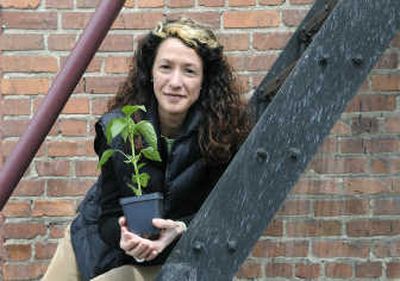
Jennifer Hall didn’t grow up on a farm.
As a child, she ate her share of junk food and never experienced the “tied-to-my-mother’s-apron-strings” lifestyle of shucking peas or baking bread from scratch.
Despite her relatively urban background, the 39-year-old has emerged as one of the region’s leading advocates for farmers and ranchers.
Their shared passion? To promote local and sustainable food.
What we eat and drink not only affects our own health and well-being, Hall said. It also influences the environment, the economy, even issues of ethics and social justice.
That’s why Hall – perhaps best known for establishing the Slow Food movement in Spokane – has made it her mission to connect the dots for consumers so that people realize that what they eat helps tie them back to the land as well as each to other.
“I want to honor the producers by sharing their stories,” said Hall, referring to the farmers, ranchers and fishers in the region. “These are people who work hard to bring fresh, flavorful food to our plates and who care deeply about socially responsible food production.”
In her role as the new “community food builder” for downtown Spokane’s Community Building, Hall’s latest contribution to the world of sustainable food comes in the form of a co-op in downtown Spokane.
Based on the vision of Jim Sheehan – philanthropist and founder of the Community Building – Main Market will be a hub for area producers to sell their goods as well as a place for people to learn about what it takes to eat, drink and live in a meaningful and sustainable way, said Hall.
Slated to open this fall at 17 W. Main Ave., the 7,100-square-foot space with the orange and lime-green storefront will include: a grocery and deli; a dining area consisting of a long “community table”; a commercial kitchen to showcase the various ways to cook and prepare local products; an area where people can order custom meats from local ranches; and freezer lockers for rent so people who don’t have storage space in their condos or apartments can still buy local meat in bulk or freeze fruit they pick while in season.
“This will provide a way to buy local and sustainable food while keeping it more affordable,” said Hall, whose mantra is to eat low on the food chain and to do so economically.
At least once a month, Main Market also will host gatherings called “In the Field” to connect consumers with farmers, ranchers and fishers. Some of these events will involve field trips so that shoppers can experience where and how their food is grown or raised. Eventually, the market will sell produce grown from a garden on the building’s rooftop.
According to Hall, Main Market won’t compete with the nearby Spokane Farmers’ Market, which is open from mid-May until October. Instead, it’s designed to “support and amplify” the farmers’ market by offering local food year-round and by providing area producers a place to sell their goods during fall and winter as well as on days when the outdoor market is closed.
The co-op also will meet the shopping needs of downtown residents, who have to drive elsewhere in order to buy groceries, she said.
Main Market’s opening in late October also comes at a time when more people are asking questions about the origins of food and seeking ways to limit their exposure to pesticides.
The increasing demand for local goods is evident in the growth of farmers’ markets nationwide. According to the U.S. Department of Agriculture, the number of farmers’ markets has nearly doubled from 2,410 in 1996 to 4,385 a decade later.
Eating locally not only ensures better quality and taste, said Hall, it’s also a way to support producers in the region, reduce one’s environmental footprint as well as foster a diverse and more sustainable food supply.
It’s also an investment in health. “We all eat every day, several times a day, but still it’s not more clear to people that how they feel is based on what they put in their own bodies,” Hall said.
While friends rave about her homemade jam, Hall’s approach to educating others about food is intellectual and business-like – more in the scientific style of Michael Pollan instead of homespun nostalgia about life on a farm.
She spent her formative years growing up in Spokane, where she was raised by a nurse practitioner mom and a stepdad who’s a physician. Hall graduated from the University of Washington with a degree in business and finance and then earned a master’s in health administration from Cornell University.
Her passion for food and its origins evolved over time, Hall said, but how it got started “stymies” her to this day.
Maybe she was influenced by that vegetable garden her family grew in Oklahoma when she was 8 years old, or the fact that her dad was a hunter. Perhaps it was the process of picking berries as a kid and learning how to preserve jam.
Regardless of how it all began, her awareness of the power of food and the desire to celebrate local offerings became evident about a decade ago while working in management for Bon Appetit, a catering and restaurant company in Seattle. Instead of ordering ingredients to be delivered by a national supplier, she encouraged the chefs she worked with to network with local producers and to develop dishes with local flavors and identities.
In her personal life, she also became increasingly committed to using locally made ingredients and cooking from scratch.
In 2000, Hall became involved with Chefs Collaborative, a national organization that promotes sustainable cuisine and artisan cooking. She also joined Slow Food, an international movement to “counteract fast-food and fast life” and to work for the preservation of local food traditions and the role of food as a building block to community.
Hall was the executive director of Chefs Collaborative when she moved back to Spokane in 2005. She returned to her hometown with the desire to walk her talk, to live life at a slower pace in a less urban environment.
“Immediately, it was apparent that she was going to make a difference,” said David Blaine, executive chef at Latah Bistro and another outspoken advocate for local and sustainable food (http://thebackkitchen. blogspot.com/).
While working part time as the small-farm marketing coordinator for Washington State University’s extension program in Spokane, Hall spearheaded a program at the Spokane Farmers’ Market called “Shop With the Chef.” She also immersed herself in all things related to food and sustainability by becoming involved in the Spokane Sustainable Agriculture Leadership Team, a volunteer group designed to support a sustainable local food system in which “producers earn a viable income and consumers can access locally produced food.”
Hall also was appointed to a five-year term as the consumer representative on the USDA’s National Organic Standards Board.
A year ago, she helped start the Slow Food Spokane River convivium, a group that meets regularly to explore local food options and now has hundreds of members throughout Eastern Washington and North Idaho.
Pete Tobin, chef instructor at the Inland Northwest Culinary Academy at Spokane Community College, described Hall as a “catalyst” who initiates dialogue among different groups and who gets the work done by bringing people together.
She doesn’t pass judgment, he said. She simply celebrates local food and the people who bring them to the table. Inevitably, her enthusiasm spreads to others.
“She’s a businesswoman who has an elegant way of motivating people and empowering them,” said Tobin, who met Hall during a harvest dinner in Colville three years ago. “As an individual, Jen just has such great passion for the whole movement.”
When Sheehan hired Hall last November to take charge of creating a downtown co-op, Hall came up with her own title as the “community food builder.” It’s an appropriate description of her job as well as her goals for both the co-op and the future of local, sustainable goods.
Food, after all, is more than just nourishment, she said.
“It’s a point of celebration and a way to bring people together,” Hall said. “The dining table is the gathering place for a community.”