
Company News: GM’s strikes will cost billions
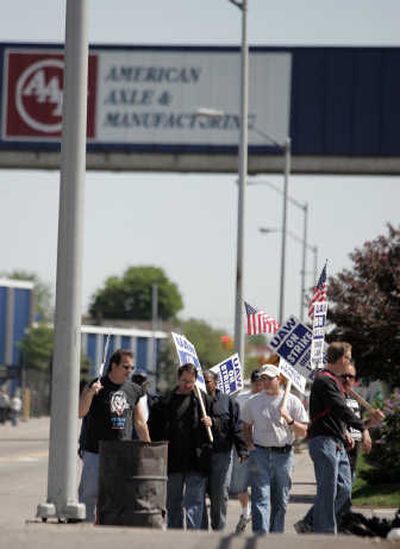
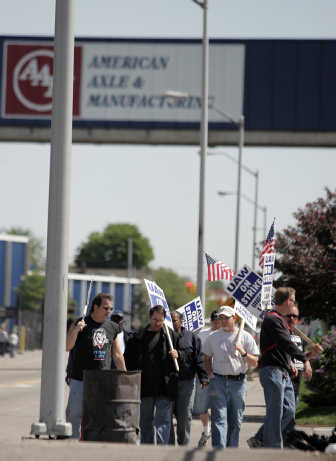
General Motors Corp.‘s stock dropped almost 5 percent Friday after the company reported that strikes at some of its own plants and parts supplier American Axle will cost the automaker about $2 billion before taxes in the second quarter.
GM also expects to produce 230,000 fewer vehicles during the quarter due to the nearly three-month American Axle strike, which crippled its production of large sport utility vehicles and pickups. The other strikes will cost it 33,000 vehicles.
“We anticipate only a portion of this lost production will be recovered, due to the current economic environment in the United States and to the market shift away from the types of vehicles that were impacted by the action at American Axle,” GM said in a filing with the U.S. Securities and Exchange Commission.
GM’s shares fell 83 cents to close at $17.60, after touching $17.38 earlier in the session, their lowest level in nearly 26 years. The last time GM traded below $17.46 was Oct. 6, 1982, when it was at $17.32, according to the Center for Research in Security Prices at the University of Chicago.
GM said the American Axle strike was expected to have the biggest effect by far, costing it $1.8 billion in the second quarter before taxes. GM previously said it lost $800 million in the first quarter and produced 100,000 fewer vehicles in that period because of the American Axle strike.
•Comcast Corp. is trying to sell 46 smaller cable systems serving 400,000 to 500,000 subscribers as it seeks to improve efficiency by shedding disparate operations.
“It’s not about money at all,” said Robert Serrano, an analyst at SNL Kagan in Monterey, Calif. “They are pruning some of the more outlying areas in order to make a more efficient cluster.”
Serrano said Comcast, the nation’s largest cable TV operator, could get $3,000 to $4,500 per subscriber, although sale prices would vary by asset.
Most of the cable systems are in eight states – Maine, Kentucky, Louisiana, New Mexico, Virginia, Georgia, West Virginia and California, and almost one-fourth of them are in rural central and northern Maine.
In Maine, the most logical buyer for Comcast subsidiaries is Time Warner Cable Inc., which serves 85 percent of the state, including areas surrounding the 11 municipalities Comcast hopes to bow out of.
•Shares of Anheuser-Busch touched an all-time high on Friday on reports that Europe’s InBev SA was working on a $46 billion bid for the St. Louis-based brewer.
Anheuser-Busch shares rose 7.7 percent, or $4.03, to $56.61 after reaching as high as $58.
The share surge followed a report on the Financial Times Web site that InBev, the world’s biggest brewer by volume, may directly approach Anheuser-Busch chief executive August Busch IV.
It’s the latest deal in a consolidating industry. Miller Brewing Co., the second-largest U.S. beer-maker, and No. 3 Molson Coors Brewing Co. are planning to combine U.S. operations by midsummer.
Miller will distribute Grolsch in the U.S. after a February takeover by SABMiller of Europe.