
Score reflects hard truths
PULLMAN – OK, we get it.
Football at Washington State is bad – desperately, despairingly bad.
It will not be fixed overnight, in a week, in a year.
The program slipped from penthouse success to the south side of Mediocrity Flats over the course of four years and now has simply fallen off the face of the earth. Likewise, the talent level somehow went from thinning to you’ve-got-to-be-kidding in a matter of months.
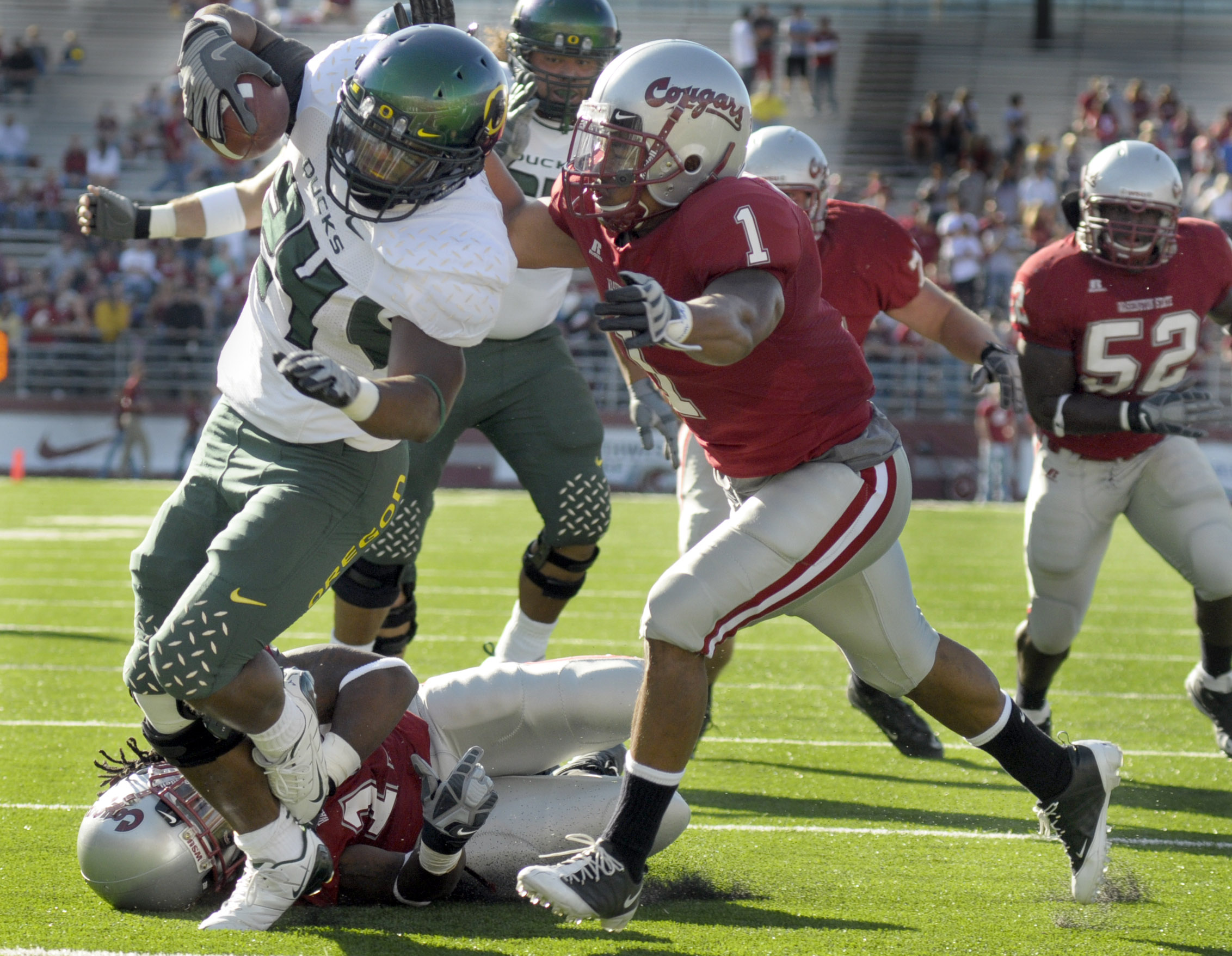
More often than not this season, it will appear as if Wazzu has no business playing the Pacific-10 Conference – and it very much appeared that way Saturday, when Oregon and its fifth-string quarterback didn’t just kick sand in Cougars’ collective face but constructed a castle on their corpse. The Ducks named their score – 63-14 – and then WSU coach Paul Wulff suggested each Cougars votary might want to try looking beyond it.
“The score is what it is,” he said. “I’m not going to get caught up in it. We lose a game, we lose it. We win a game, we win it. The score is not our issue right now.”
Wulff’s approach, his focus and his perspective in this are all healthy and admirable.
But whether he likes it or not, the score is an issue.
Even his players understand that.
“How much does the final score matter?” offensive lineman Steven Ayers wondered. “It’s not everything, but at the same time it’s going to reflect some situations, some things.”
In this case, it reflects that not only are the Cougars outmanned, as Wulff has candidly admitted, but that they’re also simply not competing commensurate with the company they keep. Now, whether that’s a “can’t” issue or an “aren’t” issue can be left to barstool debate, but again on Saturday the Cougars didn’t even give the argument a chance to get started.
The willing and promising freshman quarterback fumbled on the game’s third play and the Ducks were in the end zone a minute later. The junior running back coughed it up on the next kickoff and it took Oregon maybe 30 seconds to make it 14-0. Four minutes had elapsed on the clock, and the game was over.
This doesn’t mean the Cougs surrendered, but what happened thereafter was simply an exercise – good, hard practice with officials and a chain crew and Glenn Johnson on the P.A. and 30,000 witnesses that became half that at halftime, and can no longer be chastised for that choice.
The danger, of course, is that they become half that at kickoff.
This has become the appeal from the seats – you know, the ones that go for $50 a pop on game day, the ones that require a scholarship donation of $400, $500, $1,000 per season?
Can there be some drama, please?
Can there be some hope?
If the outcome is not to be in doubt – and that seems to be a given – can at least a seed of it be potted and nurtured through a quarter or two before it’s taken outside and exposed to the visiting elements of superior speed, size, strength and skill?
Even athletic director Jim Sterk acknowledged the reality that, “You have to stay in the game so the fans are there. You have to create something to make it exciting for them.
“And that will come,” he insisted. “There will be good things down the road.”
Sterk, of course, is wedded to that vision, having hired Wulff to undertake this reclamation not quite 10 months ago. He conceded that he himself did not grasp just how desperate the program had grown, to the point that he took an unusual step with Wulff.
“I think I apologized to him,” Sterk said.
Well, he might want to extend that to the customers.
What he dismisses is any undercurrent that Wulff is not the man for the job.
“Anyone who says Paul Wulff is out of his element, that doesn’t fly,” he said – and to make his case he pointed out to another coach with an outmanned team who got spanked by Wulff’s team a week ago, a coach with a resume of NFL success.
“It’s getting the personnel and having a system in place where they can be successful,” Sterk said. “That’s where we’re going to get to.”
But here is where they are: They’ve lost four games by an average of 41 points. Even the teams considered the worst in Wazzu’s modern history – 1955 and 1970 – were more competitive, though obviously college football is a far more wide-open affair than it was then.
The curiosity here is that for all of Wulff’s frankness, the players aren’t necessarily buying what the consensus is selling.
“I don’t believe it’s a lack of talent,” said safety Alfonso Jackson, defiantly. “I trust everybody in that locker room.”
And Wulff has to keep them believing because it’s really all the Cougars have at the moment.
“We’re taking any kind of victories, and they’re small ones,” he said. “There are some things that are truly getting better. But if you look at the score, you wouldn’t say that.”
And yet he has to know that the score matters, too.
After all, his athletic director just bought a new $2.4 contraption to keep it.