
Local filmmaker warms up to glacier climbing for Banff entry
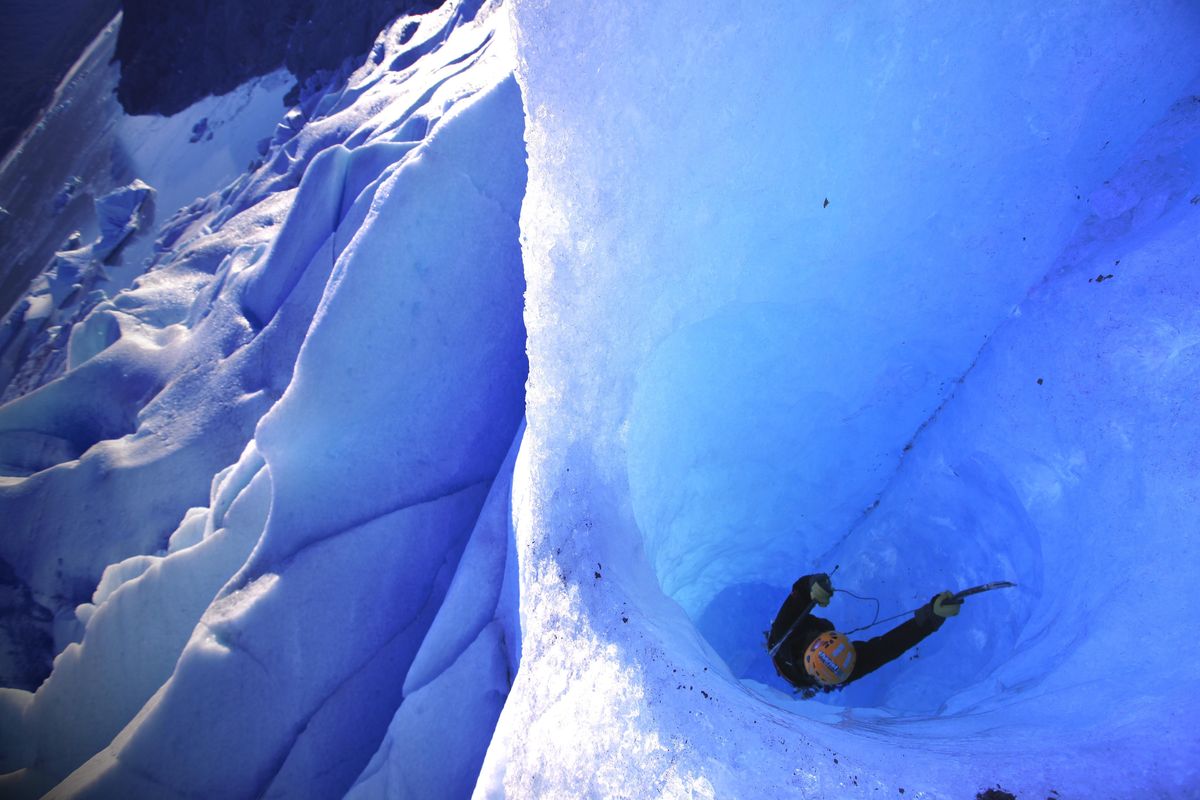
People who produce adventure films featured in the Banff Mountain Film Festival shouldn’t be stereotyped as hard-core, muscle-powered adrenaline junkies with a death wish.
“I’d never been ice climbing before I went to Alaska to help shoot ‘Blue Obsession,’ ” Jordan Halland of Coeur d’Alene said.
Halland, 31, is the first Inland Northwest filmmaker to help produce one of about 50 films selected from more than 300 entries for screening at the fabled Alberta festival.
He introduced the 8-minute movie to a full house at the Bing Crosby Theater last weekend. “Blue Obsession” was among 21 top films featured in the Banff Festival’s World Tour.
“We do have one common denominator,” he said. “The independent filmmakers competing at Banff aren’t driving Mercedes or weekending in Europe.”
“Blue Obsession” is the brainchild of Alaska ice climber Alan Gordon, who’d been chipping away for months with a Canon D5 digital SLR video camera to capture his fascination with the beautiful and ever-changing icefalls of the Juneau Icefields.
This year, he made the commitment to a video focused on climbing around the Mendenhall Glacier, one of the most viewed glaciers in the world, yet rarely explored because of the danger of being around constantly moving chunks of ice the size of tall buildings.
Gordon heard about Halland’s film-producing skills through a mutual
friend.“My friend asked if this ice climber could send me some footage to review,” Halland recalled.
“Honestly, a lot of people say they have an idea for a movie, but their footage doesn’t back up their desire. But I took one look at Alan’s stuff and was blown away. The clips were beautifully shot inside glaciers that looked like a foreign planet.”
Halland was onboard in a heartbeat, even though he knew the crunch was on. He flew to Alaska only about a month before Banff film entries were due.
“Alan knew how to make ice climbing look amazing, but he was looking for somebody to help make a story out of what he’d already shot,” Halland said.
“I helped take his footage and passion for glaciers and bring it to ‘Blue Obsession.’ ”
Gordon sometimes had trouble getting friends to help him with the climbing and filming because the glaciers are notoriously unstable.
“We were working around crevasses that were 150 feet deep,” Halland said. “If you fell in one, you were dead.
“He taught me some basic ice climbing stuff for moving around the glaciers, but basically he would set me up in one spot and I’d shoot while he climbed.
“Alan had invented an ingenious pulley system to hang a camera between two spots and get amazing aerial shots from where we couldn’t go.”
Halland started shooting interviews with the ice climber and seized on his excitement to document glaciers that were rapidly receding.
“I didn’t do any vertical climbing, but the glacier is full of huge crevasses you have to navigate,” he said.
“We’d tie in together. Alan would tell me how to hold my feet and a lot of do this, don’t do that. I quickly learned to navigate on the glacier, but some spots were very intimidating. I wouldn’t have been there without Alan.”
Halland, who works for the Kroc Center, has been involved for 10 years in making short documentaries and music videos plus producing, script writing, graphic designing and marketing.
The quality of less-expensive digital cameras has level the playing field for making films, he said.
“There’s no huge investment for taking the risk to make a film,” he said. “You might shoot something with a bunch of friends, submit to a festival and a career could take off from there, if it’s any good. Not just anybody can go out and get the shots Alan was getting.
“My role was to move the story forward, to get the interviews and connections for the footage he’d already filmed.
“I shot him kayaking out to the glacier, for example. The story needed to explain the reasons he goes out by himself on dangerous and constantly changing ice fields. The story is about Alan’s relationship with the glacier and his concern for a disappearing landscape.”
When Halland felt he had all the footage he needed, he called it a wrap and began editing a measly two weeks before the film entries were due at Banff.
“I like working against the clock,” he said. “It makes me focus. If I’d have had a ton of time, it would not have been the same movie – and I couldn’t say that it would be better.”
Halland would edit a take and upload it to a server for Gordon to review and critique in Alaska.
“He looked at it from the angle of a climber,” Halland said. “Since I didn’t know much about climbing, I’d look at it from a more artistic standpoint. It worked out pretty well. I think the film appeals as much to non-climbers as it does to climbers.
“He really wanted this to be a good movie, and so did I.”
Gordon had done the groundwork for funding the production. He bagged some sponsorships, primarily in the form of gear.
“I talked to independent filmmakers in Banff who’ve been doing this for 30 years and they know how to get equipment and funding for projects,” Halland said. “It’s not lucrative. You do it because you love it.”
Making the cut for the Banff Mountain Film Festival is like making the Olympics for an independent filmmaker, he said.
“Some people call Banff the Sundance of mountain filmmaking,” he said. “For the alpinist, mountain culture enthusiast, skier, snowboarder, mountain biker – this is The Show. It’s an unbelievable honor.
“Most short films never get mass distribution in theaters,” he said, noting the World Tour will travel to 32 countries reaching more than 245,000 people at more than 635 screenings.
“That’s huge exposure, something that’s very rare for us. It helps us break away from the thousands of short films produced every year. It’s a step toward the next project.”
Halland grew up in a family of 10 kids, with parents who were huge into backpacking.
“We would take major hikes through the Montana wilderness,” he said. “I mean serious hikes. We had a few sponsors and were featured in Backpacker magazine.
“But I must admit, I hated it as a kid. When I grew up, I vowed never to hike again.
“But being out there in Alaska made me realize I’ve been missing out on a huge part of the world.
“I have a 6-year-old son who’s never hiked or camped. My wife and I are planning to change that next year.”