
Iwakuma no-hitter lifts Mariners’ mood
In disappointing season, pitching gem a welcome diversion
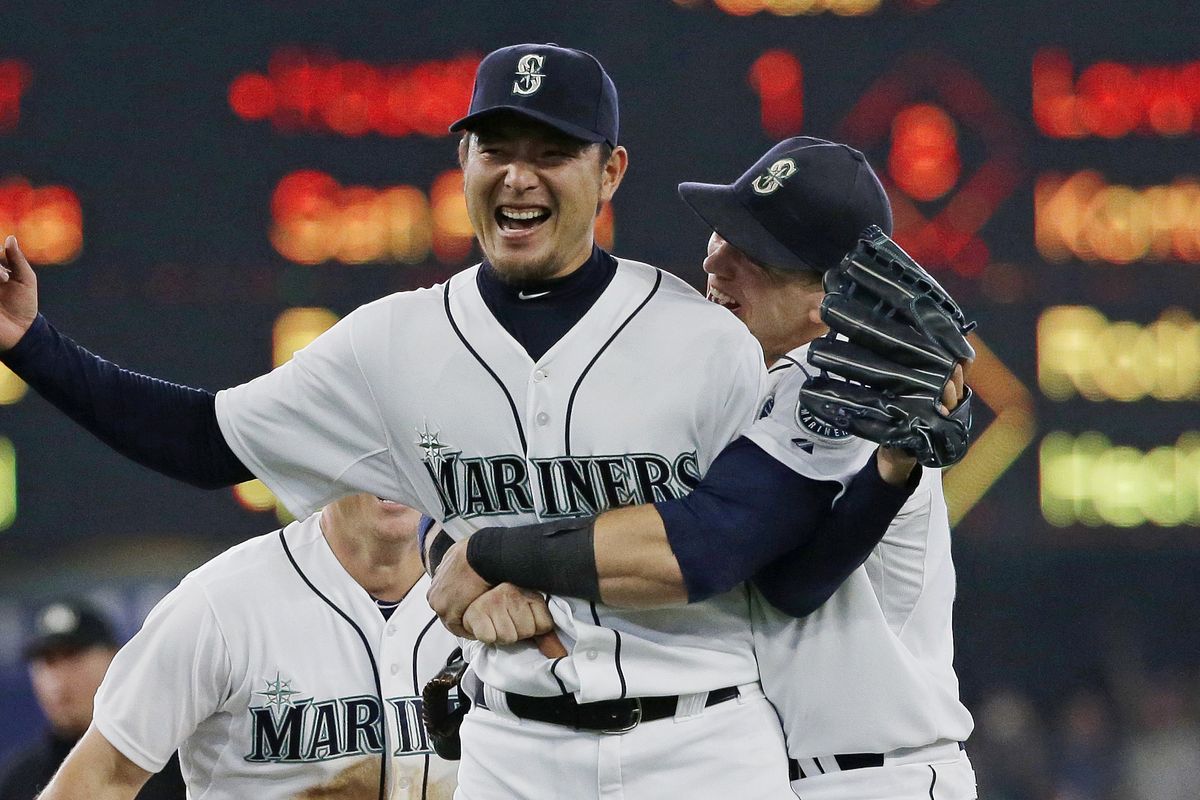
It was an eruption of joy worthy of a pennant clinching, a beacon of light and laughter in an otherwise dreary Mariners season.
In the big picture, it might not amount to anything more lasting than the dampness from a Gatorade shower. But for a ballclub yearning for hope amidst the gloom, Hisashi Iwakuma’s no-hitter on Wednesday was not going to be short-shrifted.
When Gerardo Parra’s two-out, ninth-inning drive to the outfield – just enough into the left-center gap that Iwakuma’s first reaction was, “uh, oh” – dropped into Austin Jackson’s glove to finish the no-no, the release was cathartic. And heart-felt.
The Safeco Field crowd of 25,661 stood and roared, ceaselessly. The team poured from the dugout, Felix Hernandez wearing his Kuma Bear Cap, and engulfed Iwakuma in a human scrum.
“Any time you have a game like this, it definitely sparks a fire in the team,’’ Jackson said. “You see how pumped up guys were, like we just won the World Series. That feeling that you get when you’ve got a guy going out there and pitching his heart out, you want to back him up and do everything it takes to win the ball game.”
You’d never guess that this was a ballclub that still stood seven games under .500. A team that has inched back barely close enough to the periphery of the wild-card race to allow itself, once again, to start imagining miracle scenarios.
They still don’t pencil out, but on this day, of all days, you couldn’t blame a team for thinking big. If you had asked manager Lloyd McClendon on Tuesday who on his staff had no-hit potential, he would have started with Hernandez, of course. No American League pitcher had thrown a no-hitter since Felix’s perfect game on Aug. 15, 2012. And he would have gone next to Taijuan Walker, the 22-year-old fireballer.
Iwakuma?
“Probably not, because he’s a finesse guy,’’ McClendon acknowledged.
Iwakuma’s rocky, injury-riddled season at age 34 is one of many reasons the Mariners have failed to meet expectations this year. Sidelined for all of May and June with a lat strain, he had been uneven upon his return. Many expected him to be traded at the deadline, though McClendon joked, when asked what his input into those discussions had been, “I can tell you this, ‘I would have been going with him.’ ”
Or maybe he wasn’t joking. At his peak, Iwakuma is an ace-caliber pitcher, one who finished third in the Cy Young voting two years ago and won 15 games last year despite missing most of April with an injury. Recently, he had again begun to flash that form.
“I said about three weeks ago that the Bear was back,’’ McClendon said, invoking Iwakuma’s nickname. “He’s only getting better.”
Iwakuma, who is eligible for free agency after the season, said he is trying to use this stretch drive to make up for the contributions that eluded him while he was on the disabled list.
“I missed a lot of time in the first half, 2 1/2 months,” he said through a translator. “I couldn’t help my team at all. That’s all I have in mind, to come back and give it all I’ve got each start and make up for the lost time I had in the first half.”
Iwakuma’s split-fingered pitch was devastating on Wednesday, but that was far from his only weapon. Catcher Jesus Sucre said he was surprised to hear everyone singling out the splitter.
“For me, Kuma has a nasty curve and slider, too,’’ he said. “I love to use them, too.”
Add a fastball that Iwakuma elevated beautifully on Wednesday whenever he sensed the Orioles were sitting on his splitter, and it was a classic no-hit recipe.
“He didn’t miss,’’ Orioles manager Buck Showalter said. “You could count two or three pitches that he got in the area to say, ‘Gee, we should have done something with that.’ And then as some of the anxiety mounts, you let him take you off the plate completely. That plays in pitcher’s favor when you try to do too much.”
The anxiety flowed on both sides. Sucre admitted to being nervous on every pitch from the seventh inning on. When Iwakuma, his pitch-count rising to potentially dangerous territory, walked the leadoff man in the eighth, the tension ratcheted up. Especially when he went 3-1 on Caleb Joseph with one out. But the ensuing double-play ball made many think that this was really, truly happening.
“That was the part,” third baseman Kyle Seager said, “I really got chills on.”
That feeling only increased when Seager made a sensational, over-the-shoulder grab of David Lough’s tricky foul popup near the rail to start the ninth.
“I looked at Trent (Jewett, the Mariners bench coach) when he did that and I said, ‘I think he’s going to get it.’ ” McClendon said. “That’s one of those plays that’s just magical in that particular moment.”
And the day had a magical finish, with Jackson nestling the final out off the bat of Para to give Iwakuma his share of baseball immortality. To McClendon, it’s merely an exclamation point that accentuates an already improving ballclub.
“If you look at this club since the break, we’re playing good baseball,’’ he said. “We probably should have won three out of four in Minnesota. We took the series in Colorado and won our last three series in a row. We’re starting to pick it up. This type of game only helps. But I learned a long time ago that momentum is only as good as your next starter.”
That will reveal itself Friday in Boston. But on Wednesday in Seattle, all the Mariners wanted to do was celebrate.