
Generations mark World War I centennial at Washington Capitol
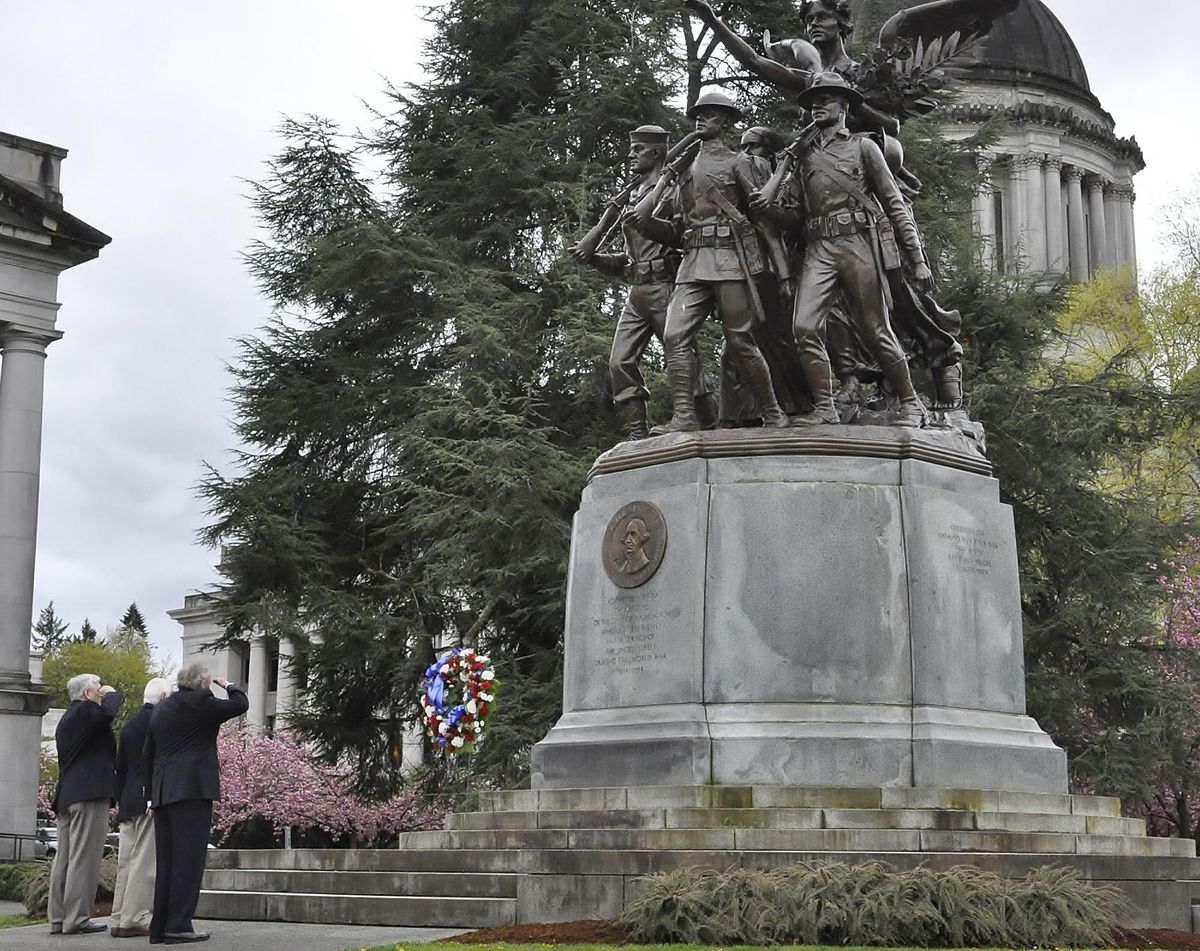
OLYMPIA – One hundred years after America entered World War I, the descendents of those who served in the war marked the centennial Tuesday by placing a wreath at the memorial to the Washington men and women who died in it.
Members of a new generation explained to some of those older generations how they are taking up the challenge to find out more about the men from Washington who fought and died in it.
“History is not done with World War I. There’s a lot more work to be done,” Lorraine McConaghy, a historian who wrote about the effects of the war on Washington, told a gathering at the Capitol.
The war helped shape Washington into the state it is today, McConaghy said, expanding shipyards and factories, mobilizing the timber industry, and giving Boeing its start building airplanes for the Navy. It came in the middle of what she believes is “the most extraordinary decade in Washington history” that also included labor unrest, free speech fights, the flu epidemic and state Prohibition that predated the national law.
Connections to the war can be found in almost every city and town, from statues, stadiums and parks to streets named for President Woodrow Wilson, who asked for a declaration of war 100 years ago this month, or Gen. John Pershing, the commander of U.S. forces, she said. In all, what was then called the Great War, or more optimistically but incorrectly “the war to end all wars,” claimed the lives of 200 Spokane residents and a total of 1,642 Washingtonians, mostly men, but some boys and military nurses, she said.
Twenty-nine Washington casualties are buried in the Suresnes American Cemetery outside Paris, but not much is known about them. A new collaboration between students at Lopez Island Middle School and the American School in Paris, called The Monuments Project: Uncovering Stories Untold, is trying to find out more information about each casualty, his family and his home. They plan to tell each story and put it on a website with an app that will link users to the people and places of 100 years ago.
After describing the project, the students joined members of the Historical Society and the Military Order of the World Wars at a ceremony to place a wreath at the base of the Capitol’s memorial to World War I, the Winged Victory Monument that features a soldier, sailor, Marine and military nurse protected by an angel of victory carrying an olive branch.
John McConnel, a Navy veteran, was one of three former military order commanders involved in the wreath ceremony and said he was heartened by the middle schoolers’ interest in World War I.
“It had a tremendous impact on the entire nation,” McConnel said. When he was in school, he learned about the war from people who were in it, and every student memorized the poem “Flanders Field,” which describes a battlefield cemetery. He doesn’t think today’s students learn that.
Keith Warren, another past commander involved in the ceremony, agreed that those lessons suffer as time passes: “As all of the people pass on, the memories go with them.”