
Joan Anderson, who twirled her way into hula hoop history, dies at 101
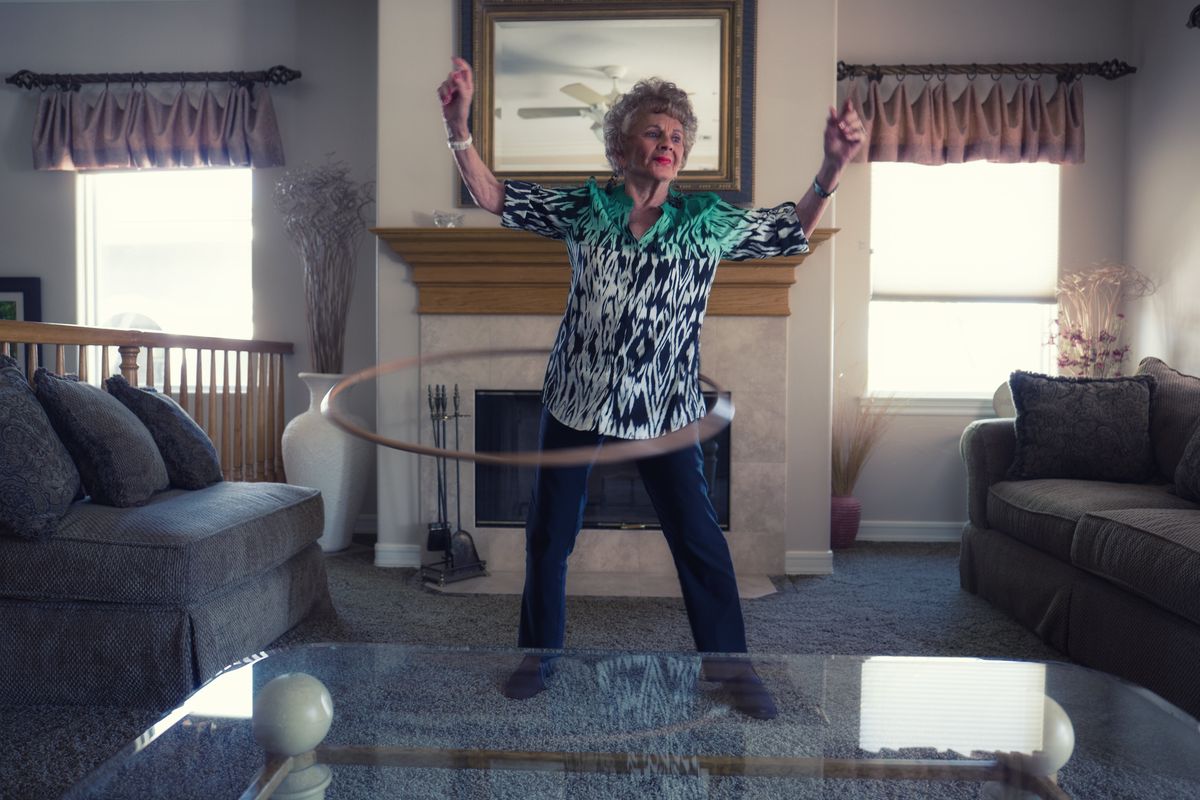
On a trip to Sydney in 1956, Joan Anderson was amazed to discover a new trend sweeping Australia’s beaches and streets. People were “doing the hoop” – twirling a sturdy, circular ring of bamboo around their hips for exercise or just for fun.
Anderson, an Australian native who lived in Los Angeles and was back visiting family, had trouble at first when she tried to join in. “It looked like fun,” she later said, “but it was really hard.”
Still, she found herself enthralled by the toy. After returning to the United States, she had her mother ship her a hoop.
Its arrival confounded the local mailman. “He said, ‘Why would anyone send something like this all the way from Australia?’ ” Anderson recalled in a 2018 documentary, “Hula Girl.” “I often wonder if he put it together that what he delivered became a sensation.”
Within a year, millions of Americans would be doing a shimmy, gyrating shake with a plastic version of the hoop – thanks, in large part, to Anderson, who in her telling, gave the toy the name by which it’s known: the hula hoop. Anderson died July 14 at age 101.
Although her name was left out of hula hoop history for years, it was Anderson who took the hoop from Australia to America and, with her husband, set a business deal in motion that turned the toy into a pop culture phenomenon: Tens of millions of hula hoops were sold by the manufacturing company Wham-O, under the brand name Hula-Hoop.
“When it hit in 1958, they sold more than 25 million in four months in the U.S.,” said Chris Byrne, a toy consultant and historian.
People have been twirling hoops forever, Byrne added in a phone interview.
Children played with barrel hoops in the 19th century, and the toy has been a standard in circuses and a fixture of Australian gyms. But in mass-producing the hoop in rigid plastic, Wham-O created an enduring hit – one of the great toy fads of the 20th century and a children’s favorite that has stood the test of time.
In the 1950s, “swaying your hips could be suggestive,” Byrne said. “The hula hoop in its fad days identified with a place and a time in our culture. It lionized teenagers and their freedom.”
Before the hoop took off in the U.S., Anderson was just twirling at home, encouraging her friends to join in. As she played around with the toy, she said, a friend told her that it looked like she was doing the hula, a traditional Hawaiian dance.
The “hula hoop” name was born.
Anderson’s husband, Wayne, saw commercial potential for the toy and knew someone who might be able to promote it: Wham-O co-founder Arthur “Spud” Melin. Within a year, Wham-O was churning out hula hoops, which became an emblem of the 1950s and one of several blockbuster toys the company would produce, alongside the Frisbee, Slip ’N Slide, Super Ball and Silly String.
As hula hoops began to fly off the shelves, Anderson and her husband stopped hearing from Melin. The executive wouldn’t return her phone calls, she said.
In corporate histories, Wham-O would say that Melin had discovered the hoop, spotting the toy “on a trip to Australia,” according to Byrne. “The way they told the story never had Joan Anderson in it,” he said.
Anderson and her husband sued Wham-O in 1960, alleging that Melin had agreed to pay them a penny for each hula hoop sold but had failed to hold up his end of the bargain.
The company argued that despite brisk sales, it had not turned a profit on the toy, only breaking even after accounting for manufacturing costs and losses related to product returns.
In the end, Anderson and her husband settled for $6,000 and tried to cast hula hoops far from their minds.
“The world isn’t fair,” she said in the documentary. “But life goes on.”
“There was never a lot of bitterness from my parents,” Ms. Anderson’s daughter, Loralyn Willis, said in an interview. “They didn’t know what to do business-wise back then, and they just accepted what happened and moved on with life.”
Sitting down for dinner with a group of friends about a decade ago, Willis mentioned her mother’s story in conversation. The mother of Amy Hill, a filmmaker, happened to overhear. She went on to connect Ms. Anderson and Hill, leading to the documentary short “Hula Girl,” which Hill co-directed with her husband, Chris Riess. The film introduced Ms. Anderson’s story to the world, and it gave Ms. Anderson a red-carpet moment when the documentary premiered at the Tribeca Film Festival in New York in 2018.
“You could see it reawakened something in her,” said Hill, who recalled how Ms. Anderson could still twirl a hula hoop even in her mid-90s. “She kept that hoop up. She was not dropping it.”
The second of three children, Joan Constance Manning was born in Sydney on Dec. 28, 1923. Her father was a real estate broker, and her mother was a homemaker.
Anderson, who stood 5-foot-2, modeled swimsuits in her late teens and early 20s, gaining a reputation as a “Pocket Venus” while appearing in Australian women’s magazines.
In 1945, she met Wayne Anderson, a U.S. Army fighter pilot who was on leave, during an outing at Bondi Beach.
They married four months later and settled in Southern California, where Anderson occasionally modeled. During one shoot with the Blue Book Modeling Agency, she worked with Marilyn Monroe, according to her family.
Ms. Anderson’s death, at a nursing home in Carlsbad, California, was confirmed by her daughter, Willis, who did not cite a cause. In addition to her daughter, survivors include two sons, Warren and Gary; and six grandchildren. Her husband died in 2007. Another son, Carl, died in 2023.
Well into her twilight years, Anderson remained lively – playing tennis into her late 80s, ziplining on Catalina Island at 90, parasailing in Hawaii at 92, boogie boarding until she was 96 and ballroom dancing until she was nearly 100.
But it was the documentary that rekindled her love for hula hooping.
“At the Tribeca Film Festival she was on the red carpet, and people were coming up and saying, ‘Can I have your autograph? And a picture with you?’” Willis recalled. “She just looked at me and she goes, ‘I would never want to be famous.’ But she enjoyed it.”