An EWU institution: From a ‘blue’ debut to his love of red, Larry Weir enters 35th season as Voice of the Eagles
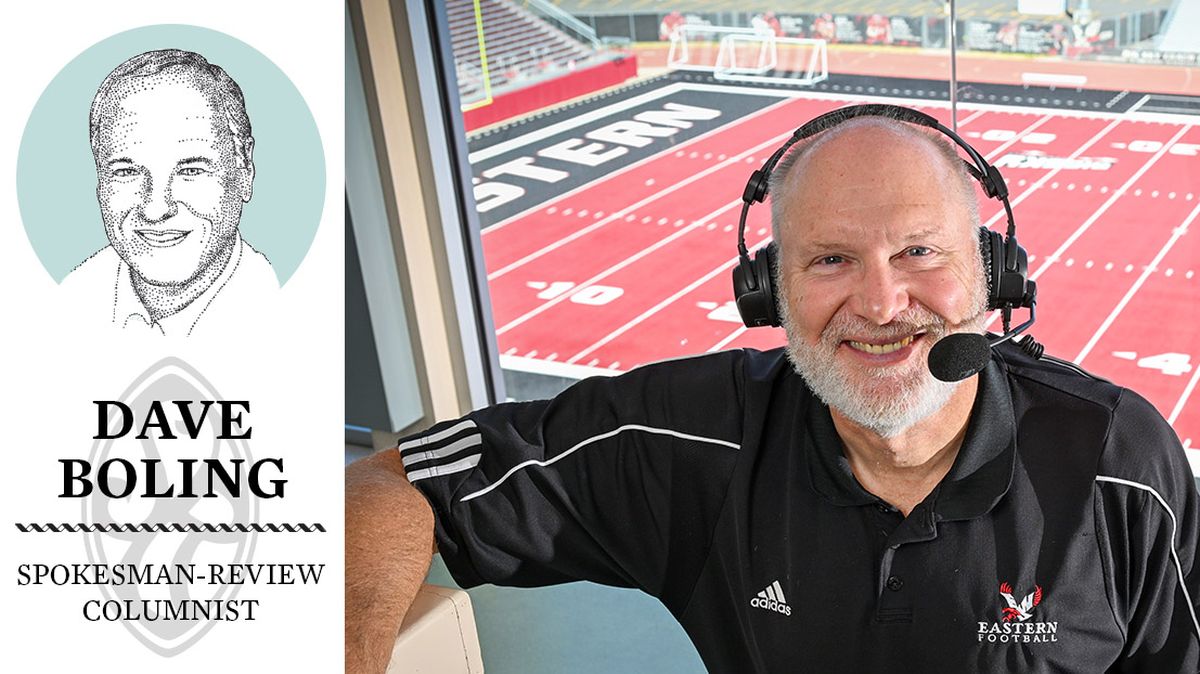
Come back in time to Larry Weir’s spectacular introduction to the radio business.
Still just a farm boy, then, age 18. Toppenish, Washington.
For logic-defying reasons, the greenhorn was entrusted to oversee a local pastor’s weekly radio sermon.
While the minister was inspiring his flock, Weir was struggling with some balky recording devices in the production area.
With no one on hand to help, Larry employed the time-tested method of coping with frustrating technology: By attacking the machinery with a richly layered, colorful string of profanity.
One problem. A nearby open mic picked up his tirade and wove his expletives into the pastor’s homily.
Bad words, Larry? “Yes.”
The real bad ones? “You name it, I said it.”
Even after hearing the complaints from the pastor, Weir’s understanding boss granted him absolution.
His lenience was a gift to generations of Eastern Washington athletics fans who have enjoyed games via Weir’s broadcasts for decades. Making the most of his second chance, Weir is now entering his 35th year as the voice of the Eagles.
Over the course of more than 900 basketball and 400 football broadcasts of the Eagles, Weir has not needed to reprise his repertoire of blue lingo on-air.
However, 35 seasons of travel to mountainous Big Sky Conference outposts such as Flagstaff, Bozeman, Odgen, Pocatello, etc., might have coaxed a few oaths from his resonant pipes.
Weir also stays busy broadcasting prep contests and minor-league baseball games, but it’s the more than 1,300 EWU contests that have buttressed his legacy.
Through this span, the 64-year-old Weir has become a truly self-actualized person, exactly where he wants to be, doing exactly what he always wanted to do.
“The grass has never been greener on the other side for me,” Weir said. “I found an area where I wanted to be, where I had a lot of relationships, and a school I had ties to. And as we got going into this thing, I just never saw myself leaving.”
His reputation among broadcasters is not only a function of longevity.
“Larry is the dean of the Big Sky play-by-play voices,” said Mitch Strohman, long-time radio voice for Northern Arizona University sports. “It’s not just because he’s been doing it the longest, but because he’s been doing it the longest at a level that is so high, he exemplifies the very meaning of ‘The voice of …’.
“He’s not just the voice of the game, but the voice of the institution.”
Weir’s parents, on the farm in Waitsburg, thought Larry would be suited to a career in law. He didn’t share their vision. After a couple years at Walla Walla Community College and a quarter at EWU, he grew convinced broadcasting was his future.
Some people claim to hear voices directing their career decisions. Weir certainly did.
The voice belonged to Bob Robertson.
The raspy voice and infinite enthusiasm of Robertson, during his Washington State and minor-league baseball broadcasts, shaped Weir’s future. Even though Robertson had no idea at the time.
“He taught me how to do this without ever actually being there teaching me,” Weir said. “It was through listening to him that I learned.”
Robertson died in 2020 at the age of 91. Although it was only a short time before Robertson passed, Weir finally got a chance to tell him how significantly he had inspired his career.
“We probably had a 45-minute or an hour conversation, just the two of us. I was thanking him, although it was mostly Bob doing the talking,” Weir kidded. “So many stories of how he did it. I wish I had recorded it.”
Through seasons of success and struggle, Weir has been a constant for EWU. In the process, he has embraced the Eagle ethos of doing the best with what they have. And much of the time, the results are better than external circumstances seemed to dictate.
“Compared to a lot of other teams in the conference – for money, fan support, resources, facilities, whatever – they’re way behind,” Weir said. “But the fact that they were able to be so good for so long, especially in football, is nuts.”
Asked of his favorite athlete to cover over the years, Weir had a lengthy list, with one perhaps edging out all others.
“Alvin Snow was always a guy that I enjoyed,” Weir said of the three-time all-conference basketball guard from the early 2000s. “What a tremendous competitor he was.”
Weir precisely remembered Snow’s statistics from a highlight Eagle s win (62-58) over Washington in 2002.
“(Snow) had 24 points and seven steals and pretty much willed Eastern to a win in that game,” Weir said.
A natural pitfall of broadcasters with long affiliations to specific universities is to become what is known in the business as a “homer.” Weir’s reputation, though, is for delivering accurate and mostly unbiased coverage of games.
“I think everybody can tell that I want Eastern to win, but I’m also not afraid to explain why they’re losing,” he said. “I try to keep it honest and not sugarcoat something unnecessarily.”
His efforts have twice earned him recognition as Washington Sportscaster of the Year.
Weir and Strohman, with decades of experience in the business and a shared understanding of their obligations to listeners, have agreed on a pact of mutual evaluation.
“We’ve seen people in our business hang on too long,” Strohman said. “You feel in your heart for those people. They don’t want to give it up. (But) neither one of us wants to reach that point.”
Weir put it more simply: “If it comes to it, either one of us has to tell the other, ‘you’re losing it … time to go.’ ”
Neither is anywhere near pulling the plug on the other’s headsets.
Weir still loves everything that goes into the job, the preparation for the games, doing his homework. The job deserves that, he said.
“I know how hard (the athletes) work, in the season and out of the season,” Weir said. “And that makes me feel, as a broadcaster, like I need to try to match that, to do the best I can to tell their stories.”
Weir’s hero, Robertson, manned the Cougars’ booth more than 50 years. Maybe he’s shooting for that. As it is, he plans to continue until he either loses his sight or starts forgetting important facts.
And until then, he might avoid any unexpected calls from his buddy Mitch.