
Trial of security guard from Coeur d’Alene Republican town hall begins with debate on freedom to dissent versus freedom to ‘command’

After Kootenai County Sheriff Bob Norris told Hayden resident Ben Stallings to leave a chaotic and politically charged Republican legislative town hall, the only thing Stallings said he was concerned about was his visually impaired wife.
He had driven her to the Kootenai County Republican Central Committee-hosted event at Coeur d’Alene High School in February. The two watched as people began shouting, both in support and opposition, to the officials on stage. Stallings became emotional and decided to take part, too. When local representatives began talking about medical care, he yelled, “You’re not a doctor!”
Stallings said that as soon as the words left his mouth, Norris walked by, pointed at him, and said, “You. Out.”
Stallings obliged and left the auditorium, only to be grabbed by two men in unidentifiable black clothing. One of them was Paul Trouette, the owner of private security company Lear Asset Management, who is on trial this week for eight misdemeanor charges, including battery and false imprisonment, related to his alleged behavior at the February town hall.
“I told them, ‘My wife is blind. There is no need to grab me, I need to reconnect with my wife,’ ” Stallings recounted from the witness stand Monday.
They didn’t let him, he said.
Stallings recalled how Trouette wanted him to leave the property altogether. At the time, he said it felt like the only people who were punished during the town hall were those who dissented.
“This case is not about politics, it’s about people,” Coeur d’Alene Chief Deputy City Attorney Ryan Hunter told a Kootenai County jury on Monday. “People should be free to make their voices heard without fear of violence or retribution when speaking out, even if out of turn.”
The charges against the owner of the private California-based security team initially stemmed from the moment a former Democratic candidate for Idaho’s House of Representatives, Teresa Borrenpohl, was forcibly removed from the town hall after she jeered the emcee on stage.
Multiple videos show Norris, wearing a hat inscribed with the words, “Kootenai County Sheriff,” approach Borrenpohl and telling her to leave. But she declined. He then asked her if she wanted “pepper spray” and told her she would be arrested, video shows.
Norris grabbed her arm with both hands and attempted to remove her from the town hall. She retorted, “Please don’t touch me.”
After she didn’t comply, Norris gestured to the two unidentified private security guards in plainclothes and pointed at Borrenpohl. According to video of the incident, Borrenpohl asked, “Who are you?” Norris responded, “It doesn’t matter.” The two men later wrestled her to the ground as she yelled, “Who are these men?” until she was pinned on the floor.
The four men and their supervisor, Trouette, were eventually charged with battery and false imprisonment. The state dropped charges against the four employees last week, but Hunter chose to move forward with the trial against Trouette, who is pictured in several photos grabbing Borrenpohl’s feet.
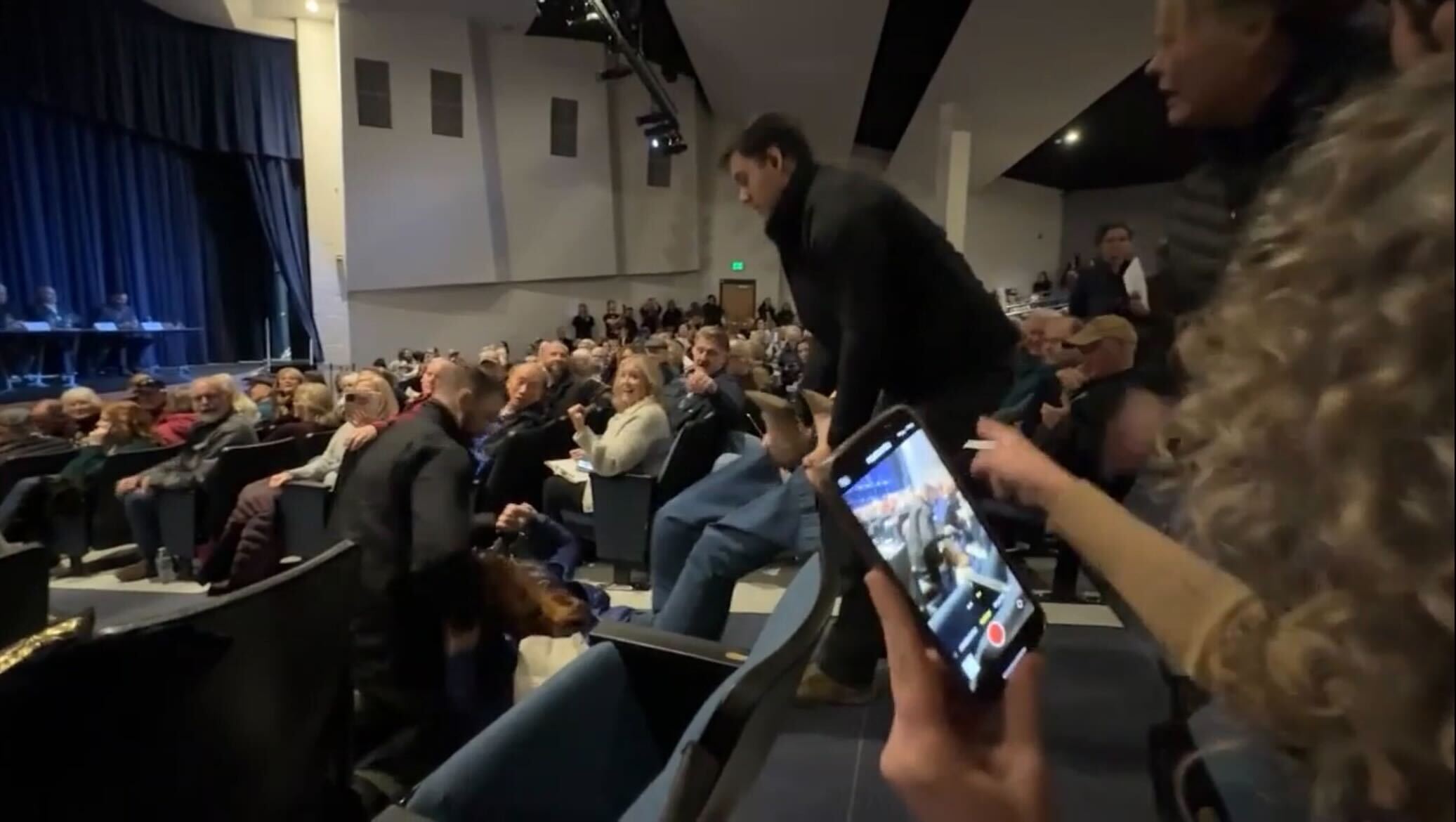
From the start, local police were concerned that grabbing and dragging a woman out of a public town hall for dissenting was crossing First Amendment lines. Coeur d’Alene police Chief Lee White told local media at the time that those who had shouted in support of Republicans onstage were not removed by Norris or security guards. Those who spoke and shouted against them were .
Borrenpohl was later dragged away from the auditorium by her arms as she cried and screamed. Attendees who left the event clearly frustrated shouted at the unidentified security guards and voiced their displeasure with the outcome of the town hall, according to video of the event.
“I saw this person’s hair getting pulled, a struggle. I saw her clothes getting pulled up. I saw her bra … It was upsetting,” Marc Stewart, a former committeeman of the KCRCC, testified Monday. “When people were coming out, I saw the looks on their faces. Yeah. I won’t forget that.”
Who’s responsible?
It appeared during Monday’s trial there was one thing on which Hunter and Trouette’s defense attorney, Josh Hanners, could agree: that Norris gestured to the unidentified men to forcibly remove Borrenpohl. But the two disagree on how that applies within the case.
Under Idaho law, it is legal for a sheriff to command people to assist him in his duties. Whether Norris used this power “well” is not up for debate, Hanners argued – what matters is that the guards were following a lawful order by the sheriff.
“If you’re one of those citizens that the sheriff grabs and commands to help, you are justified,” Hanners said. “Battery and false imprisonment was lawful because you were doing it (as ordered) by the sheriff.”
Hunter declined to elaborate on his position about the sheriff Monday, but he did allude to how he feels about the defense strategy in court motions last week. Hunter wrote that finding a security guard innocent if they were only following Norris’ commands is too vague and leaves no room for accountability or ability to question the reasonableness of the guards’ actions at the time.
Even if the fault of what happened at the town hall fell on Norris, he was exonerated of any criminal wrongdoing by the Idaho Attorney General’s Office last month. The office wrote that Norris was allowed to make physical contact with Borrenpohl to arrest her for potential charges of trespassing and resisting arrest after she refused to leave. Coeur d’Alene police eventually declined Norris’ request to trespass and arrest her, citing First Amendment concerns.
Whether Borrenpohl’s First Amendment rights were violated could depend in part on the nature of the town hall. Typically, free speech can be restricted to an extent if it’s interfering with official business, such as a city council meeting.
But there’s nothing to indicate the KCRCC was conducting any official government business that would establish restrictions on Borrenpohl’s speech. Internal emails from the Coeur d’Alene School District show the town hall was communicated as a public event, The Spokesman-Review previously reported. The event also was advertised using flyers and discussed through posts on Facebook.
“Saturday’s event was presented to the school district as a ‘public’ event. As such, we went ahead and rented the facility to them,” Coeur d’Alene Public Schools Superintendent Shon Hocker wrote to the police chief in February. “… If we had been approached by a political agency to use our facility for a ‘private’ event, it would have been denied.”
The days leading up to the town hall already felt somewhat conflicting, witnesses said Monday.
Coeur d’Alene High School facility manager Kelly Humann told the court she began preparing for the event a few days early. She was not informed there would be security there. That’s when she got a phone call.
“A phone call (from Trouette) made me concerned,” Humann said. “He asked if he was able to carry guns on campus. I said ‘No’ to him, and he wanted to push back at me. So I handed it over to our school resource officer, Josh Reneau.”
Coeur d’Alene Police school resource officer and detective Reneau told the court he called Trouette, who asked him the same thing about whether he could carry a firearm on school property during the town hall. Reneau told him it was illegal.
Trouette asked if it would change anything if he was hired by the KCRCC to provide security for the event, Reneau said. The only exception would be if he could supply the school with a contract showing Trouette and his team were officially paid and employed, Reneau said.
That never happened, either.
“I haven’t been able to find anyone that said he was hired. I told him without a contract, there wasn’t any difference between someone showing up and deciding they were going to carry a gun (on campus),” Reneau said. Trouette again called Reneau and asked if he could carry a gun if he provided a contract.
“I told him I didn’t think it would (be legal) because he wasn’t going to be paying his employees,” Reneau said. “At the end of that conversation, he agreed he wouldn’t have a firearm.”
Stewart, who helped plan the KCRCC event, also wasn’t aware there would be security. He was told Norris was going to provide security – not a group of guards in plainclothes and no identifiable markings, which is against city code.
“I wasn’t sure who they were,” Stewart said on the stand.
The town hall was politically charged “right off the bat,” Stewart said. People across all aisles of the political spectrum were yelling and shouting.
Stewart described it as chaotic.
“People were unhappy … far to the right and left. There was tension in the air,” he said. “It was very loud. It was very tense. And it was very uncomfortable.”
Following Stallings’ testimony Monday, he told The Spokesman-Review a security guard made a snide comment to him as he was leaving the school with his wife. The guard told Stallings he would “put him on the ground.”
Not wanting any more confrontation, Stallings shook his head, grabbed his wife and left.
“Now more than ever, we all have to be committed to the idea that dissent does not justify violence,” Hunter told the jury.
Deliberations in Trouette’s trial are expected to begin Wednesday.