
West Valley Schools fleet adds three (very quiet) electric buses
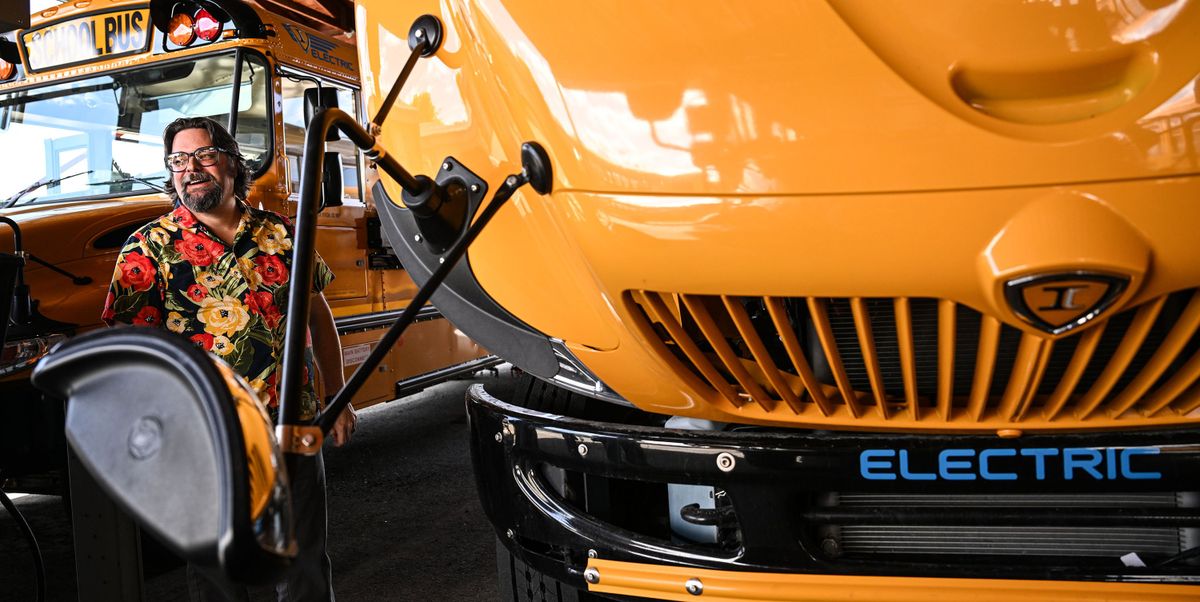
Three electric school buses quietly glide down the streets of the West Valley School District – so quietly, in fact, that exterior speakers mounted on the buses play ambient white noise so pedestrians can hear them coming.
Typical school buses use loud diesel engines, and students riding on them routinely shout or speak loudly to be heard, said Tim Morgan, West Valley School District’s operations director for transportation and nutrition services.
“On an electric bus, they whisper because they don’t want to be overheard,” Morgan said.
The district first began considering electric buses funded by a federal EPA grant a few years ago, but they didn’t have the options the district wanted and the strict grant rules, which were focused on reducing diesel emissions, required school districts to destroy old buses rather than sell them. That simply didn’t make sense in West Valley, Morgan said.
“Our buses are very well maintained and low mileage because of how small our district is,” he said. “Our fleet already meets California standards for emissions.”
Morgan did a lot of research, including talking to other districts across the country that were using electric buses. Morgan said he wanted to learn about the pros and cons, including maintenance costs and failure rates. What he heard back was encouraging.
A new grant opportunity arose last year. The features the district wanted – including chains that drop down at the touch of a button – were now available, and districts were no longer required to destroy their old buses as long as they were purchased after 2010. That meant the district’s older buses could be sold to other school districts, Morgan said.
The grant did, however, require the purchase of 25 electric buses, something the school district couldn’t afford on its own. A local business, RWC Group, volunteered to administer the grant for several different school districts at once so the 25-bus minimum could be reached, Morgan said.
West Valley was scheduled to replace three school buses this year as part of its normal replacement schedule. Each International diesel bus the district typically buys costs between $110,000 and $120,000 depending on modifications, Morgan said. West Valley usually adds the drop-down chains, an upgraded and more robust transmission and an extended warranty, he said.
The electric buses, however, cost double that. What the grant did was pay for half of each bus, Morgan said, so the district only had to spend the amount it had planned to spend on three diesel buses.
The district was able to get charging stations installed at its transportation facility for free. Avista Utilities upgraded a nearby transformer and put in the infrastructure for 15 bus charging stations, though the district only has three currently, Morgan said.
The buses arrived a month ago and began transporting children to school two weeks ago.
“I drove the first trip to test it,” Morgan said.
At first glance, the buses look like the district’s normal International buses with the exception of small blue lettering on the front bumper and the upper side identifying them as electric vehicles.
“The biggest change for drivers is it’s so quiet,” Morgan said. “The drivers are trained to be watching constantly.”
The three buses are all on regular bus routes and none typically use more than half their battery power during the day, Morgan said. The buses are charged overnight.
It will take time to collect data on the range of the buses, which will vary depending on the terrain and the driving style of the driver, Morgan said. He expects that the bus that goes up and down the Argonne Road hill every day will have a shorter range than the bus that has a completely flat route. Since the district only covers 18.5 square miles, Morgan said he doesn’t expect range to be a problem.
Based on data from other districts, Morgan said he expects the cost per mile to drop from $4 a mile for a diesel bus to between 15 and 20 cents per mile for an electric bus. He said the biggest benefit to the district will be savings in maintenance costs and fuel costs.
Morgan said he’s not sure if the federal electric bus grant program will continue, so the district doesn’t have plans right now to purchase more electric buses.
“So far, they’ve been very reliable,” he said. “It’s definitely a technology we’ll continue to look at.”