
From Palo Alto to Spokane to somewhere over Moab: the saga of a weather balloon that smashed a United Airlines window
Spokane has wound its way through the stratosphere into the national spotlight again. Quite literally.
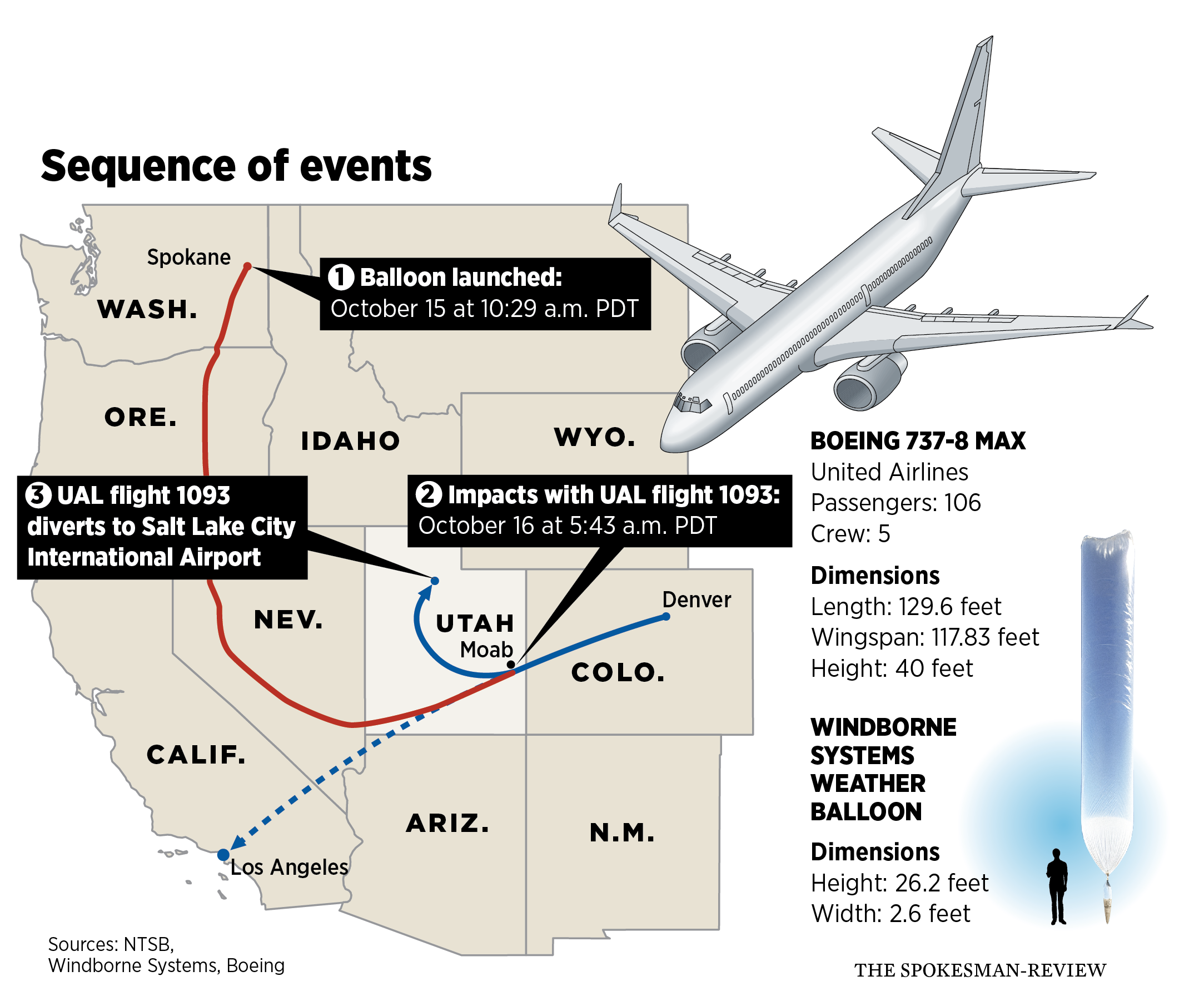
The National Transportation Safety Board announced Thursday that a weather balloon launched by a California-based company from somewhere in Spokane shattered the front windshield of a United Airlines aircraft over Moab, Utah, while it was cruising at a height of 36,000 feet.
That is right where the stratosphere begins. It also just so happens to be right in the typical range for commercial cruising altitude: 33,000 to 42,000 feet.
The mid-October collision sent pieces of glass flying through the cockpit, slicing the arms of one of the pilots, before the pair landed the plane at Salt Lake City Airport, according to the newly released preliminary findings on the investigation into the incident.
United Airlines flight 1093, a Boeing 737 Max, was bound for Los Angeles from Denver, and the flight captain’s lacerations were the only injuries sustained by any of the 112 passengers and crew aboard, the agency found. He resumed his role at the helm after quickly bandaging himself up.
The report mentions Spokane only as the launch point for the weather balloon by WindBorne Systems, a company founded in 2019 that gathers data from “long duration atmospheric balloons.” The company sells that data to government agencies like the National Oceanic and Atmospheric Administration, and uses it internally to feed an artificial intelligence for forecasts that the company says are the most accurate of any similar AI.
The balloon involved in the October incident came from the company’s “newest launch site in Spokane,” as it is identified in a company blog post from August.
When reached for comment, WindBorne Systems spokesperson Ellie Yoon said the site was set up earlier this year as part of an effort to fill gaps left by the Trump administration’s budget cuts and workforce reductions to the National Weather Service and parent agency the National Oceanic and Atmospheric Administration.
“Back in February, WindBorne’s leadership caught wind of the fact that NOAA had just been hit by a series of DOGE-related staffing cuts, which resulted in the immediate pausing of weather balloon launches out of Kotzebue, Alaska and 14 additional sites,” Yoon wrote in an email. “Weather data is crucial to accurate forecasts, with forecast degradation realized immediately when observations are cut.”
WindBorne had just completed standing up a launch site in Fairbanks, Alaska, so they offered to help fill the gaps by providing data to the National Weather Service free of charge, for six months.
“An offer that received a warm reception from both employees and political appointees at NOAA,” Yoon said.
The company moved quickly to set up five new launch sites for their global sounding balloons in Spokane, Hawaii, Puerto Rico, Oklahoma and Alabama “to ensure continued forecasting” by September, Yoon said.
Yoon declined to specify the exact location of the Spokane launch site.
“Our launch site is located in the backyard of our launch operator’s home so we’d rather not disclose that information,” she said.
In the years to come, WindBorne hopes to establish a vast network of its proprietary balloon tech to produce more accurate, longer-term forecasts than ever before, as reported by the New York Times in July.
“The most significant real-time data gap, according to the World Meteorological Organization (WMO), is the atmosphere – 85% of which is effectively unobserved,” the company’s website states. “This gap led us to invent, build, and operate a now-global constellation of one-of-a-kind autonomous, sustainable, long-duration weather balloons.”
The company’s ambitious goals were thought impossible just a decade ago, when weather balloons lasted tens of hours at most, staying roughly in the same area above their launch point, before touching back down on Earth.
While a student at Stanford in 2015, WindBorne CEO John Dean and his peers in a space club engineered a long-lasting, latex weather balloon that set record flight durations and used satellite communications to send and receive information. Dean and four other members of the club then went on to found the Palo Alto startup, as reported by the New York Times.
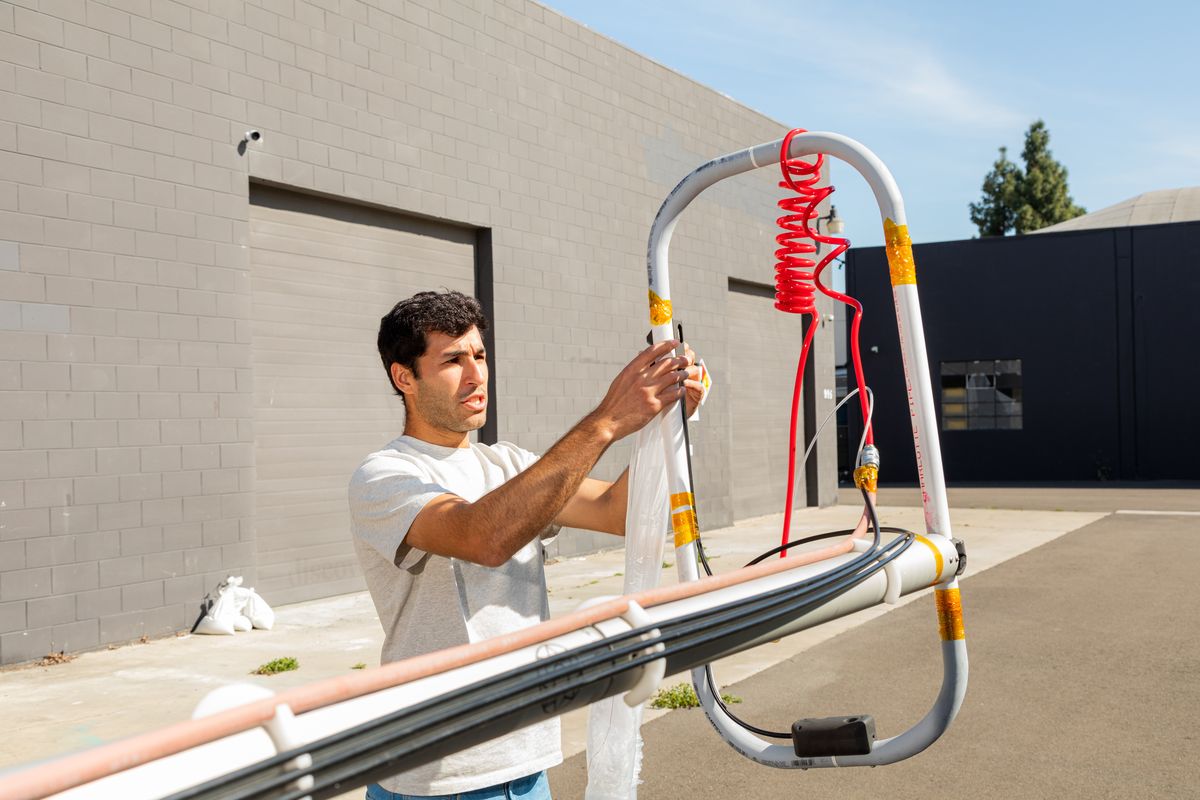
The Stanford project would become the basis of WindBorne’s “global sounding balloons,” which are more than 20 feet long, yet lighter and capable of collecting more measurements than the typical weather balloon. They consist of a large inflatable sack thinner than a human hair, which is filled with gas to lift a 2.6 pound avionics package for flight control, communications and weather measurements.
The balloons are autonomous, and rely on artificial intelligence to reach their destinations using wind patterns. A ballast system releases silica sand to help regulate the balloon’s altitude with gas used for lift. While the system is autonomous, the company mans a command center 24/7 for oversight.
WindBorne Systems says the balloons are designed without large metal or stiff structural elements, “with the intent to minimize harm in the event of an impact during flight or landing,” the federal investigation report reads. Investigators said the housing for the gear is made of “low tensile strength, plastic film,” and the sand is not particularly dense.
The report does not make clear how exactly the rig managed to smash the plane’s windshield, which are federally certified to withstand the impact of a 4-pound bird without penetration. The damaged pane was removed and sent to the agency’s material labs for testing, according to the report.
The global sounding balloon involved in the collision was launched with the proper federal notice at around 10:30 a.m. on the morning of Oct. 15, before it found its way south over Oregon and Nevada. The next day, the balloon headed northeast after slicing up and across the lower half of Utah.
The balloon’s last reading came in around 5:40 a.m. Pacific on Oct. 16.
The United Airlines captain injured in the collision told investigators that he was establishing his cruising altitude around that time when he “noticed an object distant on the horizon.”
“Before he could mention the object to the first officer (FO), there was a significant impact to the FO’s forward windshield along with a loud bang,” the report reads. “The impact resulted in both pilots being showered with pieces of glass.”
The investigation into the incident is ongoing, the report states. The company launched their own investigation following the loss of contact and reports of the plane’s diversion, and announced their suspicions that a WindBorne balloon was involved on Oct. 20.
Dean told the New York Times in October that the collision was the first time such an incident had occurred in their nearly 5,000 launches to date.
“From the data that we have, it’s a very unlikely incident to happen in the first place,” Dean said.
In a Thursday news release, WindBorne said it is cooperating with the ongoing investigation, and shared the “four additional safety measures” implemented since the collision to reduce the chance of another.
“We are deeply relieved that Flight UA1093 landed safely and with minimal damage,” the statement reads.
Those changes include additional reporting of real time balloon locations to corresponding airspace, adjusting flight paths to avoid “potential intersections” and cutting the amount of time spent in the cruising range for commercial flights by around 50%.
The company is also working on redesigning the housing for its technology to “reduce cross sectional density and impact energy,” according to the release.
“WindBorne has always strived to exceed the safety and operational standards outlined in 14 CFR Part 101, which governs high-altitude balloon systems,” the statement reads.
“However, the UA1093 incident has reinforced our commitment to continuous improvement, and we have acted immediately to further strengthen safeguards.”