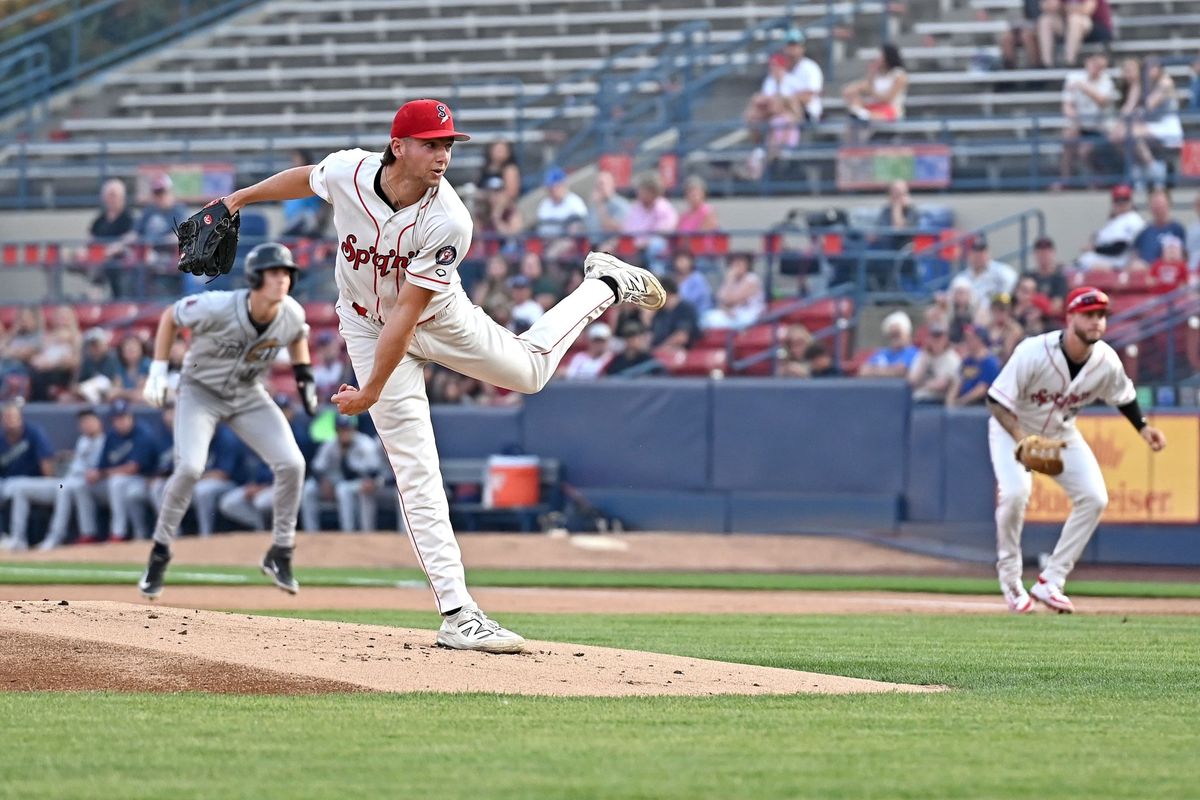
Spokane Indians pitcher Everett Catlett takes Georgetown education – from classroom to ballfield – with him on the mound
Georgetown University is known for a lot of things, including a highly-respected law school, producing 32 Rhodes Scholars, 26 U.S. governors and two U.S. presidents.
It is also known for its men’s basketball team, including hall of fame coach John Thompson, Patrick Ewing and Allan Iverson among many other notables.
What it is not immediately known for, however, is its baseball team – only three former Hoyas have reached the big leagues since 1960.
Everett Catlett hopes to add to that number as he continues to climb the baseball ladder.
Catlett, a left-handed pitcher, was the Colorado Rockies 12th-round pick in the 2024 MLB draft, and he’s pitched at two levels in the minors this year. In eight starts for the High-A Spokane Indians, Catlett – who looks like a basketball player on the mound at 6-foot-7 – is 2-2 with a 3.52 ERA and 42 strikeouts over 46 innings.
That followed a successful stint at Low-A Fresno, where he went 5-5 with a 3.46 ERA over 21 appearances and 12 starts.
Even though Georgetown isn’t a hotbed of college baseball, Catlett lives up to the axiom that “if you can play, they’ll find you.”
Catlett grew up in Manassas, Virginia – a suburb of Washington, D.C. more famous for a Civil War battlefield than it is for sports – and went to Colgan High School which opened in 2016. A steady progression in velocity – and in size – throughout high school allowed Catlett and Georgetown to become the perfect fit for both parties.
“Going into high school I was probably 6-feet,” Catlett said between starts at Avista Stadium last week. “I grew, like, seven inches in four years.”
Catlett recalled topping out at 75 MPH as a sophomore, and around 84 when he committed to Georgetown.
“I definitely wouldn’t say that I was a big baseball recruit coming out of high school at all,” he said.
“I remember my dad telling me when I was writing recruitment letters to colleges that I would end up somewhere I never even heard of, and then I ended up at Georgetown, probably less than six months later after he told me that.”
Catlett pitched mostly in relief his first two seasons with the Hoyas, but made 13 starts his junior year, striking out 84 in 77 innings to get onto the radar of pro scouts. He hopes that when folks hear “Georgetown” they think about more than just basketball.
“I’d like to say I was a part of it, my senior year especially,” Catlett said. “We sort of helped turn the program around. And it’s just awesome being a part of that with the same group of guys.”
Of course, baseball wasn’t the only thing Catlett took advantage of while at Georgetown. He was an economics major with a minor in art.
“I took three or four photography classes, and I was one class away from a minor, and then I found out I couldn’t get the minor unless I was in the School of Art,” he said. “So then I just got a minor in art instead.
“I don’t even know how I ended up (at Georgetown), but I’m so happy and blessed I did. I mean, it was an awesome opportunity to battle in the classroom every single day and on the baseball field.”
Catlett has carried that strong education onto the baseball field. He describes himself a combination of new- and old-school when it comes to preparation and training, and is a proponent of advanced metrics and video review – just not between innings when he’s pitching.
“I deal with it the morning after,” Catlett said. “Watch it run down the drain as you leave the showers in the locker room and then think about it the next day. I watch video the next morning, take the good, flush the bad, then adjust.”
Like studying the bottom line on a spreadsheet, details matter to a pitcher.
“Every outing you learn something to change, something to improve upon, good and bad,” he said. “At this point in the season, you try to make the margin of error as small as possible by what you do outside of the game. But sometimes, you’re gonna show up and the pitch you’ve had all season isn’t going to be there for 24 hours on the night you need it the most.”
Learning how to deal with the day-to-day, week-to-week adjustments is what Catlett, and many young players, need to learn at this level as much as throwing strikes.
“I’m learning every single time I throw,” he said. “Not being able to command a fastball some nights is your biggest problem. And you have to go, you know, reverse splits and throw heavy on change-up, sliders and curveballs.”
Pitching in front of good crowds as Avista Stadium for home games helps Catlett hone in on what he needs to accomplish on the mound.
“It definitely makes it easier to pitch,” he said. “The more fans you have, the easier it is to have that adrenaline, especially at this point the year. When you’re hearing a lot of noise in your background, pitching good or bad, it either kicks you in the butt or it keeps you going.”
Catlett hopes to have a long playing career, but when he’s done playing he thinks working in scouting or a front office would be “awesome.” He’s starting a master’s program in sports industry management in the fall.
“I think it’s fun to evaluate other players and see what makes them great, and see if it is something that can help me too.”