
Music review: Vega Quartet at Northwest BachFest brought consistent beauty, uniformity of tone
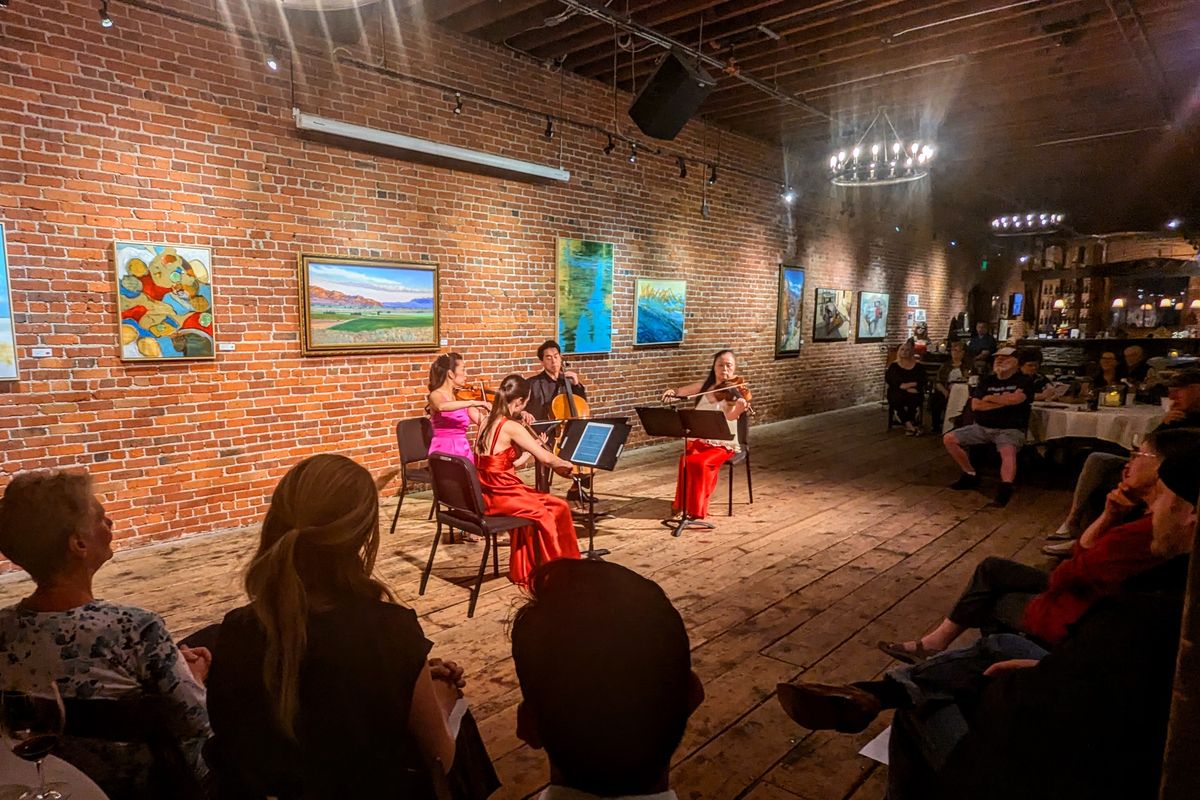
There are signs that change is afoot at the Northwest Bach Festival. Under the guidance of its music director, cellist Zuill Bailey, performances have steadily grown in both number and variety, to the point at which labeling the enterprise with the name of Bach or any other single figure, and perhaps even continuing to term it a “festival” are no longer appropriate. In remarks to the audience gathered at Barrister Winery for performances on Saturday and Sunday, Bailey was unambiguous in framing those performances as an “exclamation point” marking the conclusion of Northwest BachFest in its current form.
His indications of what lay ahead were vague, apart from the fact that he was looking forward to it with excitement, that we could look forward to an announcement of the new brand in early November, and that, in celebration of this new entity, concerts had been scheduled on Dec. 6 and 7 that will feature an ensemble with the most famous name in the entire world of chamber music: the Juilliard String Quartet. It was founded in 1946 at the Juilliard School of Music, and exerted tremendous influence, not only on the world of chamber music, but in many aspects of the performance and marketing of classical music in the 20th century.
Zuill Bailey has brought so many fine string quartet ensembles to Spokane that one can think of them as a festival in and of themselves. Our understanding of the genre and appreciation of its vast repertoire has been steadily enriched by the Balourdet, Attacca, Arianna, Ying and Catalyst string quartet, and, now, by the splendid Vega Quartet.
Sunday’s concert by the Vega Quartet and Zuill Bailey most regrettably conflicted with a simultaneous concert by Spokane’s other, and usually complementary source of insight and pleasure from the world of quartet literature: the Spokane String Quartet, comprised of four members of the Spokane Symphony. This weekend, in fact, that number was changed to five, since the quartet was joined by Julia Pyke, principal flute of the orchestra in a highly innovative program.
The Vega Quartet differs from its predecessors in some important ways, springing, no doubt, from the fact that it was formed not recently, but nearly 40 years ago. Thousands of hours of rehearsing and performing together have allowed them to perfect a style of performance that stands comparison with any in the world.
The quartet was formed in 1986 by some friends at the Shanghai Conservatory of Music, and several of the players we heard this weekend have been playing together ever since. Emily Daggett Smith, first violin, joined the group most recently, though there was no way of telling, so perfectly was her every phrase integrated into the coloristic and interpretive qualities of her colleagues, Jessica Shuang Wu, violin; Yinzi Kong, viola; and Guang Wang, cello. Kong, a founding member of the group, recently retired, but was filling in for its current violist, Joseph Skerik.
The group is celebrating its 20th year in residence at Emory University in Atlanta, and, taken together, its programs could serve as the syllabus for a course in the history of the string quartet from its origins to the present day. Saturday’s program consisted of the first of 68 quartets composed by Joseph Haydn, his Op. 1 No. 1 in B-flat (1757), followed by Anton Arensky’s String Quartet in A minor Op. 35 (1894), in which Zuill Bailey’s cello replaced the second violin, and concluding with Mendelssohn’s brilliant Quartet in D Op. 44 No. 1 (1838). On Sunday, Bailey joined the complete Vega Quartet in playing one of the over 100 string quintets by Luigi Boccherini, that in C major (1789). This was followed by “Five Pieces for String Quartet” by the Czech-German composer Erwin Schulhoff (1923), and a movement from the “Bluegrass Quartet” by contemporary composer and MacArthur Genius Award winner Mark O’Connor. To conclude, we heard one of the three string quartets composed by Robert Schumann in 1842 – his “miracle year” of chamber music – that in A major Op. 41, No. 3.
It is no exaggeration to state each of these works is a masterpiece worthy of its own review. The two works that made the greatest impact on this listener are the Arensky Quartet and the Boccherini Quintet, the first for its subtle interweaving of voices and brooding lyricism, the second for its explosive profusion of melody and irrepressible energy. Still, it need hardly be mentioned that these depended on the playing of the Vega String Quartet to bring them to life, which they most decidedly did. Listening to them is a window onto a style and a level of commitment to quartet playing that characterized the first “golden age” of quartet playing (we are now enjoying the second), which preceded the lightning bolt that was the Juilliard Quartet, as well as the juggernaut that was the Budapest Quartet.
This earlier period, populated with now half-forgotten names like the Flonzaley, the Pro Arte and the Vienna Konzerthaus quartets, strove for consistent beauty and uniformity of tone, perfection of ensemble and a type of long-breathed lyricism that maintained an arch of continuity, not only within movements, but embracing works in their entirety. That is exactly what we were treated to last weekend at Barrister Winery, and it was thrilling.
These artists are all masters of their instruments. There is nothing that can be done on a violin, viola or cello that they cannot do. They could certainly be soaking up the fees and applause that come from performances of concertos by Beethoven, Tchaikovsky and others, but they have rather committed themselves to acquiring yet another – and perhaps higher – skill: that which allows them to fuse themselves so completely with their fellow artists, as well as with the ideas and wishes of great composers, that the narrow boundaries of personality are transcended. We, in turn, are allowed to enjoy the illusion of hearing not the effort of four talented people trying to make their mark on a centuries-old manuscript, but of experiencing the music itself as it takes form before us as naturally as sunrise.