
Spokane-raised painter Jeff Olson returns to Marmot Art Space with ‘The Long Run’
Some teachers give out extra homework to high-achieving students. Painter Jeff Olson’s teacher created entire classes for him.
After taking art and drafting classes in junior high school, Olson knew art was something he was passionate about. His teachers saw that passion and gave him a lot of encouragement.
Once he entered high school, the Moscow-born, Spokane-raised Olson took all the art classes that were available. His teachers then created new classes for him so he could stay involved in the program.
Some of those classes involved drafting and architecture, and Olson decided to major in the latter at Washington State University. A year later, he switched his major to fine art.
Olson considers himself lucky that he received so much support from his teachers and his family. Growing up in Spokane, there weren’t a lot of artistic opportunities outside of school, so he tried to take in as many as he could when they came around.
One in particular, the Western Art Show at the Davenport Hotel, was a particular favorite. He would be let loose in the hallways, able to run around and see as much as he could.
“I was really impacted by the art I saw, and I think there was a moment there that I realized that was really something I wanted to do,” he said.
Now based in Seattle, Olson’s career has taken his works to galleries across the state, country and world, including exhibitions in the Netherlands and Morocco. He’ll return to Spokane with “The Long Run: New Paintings,” which opens Friday and runs through Aug. 30 at Marmot Art Space.
“The Long Run” considers not just landscapes but the passing of time those landscapes illustrate.
Olson has explored elements of the natural world throughout his career, spurred by a childhood spent outside with parents who took him and his siblings camping, fishing, hiking and hunting practically from the time they were babies.
Together the family would explore Eastern Washington, North Idaho and Western Montana.
“My summers were spent up in the mountains, and that certainly was the foundation for my understanding and appreciation of nature, as well as my own identity,” he said. “I really related to it. Still do. I don’t get up and out as much as I used to, but it was a very pivotal part of my growing up, being out in the wilderness.”
There’s always been an element of the outdoors to his work, Olson said, as his vision of the world and his understanding of his place in it were formed by his time outside. His current work may not closely resemble his earlier work, but they were rooted in the same experience, “how the processes of painting are reflected in the processes of nature, and vice versa.”
The title of his latest collection, “The Long Run,” hints at the idea that each series of paintings Olson creates is a catalyst for the series that follows. The things he was exploring in “Origins,” which dates between 1998 and 2001, became essential for what he created in “Topography,” which dates between 2002 and 2009, and so on.
Even the individual paintings informed each other. Olson will sometimes paint a new piece within sight of the previous painting as a sort of reference, or he might just keep the first painting in mind while working on the second.
He doesn’t have a predetermined image of what each piece will look like; he simply starts and lets the painting lead him.
“There’s usually something specific in the previous painting, that ‘Aha! I really like that. I want to try that again’ so I will start with that idea and then let it go on and lead to the next ‘Aha!’ moment,” he said. “Then I pick up the brush for the next painting and so on. It’s always with the thought of the previous painting in mind, but always allowing for new discoveries and new ideas to come forward.”
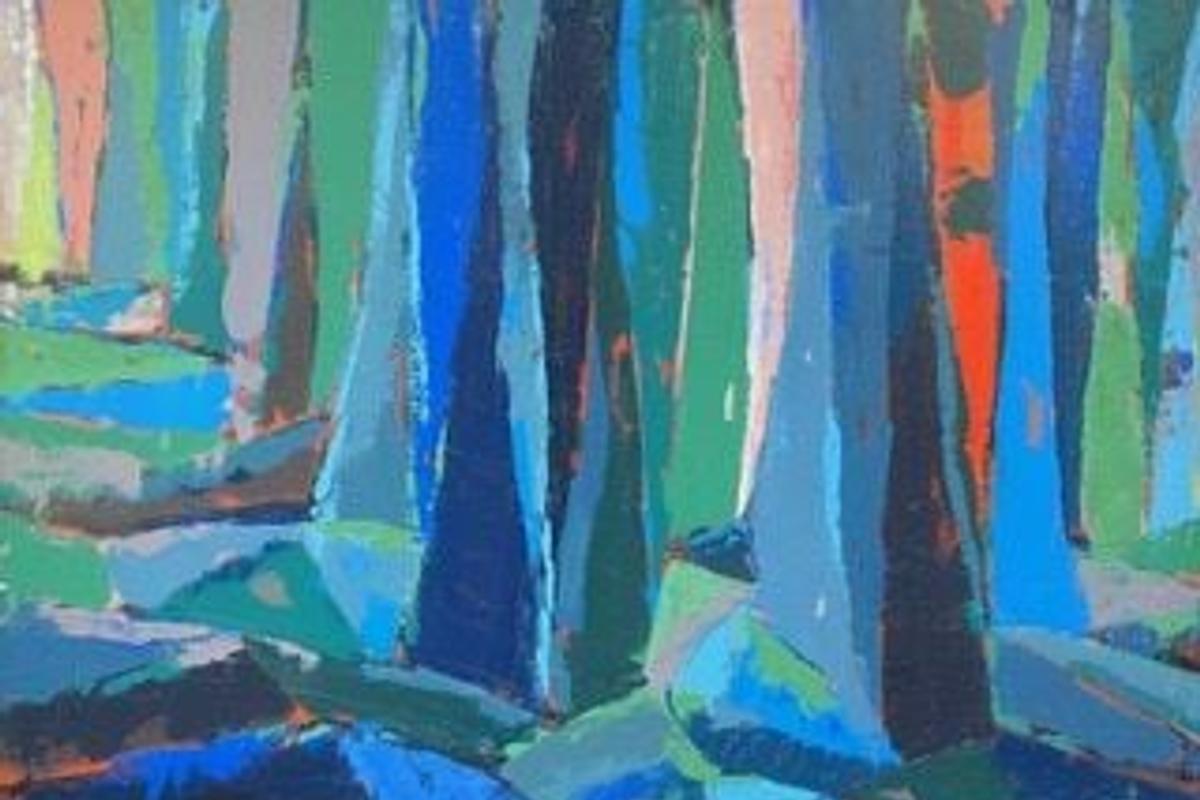
Some of the paintings in “The Long Run” share similar color palettes, like “Pillars of Mars” and “Light through the Pines,” while others share similar inspiration, like “Search Light” and “Visitors,” which both seem to stick viewers in a forest that stretches on and on.
Olson doesn’t often paint with a specific location or natural feature in mind. Instead, he bases his work on a conglomerate of memories of those places, be they mountains or rivers, forests or canyons.
He also makes note of how the passing of time has changed a location. Erosion might topple a tree, a forest fire might blacken a field, a river might take out a bridge.
“Those things that leave their mark on the landscape are what really captured my imagination and are part of what I’m trying to capture in my paintings,” he said. “And how making a painting is that same kind of process. I’m layering paint. I’m scratching paint back. Changing course. I’m changing the direction of it. All those things are left visible in the painting, just like they’re left visible on the landscape.”
Like landscapes change, so too do cities, and Olson is looking forward to catching new things about Spokane when he returns for the opening reception of “The Long Run.”
“Spokane has changed and grown so much since I lived there, and I’m always taken aback by that,” he said. “But being able to connect to that history and embrace all those changes echoes where I’ve been in my life, and to be able to converge again at a single moment in time is always really meaningful.”
This visit to Spokane will be markedly somber, as Olson returns to Marmot Art Space, where he exhibited in 2023 and 2024, following the death of its founder Marshall Peterson, who passed away in June.
Olson sees this show as not only an exhibition of his work but also a memorial to Peterson and the work he did for the art community in the Inland Northwest.
“His vision, his support, his hard work really are what have made it possible for me to come back to Spokane and share my work and be part of a community that Marshall contributed a lot to over the years that he’s been working and promoting art,” he said. “I wanted to make sure I gave a nod to him and his commitment and what he’s contributed.”