‘It was an exciting time’ | Former G-Prep, Idaho standout John Yarno recalls his days with Seahawks
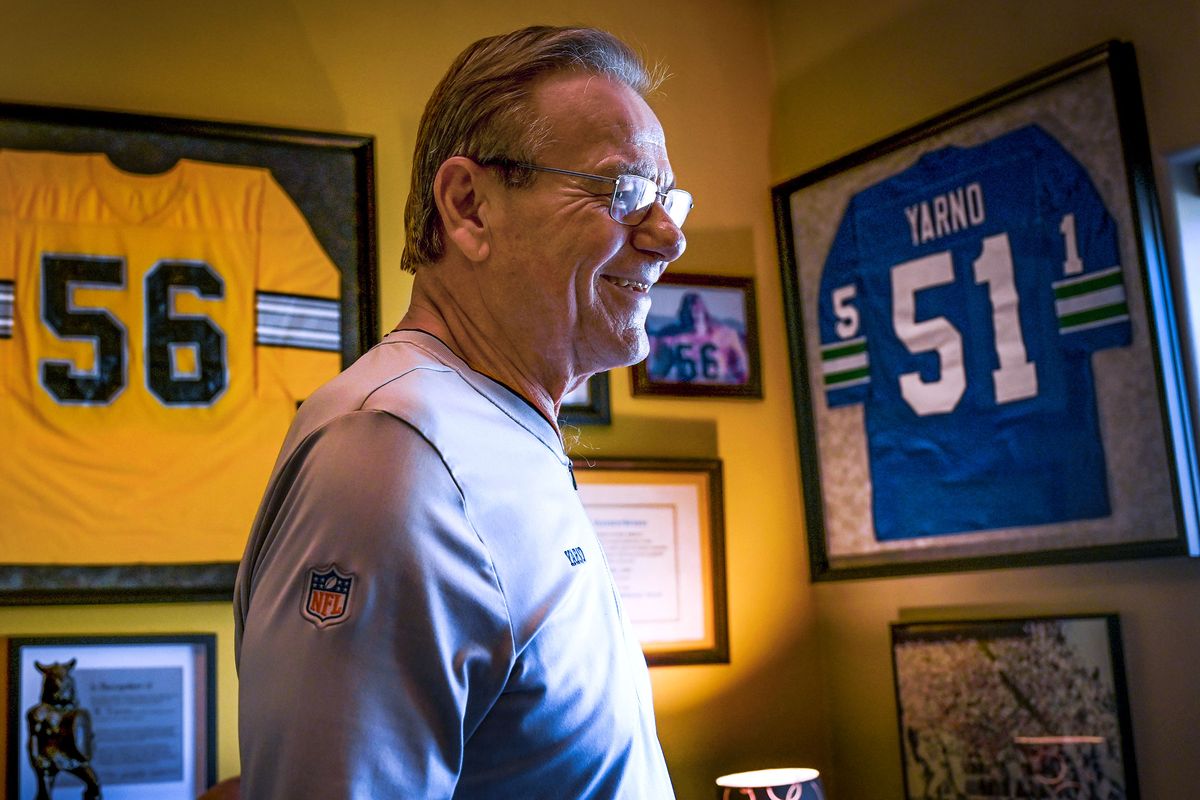
As a young Seattle Seahawk, John Yarno recalls lining up on a hash mark before games and rigidly holding his helmet in the crook of his left arm during the national anthem.
He remembers training camp two-a-days without water breaks in Cheney’s August furnace.
He thinks back to formidable Seahawks coach Jack Patera, who first made a name for himself as a rugged offensive lineman, then later as the architect of two of the meanest defensive lines in NFL history – the Los Angeles Rams’ Fearsome Foursome and the Minnesota Vikings’ Purple People Eaters – before arriving in Seattle.
You had to be tough, physically and mentally to be a Seahawk, he said. It was a much different era than today’s glitz-and-glamour NFL.
These were Yarno’s Seahawks.
Fresh off a 7-4 season in 1976 at the University of Idaho where, improbably, he was named the first-team center on the Associated Press All-America team – the gold standard of All-America teams – Yarno was the Seahawks’ fourth-round pick in their second season, in 1977.
“I thought I was going to Detroit,” he said. “I came in 1977. The staff was brand new. It was so exciting to be in Seattle. Everybody was so proud to be there.”
Coming off an initial 2-12 season as an expansion team, the Seahawks improved to 5-9 in Yarno’s rookie year under the taskmaster, Patera. Even at an imposing 6-5, 250 himself in an era when 300-pound linemen were rare, Yarno acknowledges, “I was scared of (Patera).”
“I was afraid of him, but he liked me, so I got a chance. It was a very competitive environment there, and I thrived on that when I was younger.”
Patera’s insistence that his team present a certain way for the national anthem instilled in him a thrill for the song that continues to this day, Yarno said.
The Seahawks trained at Eastern Washington University in those days, and there were advantages to being a local guy. Yarno, who played at Gonzaga Prep, said he could look out over the crowd at August practices and spot his father and friends.
He also forged a bond with his offensive line coach, Howard Mudd.
“He really believed in me,” Yarno said. “I got very close to him.” It was a relationship that endured until Mudd died in 2020. “I really got a lot from him. He was a big influence on my life.”
Those were the Jim Zorn-to-Steve Largent years, and if the Seahawks were not great at stopping teams, they were good at scoring points. When Yarno played, from 1977-82, the Seahawks put together back-to-back 9-7 seasons that helped them set the five-year record for expansion team wins.
“It was an exciting time to be in Seattle with that group,” Yarno said.
He survived a career-threatening knee injury in 1978, his first year as Seattle’s starting center.
“I was told, ‘You will never play again,’ ” he said. “But I came back and played five years on it.
“Now I have four artificial joints” – both shoulders and both knees – said Yarno. But he insists the toll on his body was worth it for the opportunity to experience the thrill of playing NFL football in a city that adored its new team.
“I was so lucky to go to Seattle,” he said.
The Seahawks, who will play in their fourth Super Bowl on Sunday against the New England Patriots, didn’t exist when Yarno was an offensive line mainstay at Gonzaga Prep and for much of his career with the Vandals. His favorite team then was the Green Bay Packers, and his favorite player was Jerry Kramer, the pride of Sandpoint High School and the University of Idaho, NFL Hall of Famer, and the starting right guard on Vince Lombardi’s near perennial NFL champs in the 1960s.
If a significant part of life is learning to navigate around disappointments, Yarno learned the lesson early in his football career. Bill Frazier was Gonzaga Prep’s legendary coach (1939-73) when Yarno played.
“I showed up to training camp as a freshman. I had never talked to him before,” Yarno said. His father and uncle had played center for Frazier, and Yarno said Frazier walked over to him that first day and said, “‘You’re Yarno, aren’t you? You learn to hike the ball,’ and he walked away.”
Yarno thought, “No, I’m going to be Jerry Kramer. The pulling guard. The sweep.” Playing in the middle of the line, however, worked out extremely well. Yarno continued as a center at Idaho, and he said appreciatively, “Idaho gave me a chance.”
As a center in a run-oriented veer offense, Yarno said his primary role in college was “to try to push the nose tackle into the back-side linebacker.”
It was a different game than the Seahawks played.
“I had to learn to pass block,” he said. “I had no coaching on that phase of it at Idaho. I enjoyed pass blocking. Dropping back in the pocket and start reading the defense.”
In the end, though, “the game is still the game. It is different in a lot of ways now, but you have to force your will on somebody who doesn’t want their will forced. Do you have that thing inside you? That’s football. Schemes change, but it still comes back to that. The desire to prove yourself,” Yarno said.
His Seahawks career ended in early 1983 when Chuck Knox succeeded Patera. Yarno played a season for the Denver Gold in the United States Football League then retired. He returned to Seattle for more than two decades before retiring to Coeur d’Alene.
He remains a Seahawk, though. He attended that Super Bowl in 2015. The Seahawks, trailing 28-24, had the ball on the 1-yard line with seconds remaining, and the battering ram that was Marshawn Lynch in their backfield.
“We were high-fiving. We were going to win the game,” Yarno remembers. Then the Seahawks came out in a spread formation.
“Where’s the fullback?” Yarno thought. Of course, Russell Wilson’s slant pass was intercepted by the New England Patriots’ Malcolm Butler.
In a way, falling short the way they did made the game resonate with Yarno’s Seahawks career.
“I never got that Super Bowl experience,” he said. “We were in a building environment when I was there. We were not a completed package. But the experience was amazing.”
The first three years he played in Seattle, Yarno said, he made so little money he had to work in the offseason.
“I never did it for the money,” he said.
Chasing that part of football, apparently, is eternal. Yarno has had the opportunity to meet with Kramer on a number of occasions. Kramer has always been welcoming, Yarno said, but once when Yarno was still playing, Kramer told him, “You can have all the rings, all the championships. I would like to trade places with you. I just want to do it again.”
“That has stuck with me,” Yarno said.