
Concert review: Technicality and vitality on display at Classics Northwest concert featuring pianist Piers Lane
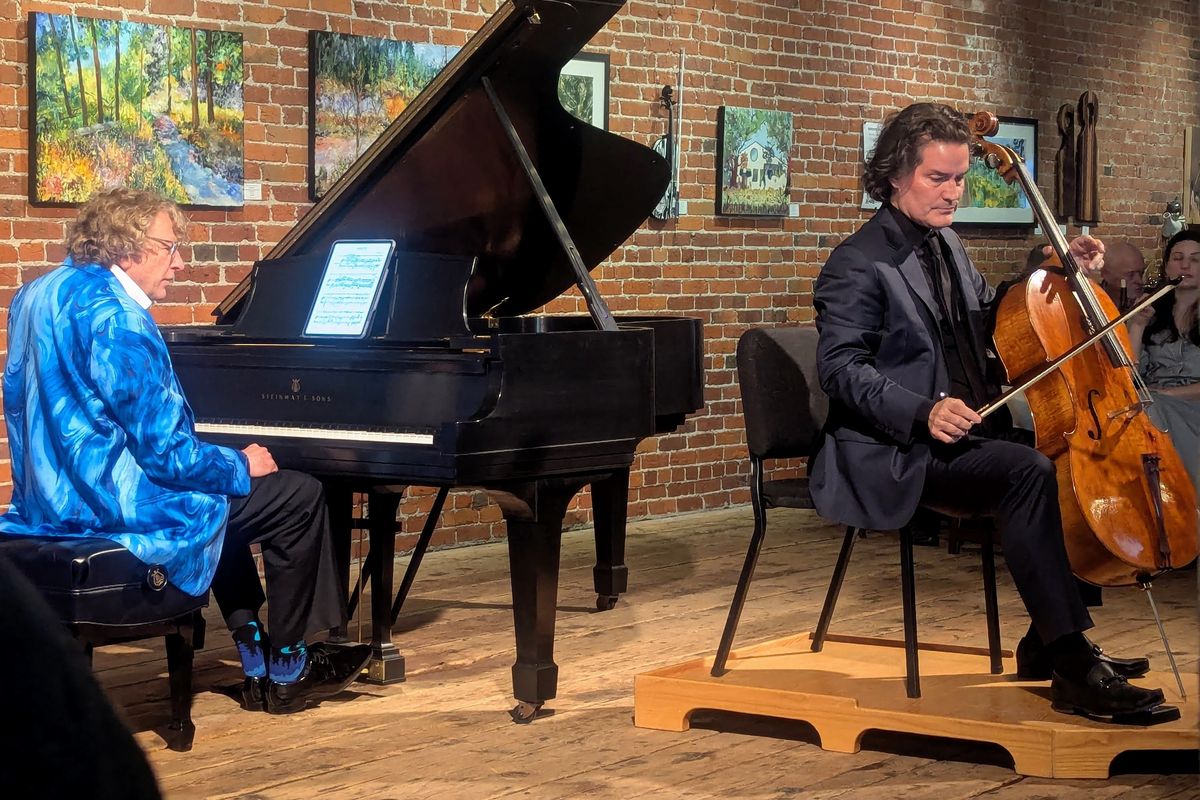
Like a springtime Santa, Zuill Bailey blew into town over the weekend, bringing with him his customary bag of gifts: irrepressible energy, a tireless pursuit of excellence and an abiding belief in the power of music to enhance our lives. Also as customary, he was accompanied by a member of his worldwide network of colleagues exhibiting the same traits. This time, it was the Australian pianist, Piers Lane, who last appeared under Zuill’s aegis some dozen years ago. At that time, he guided us through a tour of European music beginning with the crystalline clarity of Mozart and ending in the demented super-virtuosity of Leopold Godowsky.
This time, the program of a pair of recitals at Barrister Winery, featuring both Bailey and Lane, was much more narrowly focused on music of the Romantic era. Last week’s concert by the Spokane Symphony featured works by three composers of the Romantic era: Robert Schumann, his wife Clara and the other man who loved Clara, Johannes Brahms. Zuill Bailey obligingly filled in the mural of this era of musical history by programming works of Franz Schubert (1797-1828), Felix Mendelssohn (1809-47) and Frederic Chopin (1810-49). Even for us, living in a period of rapid progress, it is remarkable to consider that all of the masterpieces performed on Saturday and Sunday were composed between 1825 and 1847.
Both concerts were divided into two sections, with the first consisting of solo works performed by Piers Lane, who was joined after an intermission by Zuill Bailey to perform works for cello and piano. Saturday’s solo program was dedicated to works by Schubert: his Impromptu in G-flat major D. 899 and his Piano Sonata in D major D. 850 those numbers preceded by a “D” specify where the work can be found in a catalogue of Schubert’s works compiled by Otto Deutsch). From the opening measure of the Impromptu, the luminous tone produced by Piers Lane assured everyone present that the treasured repertoire they were about to hear would come to them from the hands of a master. While singing out Schubert’s melody, both serene and sad, Lane maintained the accompanying arpeggios both at a lower volume and softer touch. When Schubert’s tone darkened to suggest the tragic underpinnings of earthly happiness — a distinctive feature of all of Schubert’s late works — Lane managed to increase the volume of the music while maintaining the suffused, non-percussive quality of the tone.
In the D major Sonata which followed, the range of Schubert’s expression greatly increased, and with it our awareness of Lane’s skill. At one point in the second movement, for example, where Schubert asks the pianist to alternate the melody between the two hands, Lane altered the tone quality between the hands to preserve the balance between melody and accompaniment. While piano mavens might wonder at the technique required to render Schubert’s argument with such clarity and consistency, the average attentive listener heard no technique at all; only music that seemed to spring from the piano as freely and spontaneously as it did from the composer’s uniquely gifted mind and heart.
As Saturday’s program progressed, Piers Lane’s remarkable ability to convey the essential voice of the composer, rather than drawing attention to the charm, wit and sensitivity of his own personality, became more and more apparent. He remained seated quietly before the piano, regardless of the emotional temperature of the music. Unlike some fabled keyboard masters, he never looked heavenward to seek heavenly inspiration, or swayed to and fro in the grip of emotion. To have done so would have drawn attention from the music, and it was with the music alone, in all its richness, power and diversity, that Lane was concerned.
Sunday’s recital was devoted entirely to the music of Chopin, and, had one not been present on Saturday, one would have thought that Chopin was the only composer Piers Lane ever played, so completely did he command that composer’s unique lyrical voice and technical vocabulary. For the solo portion of the program, Lane chose to play a varied group of Chopin’s works that had been arranged for orchestra by Alexander Glazunov in order to create the score for a ballet entitled Les Sylphides. As a recital program, they offer a satisfying survey of Chopin’s incomparable attributes: the vocal quality of his melodies, which was much influenced by his love of Italian opera, and his ability to combine the melancholy of his Polish roots with the translucent gaiety of Paris, his adopted home.
Lane performed a demanding list of 11 pieces without interruption. Most were based on dance forms, as one would expect: A Polonaise in A major, followed by an assortment of waltzes, mazurkas and a tarantelle, with the addition of a nocturne and a prelude. Each presented its own technical challenges and interpretive demands, all of which were resolved by Piers Lane by answering a single question: What does the score say? By following that lodestar with resolution, by totally absorbing everything on the page and then bringing it to life with vitality, commitment and sovereign technical command, Piers Lane brought the whole of Chopin’s genius to the audience, which responded with a heartfelt ovation.
The second half of both programs allowed us to see the effect of joining Lane’s chamelion-like versatility with the powerful personality and distinctive voice of Zuill Bailey. In their performance of Mendelssohn’s early Variations Concertantes and his later Cello Sonata No. 2, Bailey and Lane acted as a prism, separating the composer’s blend of classical order and Romantic ardor into two channels, with Lane taking the first and Bailey giving voice to the second.
Never it seemed had Bailey’s cello emitted a greater rainbow of color or a more dramatic variety of expression. In the sonata’s third movement, a lyrical Adagio, it seemed that each note from the instrument had a life of its own, passing through changes of color and dynamics to tell its own story, before giving birth to the next note. In the final movement, the two players, equally in tune with Mendelssohn’s desire for an exhilarating conclusion, challenged one another to ever greater levels of velocity, without ever sacrificing clarity or accuracy. One hopes that the resulting response from the audience did not too greatly damage the roof at Barrister Winery.
In the Sonata in G minor Op. 65, his last completed work, Chopin sought from the cello the true legato sound — in which each note is seamlessly joined to those that precede and follow it — which throughout his life he attempted to achieve on the piano. Had he been present on Sunday afternoon, he would have heard his hopes realized by Zuill Bailey, most notably in Bailey’s performance of the Largo third movement which, for perfection of phrasing and subtlety of coloration, could serve as a standard for any musician, regardless of instrument.