
Dear friend of late ‘Train Dreams’ author recalls the history that led to film’s Academy Award nominations
Barb Rawlings was in disbelief when A-list actors William H. Macy and Joel Edgerton eagerly approached her at the Toronto International Film Festival in September. They had no shortage of questions about her late friend, Denis Johnson, the author behind one of the year’s most poignant films, “Train Dreams.”
“I was a little gobsmacked,” Rawlings said. “I’m just, you know, the dork from Bonners Ferry.”
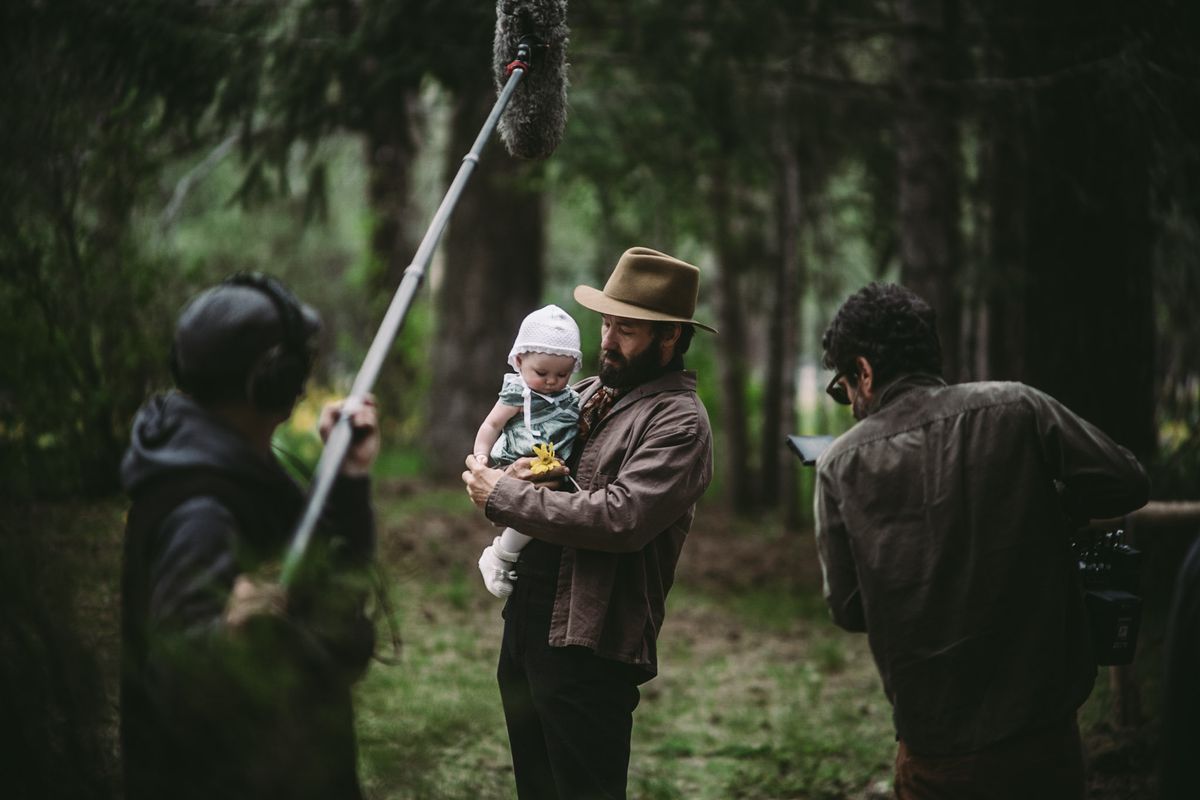
Adapted from Johnson’s novella, “Train Dreams” follows the life of Robert Grainier (Joel Edgerton) as he experiences loss, isolation and unexpected beauty in the rapidly evolving Inland Northwest during the early 20th century.
With a talented film crew operating at the top of their game – much being local to Spokane – director and screenwriter Clint Bentley crafted a critically acclaimed film, leading to four Academy Award nominations, including best picture.
On Friday, local audiences will get to experience Johnson’s novella come to life on the big screen at the Panida Theater in Sandpoint one last time before Sunday’s Academy Award ceremony and hear about Johnson’s life and the film’s historical significance in a postfilm discussion with Rawlings and “Train Dreams” historical consultant, Jack Nisbet.
Rawlings became friends with Johnson after he frequented the bookstore she and her husband owned in Bonners Ferry. She recalled Johnson would browse the shelves in his old, beat-up leather hat and leave after purchasing a stack of interesting books.
Rawlings and her husband invited him up for dinner one night, and the trio hit it off instantly.
“He was one of the most interesting people I’ve ever known. He could tell a story unlike anyone I’d ever met,” Rawlings said. “And he, of course, had all these outrageous, crazy, wild adventures that he would go on. And he was eminently engaging.
“He was always interested in what you had to say and curious.”
Johnson was inspired to write “Train Dreams” after reading a book about the history of Boundary County, Idaho. His imagination was captured after seeing photographs of the logging industry and the rapid changes it went through during the early 1900s, Rawlings said.
The story differed tonally from his other works, but it was a welcoming contrast for Rawlings when she first read it.
“I have to admit, a lot of Denis’ work is pretty intense and dark and a little difficult for me. And this one was just, I found it to be so beautiful. I loved his writing, but he could always be pretty dark, and this one captured my heart,” she said.
The novella was first published by the Paris Review in 2002 and then published in 2011 by Farrar, Straus and Giroux.
Rawlings remained close friends with Johnson until he passed away from liver cancer in 2017, and she keeps in close contact with his wife, Cindy. The pair were invited to attend the film’s premiere at the Toronto International Film Festival in September.
It was surreal having award-winning celebrities that worked on the film gravitate toward them to talk about Johnson, she said.
Whereas Rawlings’ involvement in “Train Dreams” is at a personal level, Nisbet’s journey with Johnson began when he received an email in 2021 from filmmakers Bentley and Greg Kwadar asking for his help with research for their next project.
Nisbet, a local teacher, naturalist and author, had read Johnson’s novella several years prior, but then revisited it immediately after filmmakers reached out.
Nisbet drove Bentley and Kwadar around North Idaho to give historical context to the circumstances of the logging world in the World War I and post-WWI era. He even drove all the way up the Moyie River from Bonners Ferry to Canada to give Bentley and Kwadar a visualization of Grainier’s world.
Colossal trees are present throughout Johnson’s novella, so Bentley and Kwadar were thrilled to see them firsthand as they towered overhead in a snowy landscape, Nisbet said.
Nisbet told filmmakers of the integral role the Kootenai Tribe played in the area, as well as in Johnson’s story, portrayed in the character Ignatius Jack (Nathaniel Arcand), who served as Grainier’s guide and savior after suffering the loss of his family.
“I tried to emphasize that the Kootenai were a big part of the tone of North Idaho and had been for 12,000 years or more. And they understood that … They aren’t an overt presence, but they’re implied throughout,” Nisbet said.
The history and guidance Nisbet provided laid the groundwork for the filmmakers in their adaptation of the novella. Despite being wary of its adaptability, Nisbet knew it was in the right hands.
“We spent a lot of time talking about what an impossible book it would be to make a film out of,” Nisbet said. “It’s a really abstract book, and I could tell that they had some ideas about it.”
Academy voters would agree that Nisbet’s instincts were correct, as Bentley and Kwadar received a nomination for best adapted screenplay.
Eileen Wheaton, a member of the North Kootenai Tribe, will also be present on the panel. A friend of Johnson, Sandpoint Magazine publisher Chris Bessler, will moderate the discussion.
Nisbet and Rawlings share the sentiment that the film begs to be seen on the big screen, where the beauty of the Northwest captured by Academy Award-nominated cinematographer Adolpho Veloso is on full display.
“Any film with a good cinematographer deserves to be seen on the big screen,” Nisbet said.
Rawlings is admittedly nervous to step up on the stage in front of the packed seats at Sandpoint’s historic theater. But she’s willing to endure it for her dear late friend.
“I feel honored to be able to speak about Denis,” she said.