
U.S. vows to block Iran’s attempt to shut down key global shipping route
WASHINGTON – The leaders of America’s war effort vowed on Friday to thwart Iran’s attempts to block the Strait of Hormuz, calling Iran’s move on the crucial shipping route “desperation.” But they did not offer any timetable to restore safe navigation for the vast oil exports that had flowed through the channel.
Defense Secretary Pete Hegseth said at a news conference that the disruptions in the strait were “something we are dealing with,” but added, “Don’t need to worry about it.”
His remarks came as the Trump administration sought to reassure a world lurching into crisis over surging oil prices caused by Iran’s retaliatory attacks on Gulf maritime traffic. Hours earlier, the administration had lifted some sanctions on Russian oil to try to bolster the global supply, dismaying European allies who wanted to continue punishing Moscow for the full-scale invasion of Ukraine.
At the same time, U.S. officials said they were sending more forces to the Middle East, while President Donald Trump continued his bellicose messaging.
“Watch what happens to these deranged scumbags today,” Trump wrote on social media shortly after midnight on Friday. “They’ve been killing innocent people all over the world for 47 years, and now I, as the 47th President of the United States of America, am killing them. What a great honor it is to do so!”
He did, however, back away from his frequent early calls for the Iranian people to rise up against their rulers. It was an acknowledgment that one of the original goals of the war, to replace the repressive regime, might have been harder than it seemed.
There are government forces in Iran that “go around with machine guns,” Trump said Friday morning in an interview with Fox News. “And they say, ‘Anybody protests, we’re going to kill you in the street,’ ” he added. “So I really think that’s a big hurdle to climb for people that don’t have weapons.”
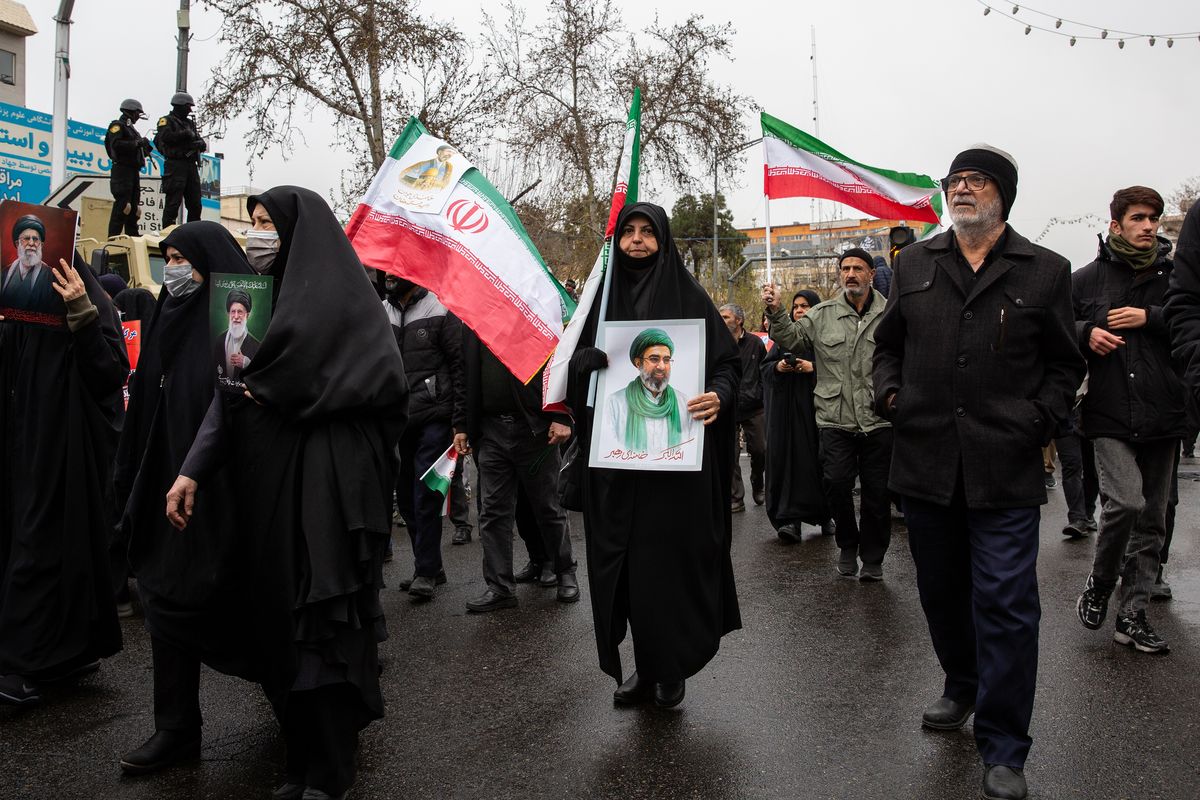
Hegseth said on Friday that the Iranian leadership was “desperate and hiding,” but that portrayal was at odds with the scenes in Tehran, where thousands of Iranians turned out for an anti-Israel rally as the sound of explosions resonated nearby. The attendees included the president, the top security official, the chief of the judiciary and the foreign minister, according to social media posts and Iranian news media.
The rally commemorated Quds Day, an annual, government-sponsored event held on the last Friday of the Islamic holy month of Ramadan. The country’s foreign minister, Abbas Araghchi, shared a video on social media of Iranians gathering for the demonstration, pumping their fists and defiantly chanting, “God is great,” as a large cloud of smoke possibly from a blast is seen in the sky.
In the Pentagon briefing on Friday, Hegseth said that the United States had hit 6,000 targets in Iran since the start of the war.
“Iran has no air defenses, Iran has no air force, Iran has no navy,” he said. “Their missiles, their missile launchers and drones being destroyed or shot out of the sky.”
Still, Iran continues to launch drones and missiles at Israel and other countries in the Middle East.
Gen. Dan Caine, the chair of the Joint Chiefs of Staff, said during the same Friday briefing that all six crew members of a U.S. aerial refueling tanker had died in a crash the day before in Iraq, raising the number of American service members killed in the war to at least 13. The crash was under investigation, U.S. Central Command said, which added that it had not been caused by hostile or friendly fire.
U.S. officials also said on Friday that about 2,500 Marines aboard as many as three warships were heading to the Middle East from the Indo-Pacific region. The Marines, whose deployment was reported earlier by The Wall Street Journal, will join more than 50,000 U.S. troops in the region.
Hegseth repeated the message that one objective of the war was to destroy Iran’s nuclear capabilities, but he declined to say how the United States would deal with the existing nuclear material in the country.
“We have a range of options, up to and including Iran deciding that they would give those up, which, of course, we would welcome,” he said.
A day after Iran’s state media published what it said was the first statement to the nation by Mojtaba Khamenei, the new supreme leader, Hegseth was dismissive of Khamenei and the entire Iranian leadership.
He called Khamenei a “so-called, not-so-supreme leader” and said the Iranian had been “wounded and likely disfigured.”
Markets have been unnerved by the spike in oil prices and the lack of a clear plan to clear the Strait of Hormuz. In addition to carrying around a quarter of all oil shipments, the passage is also a critical choke point for natural gas and fertilizer. U.S. officials have also given contradictory accounts of Iran’s military capabilities in the waterway.
A U.S. official briefed on intelligence said Thursday that Iran had begun to lay mines in the strait. On Friday, Hegseth said the United States had “no clear evidence” that Iran had done so.
But Iran has managed to strike at least one ship in the strait, and others carrying oil or cargo in or around the channel have been attacked, according to a British maritime agency, making many shippers afraid to go near it.
In order to help ease the oil shortage – the worst blockage of global oil flows in history, according to experts – the U.S. Treasury Department on Thursday issued sanctions exemptions to allow all Russian oil that was loaded on vessels to be sold and delivered around the world.
The move caused a rift among Western nations, with many of America’s allies calling for the sanctions to be reimposed. They are part of a package of measures designed to punish Russia for its full-scale invasion of Ukraine.
On Friday, Prime Minister Mark Carney of Canada, Chancellor Friedrich Merz of Germany and Prime Minister Jonas Gahr Store of Norway called for a restoration of sanctions on Russian oil. Merz said that all members of the Group of 7 nations except the United States opposed removing the restrictions.
Paula Pinho, a spokesperson for the executive arm of the European Union, described the lifting of sanctions as “a total strategic blunder.” President Volodymyr Zelenskyy of Ukraine said during a news conference on Friday that the move “certainly does not help peace.”
The effects of the expanding war, which have killed more than 1,800 people in the region – the majority in Iran – continued to reverberate on Friday.
NATO air defenses on Friday intercepted a missile fired by Iran that entered Turkey’s airspace, the Turkish defense ministry said. It was the third such interception of an Iranian missile over Turkey in 10 days.
In northern Iraq, an officer in the French military was killed and several others wounded in an attack, President Emmanuel Macron of France said on social media. The troops were in Iraq as part of the fight against terrorism, Macron said.
In Oman, a drone struck an industrial zone, killing two foreign nationals and wounding others, the state-run Oman News Agency reported, citing a security source. Oman has served as a mediator between Iran and the United States. It has faced fewer drone attacks than its neighbors.
And in Lebanon, the Israeli military escalated its attacks against the Iran-backed militant group Hezbollah, carrying out strikes beyond the group’s traditional strongholds, including parts of Beirut once considered comparatively safe.
More than 800,000 people have fled their homes in Lebanon, fearing the expansion of the war. Across the border, a missile attack in northern Israel on Friday damaged homes and injured dozens of people, Israel’s emergency medical service said. Hezbollah said that it had launched missiles toward northern Israel.
This article originally appeared in The New York Times.