
City of Post Falls looks to commercialize town museum, Historical Society balks
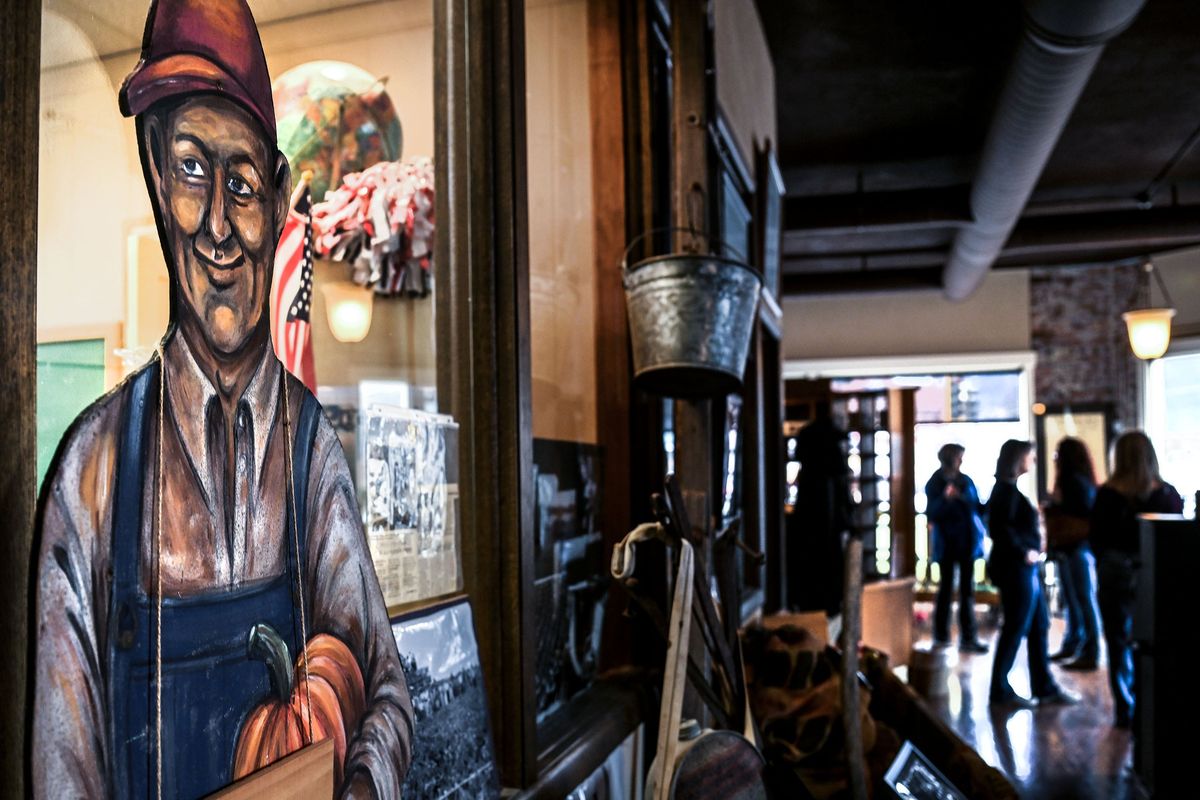
Weeks after Post Falls City Council opened a proposal period for new uses of the historic Chapin Building downtown, the current occupants – the Post Falls Historical Society – held an open house to drum up community support for their mission.
Dozens were in and out of the museum last Thursday, pausing to look at hand-carved canoes, old logging equipment and military memorabilia dating back to the civil war. Volunteer staffers knew many visitors by name, sharing life updates between snippets of historical information.
“This building is a part of Post Falls,” Liz Boutin, a longtime visitor, said. “It’s got soul.”
The Historical Society has occupied the city building, located at 101 E 4th Ave in Post Falls, since 2008, largely taking care of maintenance in exchange for rent forgiveness. But the 103-year-old building has suffered water leaks from its neighboring property and mold issues since before the society moved in. Last month, the city council voted to move forward with issuing a request for proposal on the building, opening doors for anyone to pitch a commercial use for the space.
City Council President Joe Malloy said that it is not the council’s intent to “kick the society out” or have the building not be a museum, rather, it hopes to “get creative” with ways to keep the building maintained.
“The short story is that the building needs a lot of maintenance and repairs are expensive,” he said. “The historical society or the city doesn’t have enough money to do them.”
If the city pays for repairs, that means an increase in taxes for residents, he said. If it doesn’t, it could mean a decrease in services. Combining the free-to-visit museum with a revenue stream of some sort could serve as a compromise between these “two opposing forces.” The example of sharing the space with a coffee shop has come up during city council meetings.
Alternatively, Councilman Marc Lucca suggested exhibits could be put on display in Coeur d’Alene’s North Idaho Museum for a wider audience, or perhaps in City Hall’s rotunda. While appreciative of the work the Historical Society has done for the community and hopeful for its future, he said “I don’t think that the city should be subsidizing a museum, because that’s not – I don’t think that’s our function.”
A charter member for the society, Kim Brown, said that she doesn’t believe it is the function of the government to rent property out, either.
“This is the taxpayers’ building. Do the citizens have a say in this?” Brown said. “This is why we have this open house today, it’s because – look, we put a lot of money into it. What are we going to say to our members who’ve been supporting us for 15 years with their artifacts, and with their money, and with their volunteer time?
“What do we say to them?”
The building is realistically too small to share with a coffee shop, Brown said, and might not even be up to food health code because of the continuing water leak. Historical Society president Kris King said that the nonprofit has put over 70,000 donation dollars into maintaining and repairing the interior of the building over the years. Members also have used grants for restoration projects around the town and gotten multiple city properties onto the National Register of Historic Places.
The Historical Society moved into the Chapin Building with the support of many former city administrators, Brown said, gesturing to the society’s charter, framed on the wall. The document has around 100 community signatures calling for the creation of the society in 1988. By will of the public during a comprehensive plan in 2008, the Chapin Building went to the society for preservation and museum creation after the city’s parks department left.
The Chapin Building was originally built as a drug store in 1923 by Walter F. Chapin, a local pharmacist. It was part of town founder Frederick Post’s original townsite plat. After Chapin moved out, the building acted as a gardening store, a laundromat, a school dance venue, the local police station and home base of town’s parks and recreation department before being taken in by the historical society.
“And we’re still standing because we do walk in the footsteps of the past,” Brown said. “So those pioneer efforts in even having a museum are in great part because of these folks saying, ‘yes, let’s do it.’ “
The society specifically had a “license to use” agreement with the city, meaning that it can be removed at any time. It’s always been “a little touchy,” Brown said.
Still, the Historical Society felt blindsided by the city administration’s decision to put out a proposal request for the space after 15 years of agreement. There has been “about zero” communication over the past two years, Brown said, despite members reaching out to have meetings with leadership.
“We were in negotiations with them for over two years, and then all of the sudden they come along with this proposal,” she said. “I don’t want to air dirty laundry, but I have worked with several mayors and we have had some of the green-lighters and some of the red-lighters. And this group is below red. I mean, geez, really.”
Post Falls Mayor Randy Westlund said that the city has talked with the society “a lot” over the past couple months. He said there is no bad will towards the society and that their work is “really important.”
“They are preserving a lot of local history that would otherwise be forgotten,” he said. “The mission is always going to be preserving the building and continuing to preserve local history to make accessible for residents.”
He aligns with the council on the use of the Chapin Building, though. No revenue means an increase in taxes for residents, he said.
“It’s sad because we are more respected at the state level than we are in our city council,” Brown said. “I think everyone is hiding behind tax dollars and, ‘Oh, we need money and, oh, we need this and that.’ Well, I’ll tell you what – we’re working with a group of volunteers. They’re doing this for free.”
The society is recognized at the state level, too. Don Pischner, former Idaho legislator and current trustee of the Idaho State Historical Society attended the museum’s March 12 open house. He pointed out that Brown received an Esto Perpetua award for her work in Post Falls – the highest historical award granted in the state.
Malloy said that the city council had not heard about the request for proposal until the Friday before their vote, the idea being pitched by city staff. City administrator Shelly Enderud said during her presentation to council that the society was open to moving artifacts to make them more readily available to the public.
Right before the vote, multiple council members said they were appreciative of the work the Historical Society does and want to support it in some way moving forward, regardless of outcome. Malloy said that if the request for proposal doesn’t yield any good solutions, “then we move on to Plan B” – which has yet to be developed.
“I do hope we can remain in the building and serve the public, visitors, students and newcomers,” Brown wrote in a follow-up email. “There is an old adage that Post Falls used to value. We are ” A pioneer town with a progressive spirit.” We have lots of development in all directions. We should not forget the pioneer foundation and multiple citizen chapters that are an important part of where we are today!”