
‘Stronger together’: Lewis and Clark girls tennis boasts 120-plus participants across varsity, JV and C teams | 2026 Spring High School Sports Preview:
It’s not always easy recruiting athletes for spring sports in the area. There are so many options available, so many demands for time on the student-athletes, and – let’s face it – the unpredictable and often inclement weather makes practice, games and spectating difficult on everyone.
But there’s one program in the area that is having no difficulty attracting participants – quite the opposite.
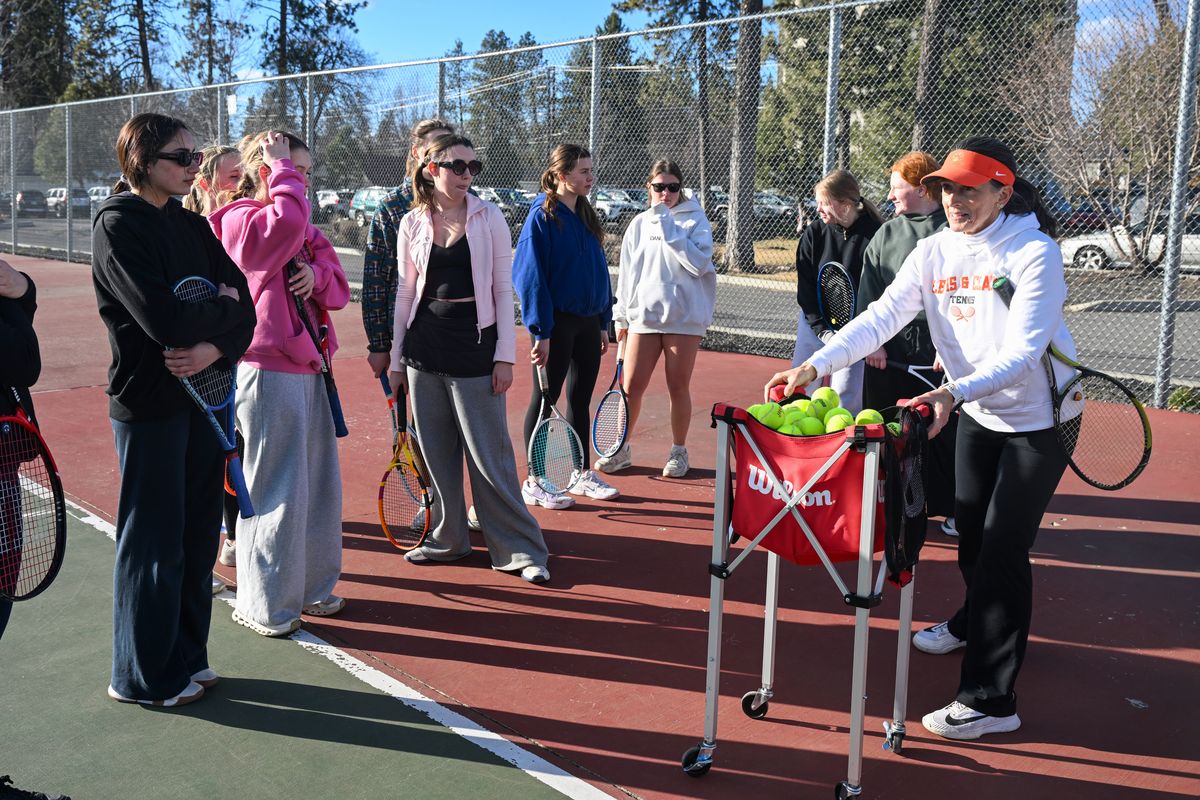
The Lewis and Clark girls tennis team is growing at an exponential rate. So much so that coach Kate Burns has enlisted school and district administrators to help find enough court space so that each member of her team – all 120 or so of them – finds enough practice time.
Burns has a robust varsity team, which she expects to finish at least in the top third of the league. Emma Chow has qualified for state each of the past two years in doubles, placing eighth last year, and singles players Daphne Rabinovitch and Laila Kaiel were regional qualifiers. All three are now seniors.
With only 10 varsity positions available, Burns said she has “about eight girls vying for four spots,” and the competition for those spots has been “very even.”
But the varsity team is only part of the equation for Burns, who has four assistants now to help her manage the JV and C teams – which make up the bulk of her participants in the program.
The Tigers girls tennis team is “attracting every type of student athlete,” Burns said – from complete novices to former club players to athletes from other sports.
“We’ve got girls who might have been barely introduced to tennis as a kid. Or left it because that’s not what their friends do,” Burns said. “We get a lot of juniors, even seniors, coming out for the team. We have girls who are burned out from other sports, and then they hear, ‘Oh, tennis is a lot of fun,’ and then they’ll come out. We have girls who have never even tried a sport in their life, and they come out for tennis.”
Burns even sees girls turning out in tandem because they’re more comfortable playing with a friend.
“They’ve heard about how fun tennis is before they even try out and then they get their good buddy to join tennis with them. And then so they come out, and they’re actually pairing up before they even get to us. … Then they’ll say, ‘Oh, yeah, this is my doubles partner,’ and so we always put them on a team together, so they can travel to matches together.”
Burns takes pride, and joy, in helping spread the love of tennis to new participants.
“Sports, especially for young girls, can be intimidating,” she said. “But I think the reputation of our program has filtered down, and so people hear how fun it is, and we get girls signing up for that.
“We’re stronger together, aren’t we? People learn that. They learn the cheers, and they get to wear the uniform, and they get to ride the bus together. … We just wanted to kind of bring girls into the fold and get them to be active, and get them to know athletics, and get them to know that yes, you can be strong and feminine.”
It’s all about “team” within the Tigers’ program.
“Tennis is an individual sport by its nature,” Burns said. “Andre Agassi, in his autobiography, said tennis is the ‘loneliest sport in the world.’ And so what we emphasize is that team culture. When we go to matches, girls have to stay and cheer each other on. We do team building exercises outside of the tennis court.
“We’re all welcome here. We support one another. It doesn’t matter. And what I tell my varsity – because of course, varsity is scored as a team. I tell my girls, ‘It doesn’t matter if you’re playing No. 1 singles, or if you’re playing No. 3 doubles – if you win your match, you earn a point for our team. So no one is more important than anybody else here. We’re all equal, and we’re all going out on those courts and we’re working hard for our team in order to get that point, in order to win the match.”
While the C team athletes are learning the game in a less stressful situation, some of those athletes aspire to move up to JV or even varsity.
“We have girls on our varsity team right now who started out as girls who showed up and didn’t know how to hold a racket,” Burns said. “But there are a lot of girls who don’t have that ambition or that drive to be varsity. They really just want to come out and do a social sport and have fun.”
Within the C team, Burns has set up “ladders” so that there’s a way for new and lesser-experienced players to gauge their progress.
“Some girls are getting the first taste of competition in their entire lives – healthy athletic competition, that is.”
Burns makes sure that every athlete in the program is subject to the same expectations within the overall team dynamic. Everyone is included – from the most experienced varsity member to the most novice. It’s yet another way of showing inclusivity.
“We truly try to treat the C team and the varsity with the same expectations. You know, you can’t have unexcused practices. You will show up to practice. You will be there to cheer on your teammate.”
Part of that is also providing an opportunity to experience real-life competition against peers from other schools.
“We’ve started a C team tournament,” Burns said. “The varsity has districts and regionals, the JV has a year-end tournament. And I was like, ‘Well, the C team, those girls, need a year-end tournament. So last year we put one on and it was so big … We started at 9 a.m. and we were here all day.”
But with that many student-athletes participating, the program has outgrown just practicing at the courts at Hart Field.
“When I started, we had 30 girls on the team, and it’s just been growing,” Burns said. “At first, we were like, ‘OK, we can have multiple shifts at Hart Field, and then we can also use Comstock (Park). But you can’t have 10 girls on a court.”
In desperation, Burns called Spokane Falls Community College after SFCC cut its tennis program. And she asked LC athletic director Marcus Scott to work with Spokane Public Schools to iron out the logistics.
“There were tennis courts there not being used,” she said. “And I got Marcus on that right away, and they figured out how to make it work so that Spokane Falls is technically one of our ‘home places.’ … They were amazingly accommodating.”
So how does she fund such a huge program?
“I write grants. The (United States Tennis Association) has given us money for the last three years because, like, I need rackets,” Burns said. “Some of these girls are showing up without rackets. The booster club – I keep going back. I need uniforms. The booster club, everybody, is supporting us, which is truly amazing.”
Burns can’t – and doesn’t – do it all herself. An all-female staff of five – varsity assistant/JV head coach Amber Eastham and C team coaches Gretchen Tempel, Toni Sharkey and Carolina Montufar – all share Burns’ passion for Tigers tennis.
“I have an amazing staff. From my first day, I’ve had an assistant (Eastham) who truly believes. She’s a former competitive tennis player too, and she believes in the vision as well. And so I couldn’t do it without my staff.”
Maybe the most amazing part of the growth is that it is all organic. Burns doesn’t work in the building at LC. There’s no recruiting in the halls, no posters, no pressure – just engaged student-athletes spreading the word of inclusion and togetherness.
“We don’t hold meetings. We don’t rah, rah. It’s been organic and word of mouth,” Burns said. “We truly just treat everybody with respect. We try to make it fun and they enjoy themselves, and they have good time with each other. And the girls just love being together. And I think they just really enjoy that team camaraderie.”