
Tails, wings and spreadsheets: At wing bee, biologists search for details on Washington’s forest grouse populations
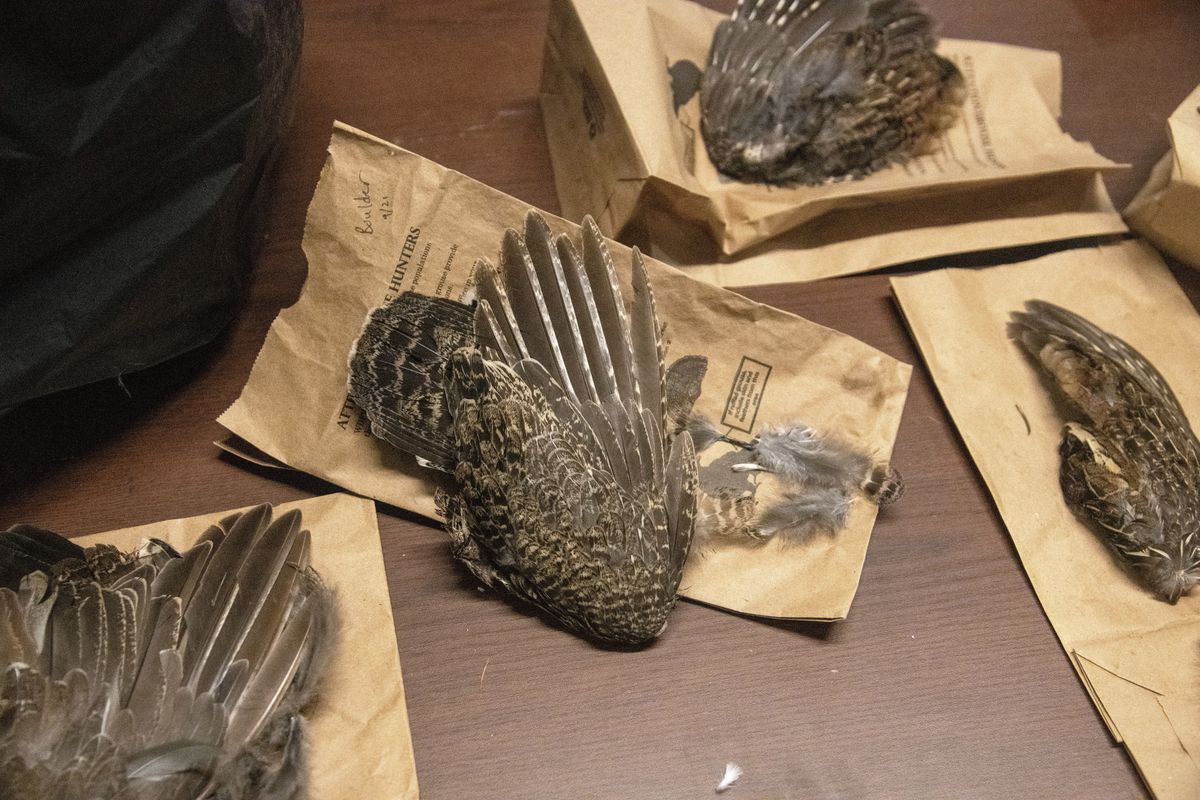
Matt Brinkman knew something was off as soon as he pulled the wing and tail out of the brown paper bag.
The bag was dated Sept. 18. A grouse hunter had dropped it into a Washington Department of Fish and Wildlife wing barrel near Bonaparte Lake. Some time later, it was moved to a freezer. On a recent Wednesday morning, it was brought to a warehouse in north Spokane, where it was to be processed alongside hundreds of other small brown bags containing grouse parts for WDFW’s east side wing bee.
A wing bee is about gathering information. Wings and tails contain a lot of it. Brinkman, a WDFW biologist, was one of about a dozen people tasked with searching each feathered appendage for signs that give away a bird’s species, sex and age.
Quantity also matters, which is why Brinkman was puzzled by what he’d just pulled out of a bag.
One bag is supposed to mean one bird. Instructions printed on the outside of the bags say so, with emphasis: “Use ONE bag for EACH bird.” But these parts didn’t match.
The wing appeared to be from a young male dusky grouse. The tail, with barred feathers in the center, looked female.
He showed them to Sarah Garrison, WDFW’s small game specialist and the boss of the wing bee. She agreed, but said two birds in one bag seemed unlikely.
“That’s an odd one,” she said.
She brought them to Mike Schroeder, a longtime WDFW grouse biologist and the final arbiter of the toughest of wing bee mysteries. He said the parts definitely came from two separate birds, and he had a theory: The hunter had probably killed two grouse and inadvertently mixed up their parts.
“They do that. They mix wings and tails in bags,” Schroeder said. “There may have been a different bag that they turned in, another mixed up tail and a wing.”
Moments later, Brinkman reached into another small brown bag. Same date, same location, same problem but inverted – a male tail and a female wing.
A quick comparison showed the species and ages lined up. Mystery solved. Two bags, two birds. On to the next one.
Over the course of the next few hours, a series of minor ornithological capers were dispatched as the group sorted through the various pieces of spruce, ruffed and dusky grouse.
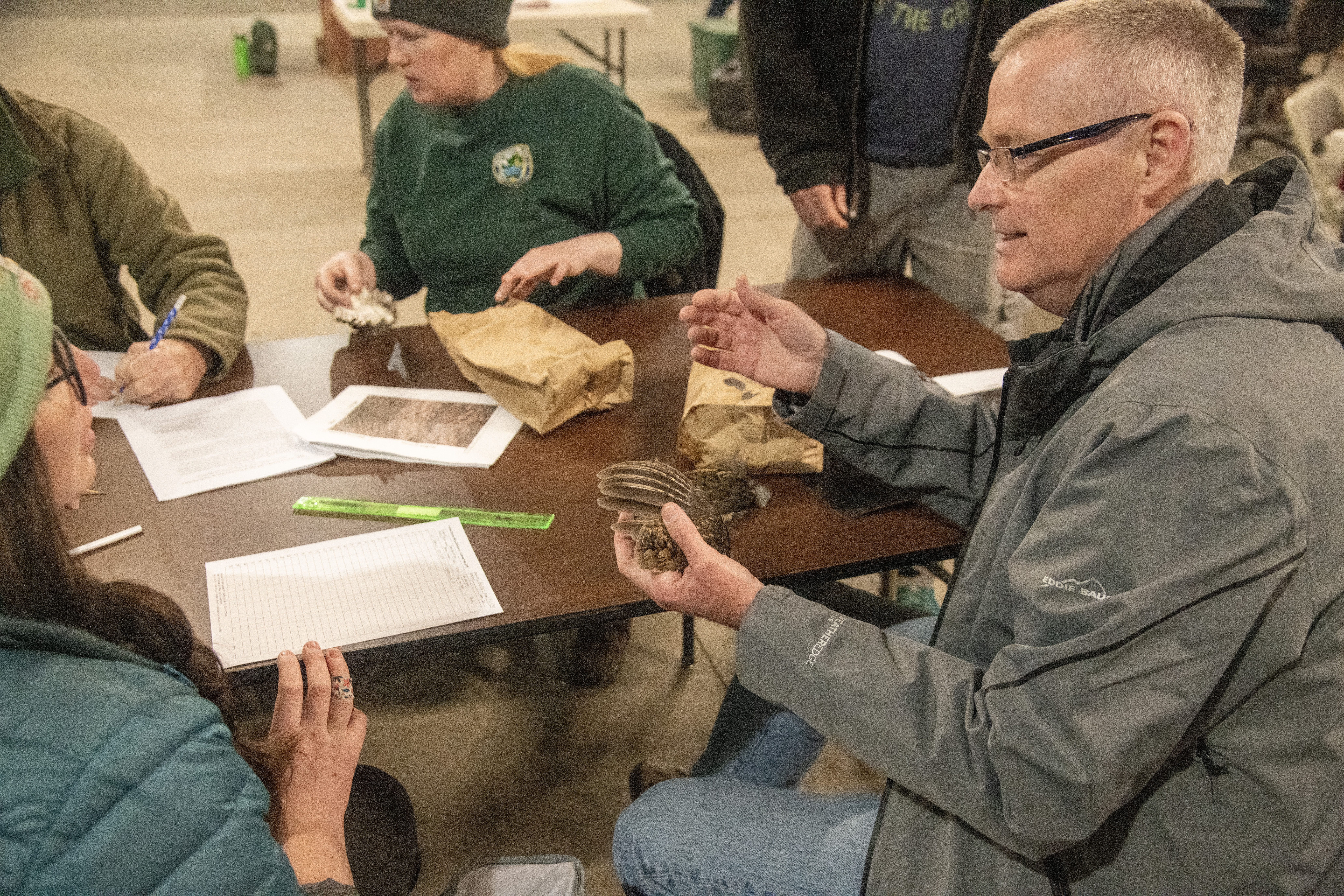
Some were easy. An obvious female adult ruffed grouse here, a juvenile male spruce grouse there. Others were more difficult, requiring lengthy discussions about things like the intensity of the mottling pattern on a set of covert feathers.
Once they knew the species, age and sex of a bird, they wrote it down on a spreadsheet. With each line, they added to a dataset that’s crucial in helping WDFW understand the makeup of the state’s grouse populations.
Annual hunter harvest surveys tell the agency how many grouse are being shot, which gives a sense of population trends. Wing and tail collections allow biologists to record finer details, such as the sex and age distribution among birds in a specific area.
The information has major implications. It was part of the reason Washington delayed the start of grouse season by two weeks starting in 2021 to protect brood hens and young birds.
They were seeing a lot of adult females and young birds getting killed early in the season. Delaying the start date was meant to give birds more time to disperse. So far, officials say the shift has been working.
The data also allows the agency to estimate grouse productivity rates. Because wings show a bird’s age, they can track the number of young birds that show up in barrels and compare them to the overall total. If there are a lot of juvenile wings, they can assume a lot of young birds hatched that year.
Garrison said that while overall grouse numbers have been on a long-term decline, those numbers have looked good in recent years.
“We have seen good juvenile production rates,” she said.
WDFW first put wing barrels out in the early 1990s in north-central Washington. Collections stopped in 2014 but restarted in 2016 with a wider focus, and have since expanded to the entire state. WDFW’s website now lists more than 60 barrel locations.
Hunters are encouraged to turn in parts from each bird they kill, but WDFW knows it doesn’t get every bird. Between 2016 and 2024, the agency collected a little more than 7,700 samples, according to its most recent status and trends report.
They come from all over the state. The week before she was in Spokane, Garrison led a wing bee on the west side.
“We get more (wings) on the East Side than the West Side generally,” she said.
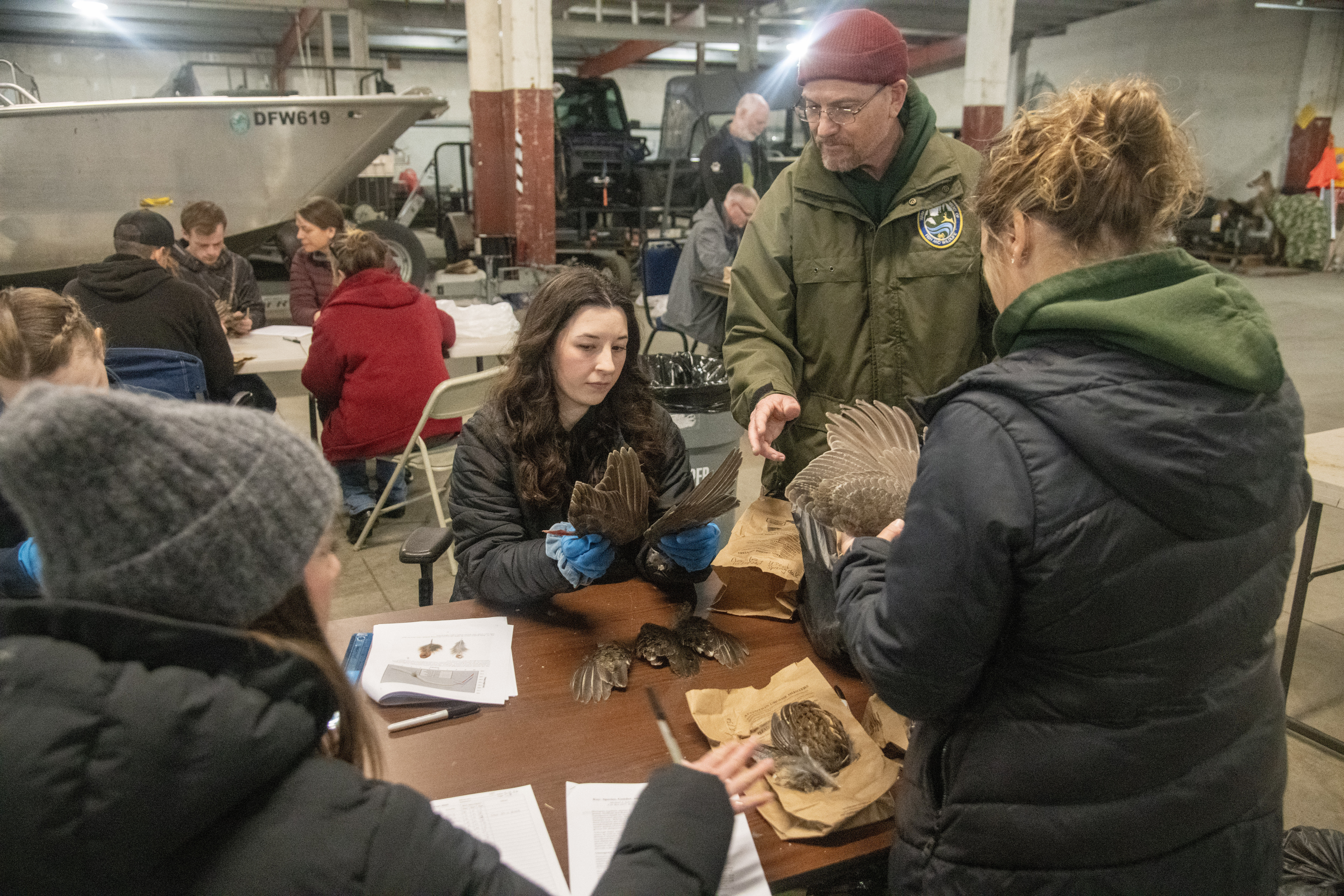
At the start of the day, there were about 20 trashbags strewn about the warehouse, all full of wings and tails. There were WDFW biologists from all over the state, one from the Kalispel Tribe and a handful of other WDFW staffers. Some were wing bee veterans. Others were rookies.
Distinguishing between the species is probably the easiest part. Because sooty grouse live mainly on the west side of the Cascades, the group only had to decipher between ruffed, dusky and spruce. Ruffed grouse have a white spot on the edge of certain feathers. Size helps with the other two – dusky are the largest of the three species, spruce are the smallest.
Age can be found by examining the primary feathers. Each wing has 10 primaries. On a juvenile bird, only eight of the 10 feathers go through molt – a process of shedding old feathers and growing new ones. If the ninth and 10th primary feathers have molted, the wing belongs to an adult. Adult primary feathers are also wider and rounder.
Telling males from females is tougher. The sex of a ruffed grouse can only be confirmed by looking at the tail. Two white spots on rump feathers signals male, while one means female. The black band on the end of the tail is another sign – if it’s broken, it’s a female.
For spruce and dusky grouse, tails help, but wings can spell the difference. Male spruce grouse wings have consistent barring patterns. Female wings are more blotchy.
Male dusky grouse feathers are more drab and gray. As with spruce grouse, the female feathers are more mottled. The only problem is that young male birds sometimes have a similar pattern, making them easy to mistake for females.
That’s the sort of problem that made the wing bee crew turn to Schroeder. He’s been working on grouse for more than 40 years. He did a graduate thesis on spruce grouse in the early 1980s, and he was behind the barrels that were put out in north central Washington in the 1990s.
Experience pays off. Wings that confound others sometimes look obvious to him.
“People get really confused,” he said. “The reality is there’s a lot of variation in these birds. You can take a female dusky grouse and you have all sorts of shades, from gray to brown or reddish. There’s just amazing variations.”
What hunters deposit in wing barrels varies, too.
Schroeder recalled seeing a sage grouse wing in a barrel near Wenatchee in the 1990s. Garrison saw a pheasant wing at the west side bee. In Spokane, not long after the case of the mixed up bags was solved, a wild turkey wing appeared.
Each bag was full of surprises. Maggots fell from some of them. A busted freezer in one WDFW office meant one batch of materials smelled worse than the rest.
There were a handful of fully intact birds, minus their breast meat. More parts than necessary. Carrie Lowe, another WDFW biologist, had one bag with the opposite problem: a tail with precisely two tail feathers.
“They probably shot it in the tail,” Lowe said.
Most of the samples arrived in the small brown paper bags, which are provided at wing barrels. Paper prevents them from decaying, which allows biologists to collect and freeze wings in the fall and wait until spring to process them.
Hunters don’t always follow the instructions printed on the outside of the bag, though. They forget to write down the date or the location, or they forget to separate their birds into individual bags. One bag that came to Lowe’s table contained five right wings, four left wings and a tail.
More than a few overstuffed bags came to Brinkman’s table. One held five wings and five tails. The good news was that they matched. Verdict: five juvenile dusky grouse.