‘It’s a lost art’: Chinook Steak, Seafood and Pasta Restaurant introduces dry-aged beef program in nod to Coeur d’Alene Tribe
Long before they were given the name “Coeur d’Alene” by French traders and trappers, they called themselves “Schitsu’umsh,” meaning “The Discovered People” or “Those Who Are Found Here.”
They fished and hunted across a vast domain. In the evening, the aroma of meat grilling over an open flame invited family and friends to come together, eat and share stories of the day’s adventures.
At Chinook Steak, Seafood and Pasta Restaurant at the Coeur d’Alene Casino Resort Hotel, executive chef Alex Santos-Cucalon celebrates that cooking method and has enhanced it with a centuries-old way of preparing meat: dry aging.
“The Chinook dry-aged steak program requires time, precision and patience,” he said. “These principles align with those of the Coeur d’Alene Tribe, aging beef the same way the land teaches – slowly, intentionally, respectfully.”
Dry aging beef dates back to the 15th century when it was referred to as the “hanging” of meat because the meat was hung on a hook to dry.
Technology has made the process much safer and more appetizing.
At Chinook, beef is placed in two state-of-the-art units.
HEPA-filtered air circulates continuously over Himalayan sea salt, while the temperature and humidity are carefully controlled. This process allows the meat to release moisture and inhibits microbial growth.
As time passes, enzymes in the meat break down and tenderize the muscle and connective tissue, resulting in a concentrated and savory transformation.
“It’s unique to our area,” Santos-Cucalon said. “It’s a lost art, and we wanted to show the craftsmanship of it.”
He noted that one or two other local venues serve dry-aged beef, but only Chinook ages it in-house.
“We started with the tomahawk cut – it’s the most sought-after cut of beef.”
He has dry-aged the huge 42- to 52-ounce steaks for up to 57 days.
“I tried it at weekly intervals,” Santos-Cucalon said. “You can really taste the meat development. It’s soft and tender with a rich, nutty flavor.”
Several other cuts, including rib-eye and New York strip, are also dry-aged.
The meat is then cooked over an open mesquite fire. The tomahawk, a meal for two, is carved tableside and lightly seasoned with black pepper and Maldon salt.
On April 30, Chinook hosted a media event to introduce the tasty results.
We walked past the dry-aging units on our way to our table and stopped to gawk at the impressive display of beef in various stages of the aging process.
After a light Caesar salad served with house-made rolls and butter, Santos-Cucalon presented a “steak flight.”
To show the progression of flavors, he started us with a fresh bone-in rib-eye – the kind you can grab at a supermarket.
The 16-ounce steak (and those that followed) were sliced at the table and served family-style, so every guest could have a taste without falling into a meat coma by the end of the evening.
It was a delicious, but the flavor quotients intensified with each new offering.
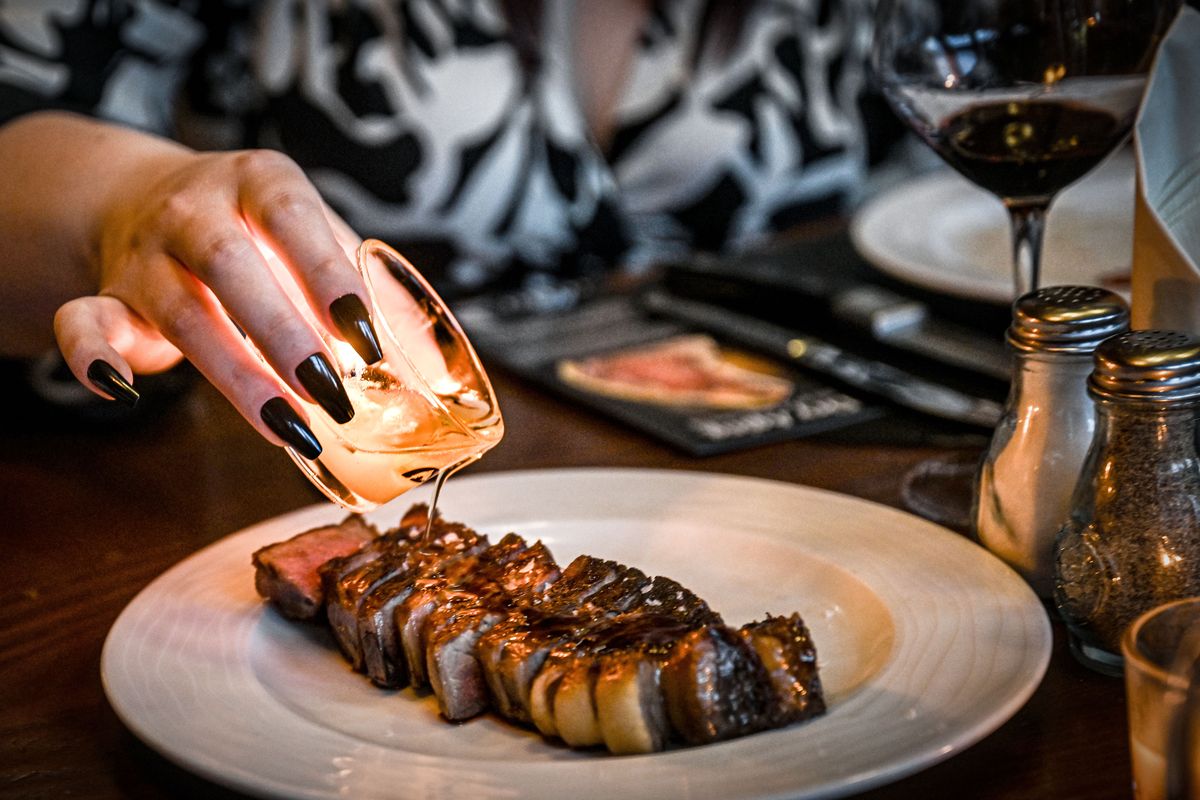
A 20-day-aged boneless rib-eye followed. Bone marrow butter candles, fragrant with rosemary, lined the table, and Santos-Cucalon urged us to pour the melted candle over the meat.
The brown butter flavor added an extra note of richness to the tender rib-eye. The candles ($5) are made on site and available for purchase at the restaurant.
Next came the impressive 35-day-aged, 51-ounce tomahawk, carved tableside.
The table hushed except for occasional happy sighs, as we savored each incredibly juicy, melt-in-your-mouth bite.
Last came a New York strip, aged 57 days. This cut was much denser but still tender, featuring earthier notes.
It’s easy to see why the dry-aged steaks have been a hit with diners. The restaurant is open Wednesday through Sunday, and if you want to try a dry-aged tomahawk, dining earlier in the week is best.
“We only have seven tomahawks available per week,” Santos-Cucalon said. “We’re already selling out.”
Marketing Director Yvette Matt said the dry-aging program aligns with their cultural tourism initiative and reflects the tribe’s desire to revive and preserve nearly forgotten traditions.
“We don’t want to lose who we are as we grow and expand,” she said.
Santos-Cucalon agreed.
“Dry-aging and cooking over an open fire is going back to our roots,” he said. “It brings home the feeling of family and being connected at the table.”
Contact Cindy Hval at dchval@juno.com