
ASL interpreters help with accessibility in theaters, but more advertising would go a long way
To make something accessible means to make it available for all. There are ramps and elevators for those with mobility aids, texts in Braille for those who are blind, accessible parking and restrooms.
At live performances, like a play, musical or concert, that accessibility comes via American Sign Language interpreters, who ensure members of the deaf and hard-of-hearing community don’t miss out on a single moment.
Interpreter Kim James took her first ASL course at Spokane Falls Community College to fulfill a foreign language requirement for her bachelor’s degree. Most people have one of two reactions to the class, she said. They either finish the class and think “Well, that was fun” or they think “I need more.”
James was in the latter group.
“I love languages and my mom always used to joke that I talk with my hands anyway so I might as well make sense,” she said.
James learned that she could work as an educational interpreter, an enticing option because it meant she worked the same schedule as her children. She got her interpreting degree and was hired by Spokane Public Schools, where she has worked ever since.
Interpreter Angie O’Bleness too began learning ASL on a bit of a whim. Her father taught at SFCC, so she decided to take classes there. She thought she would become a teacher but “fell into” ASL class and found it came naturally to her.
She completed the two-year program but was aware it would take her far longer to become fluent. This was before helpful tools like YouTube, so she trusted CODAs (children of deaf adults) to help her get involved in the deaf community.
After finishing at SFCC, O’Bleness earned a bachelor’s degree in ASL-English interpreting from the University of Northern Colorado and a master’s degree in ASL instructional studies from Western Oregon University.
Having previously taught ASL at SFCC, O’Bleness now teaches at Gonzaga University and Eastern Washington University. She has worked as an interpreter for Spokane Public Schools for 28 years now and is a freelance interpreter.
When not in the classroom, James and O’Bleness can be found in theaters around town acting as interpreters for deaf and hard-of-hearing members of the audience.
O’Bleness began interpreting plays and musicals in 1996 after an interpreter named Stephanie Smith led the way, as O’Bleness puts it.
James began her event interpreting work in 2014 as part of a volunteer interpreting group called By His Grace that would interpret concerts from Christian artists performing in town. She moved to theater events in 2018, beginning with “Beauty and the Beast” at Spokane Children’s Theatre.
James said she is typically introverted and would normally despise the spotlight, but while working as an interpreter, she has no problem being the center of attention because she’s embodying other people.
“It’s freeing,” she said. “I can put myself aside and convey all of what’s happening and lose myself in it. Then I go back to being me where I’d be like, ‘Do not put a spotlight on me. I do not want to be in the front of the room.’ But as far as interpreting goes, I’ve gotten to where I love it so much that I’m like ‘I don’t care. I’ll do it.’ ”
O’Bleness said not all interpreters are cut out for live events, as one must have large signs to be clear. Interpreters interested in working events are reviewed by a panel of deaf people to see if they’re up to the necessary standards.
“It’s a specialized type of interpreting,” she said. “Same with legal or medical. You’d want somebody who has a strong understanding.”
When preparing to interpret a show, James and O’Bleness, like the actors, begin by studying the script.
Interpreting teammates can divide a script many ways, including male and female characters, good and evil or children and adults. Some interpreters like to handle one act themselves and have their teammate handle the second, while others like to discreetly swap back and forth during the show.
Ultimately, they must find a balance so one interpreter isn’t handling a bulk of the show.
“Most plays generally are around 45 minutes to an hour for the first act and about 30 for the second act,” James said. “An hour is too long. Your brain cannot physically continue processing well (after) an hour of that continual input and output. You can’t do it. Also it’s really hard on your physical body.”
O’Bleness memorizes songs she doesn’t know, saying it can be difficult to hear songs during a live event. She doesn’t fully memorize the script, however.
James begins by signing songs however she would if there were no tempo to worry about, just letting her hands tell the story of the song through the first signs that come to mind. She then takes a closer look at each song.
English is all about words, she said, while ASL is about pictures, so she finds the signs to create the most accurate picture possible. ASL sentence structure is also different from English.
Instead of signing every word in the sentence “I’m going to the store,” James would instead sign “Store I go” to convey the same meaning. A deaf or hard-of-hearing person could request the interpreter sign every word as it was spoken, if that was their preference.
During the live event, James and O’Bleness work to accurately convey whatever is happening on stage through signs that are, for example, bigger when an actor is yelling and smaller when someone is whispering, and facial expression and what are called non-manual markers.
If James is signing for a younger or shorter character, she might look up while signing. If the character is older or taller, she might look down while signing. Signs for a character with a deep voice might be bigger, while signs for a sweet character might be accompanied by wide eyes.
“We try to incorporate the emotion, the dialogue, and you cannot buffer the message,” O’Bleness said. “If they’re slinging out F-words, F-bombs, you give it, because that’s what it is.”
They will sign to the deaf or hard-of-hearing audience member when music is playing before or during a song and change their signing to express the rhythm of the song being performed. Interpreters will also sign when there are loud noises on stage, like a slammed door or a gunshot.
If multiple characters are talking at once, interpreters can choose to sign individual lines they hear or make it clear they’re arguing on stage by signing “murmuring” or “Everyone is upset.”
As ASL is a living language, interpreters must stay on top of signs for new slang and phrases that arise. James and O’Bleness both look up signs frequently to make sure they’re still accurate and check in with the deaf community when they see a new-to-them sign.
“I ask them out of respect for their language,” James said. “You can learn more from them than anybody. No matter what you learn at college, you always learn more from the deaf.”
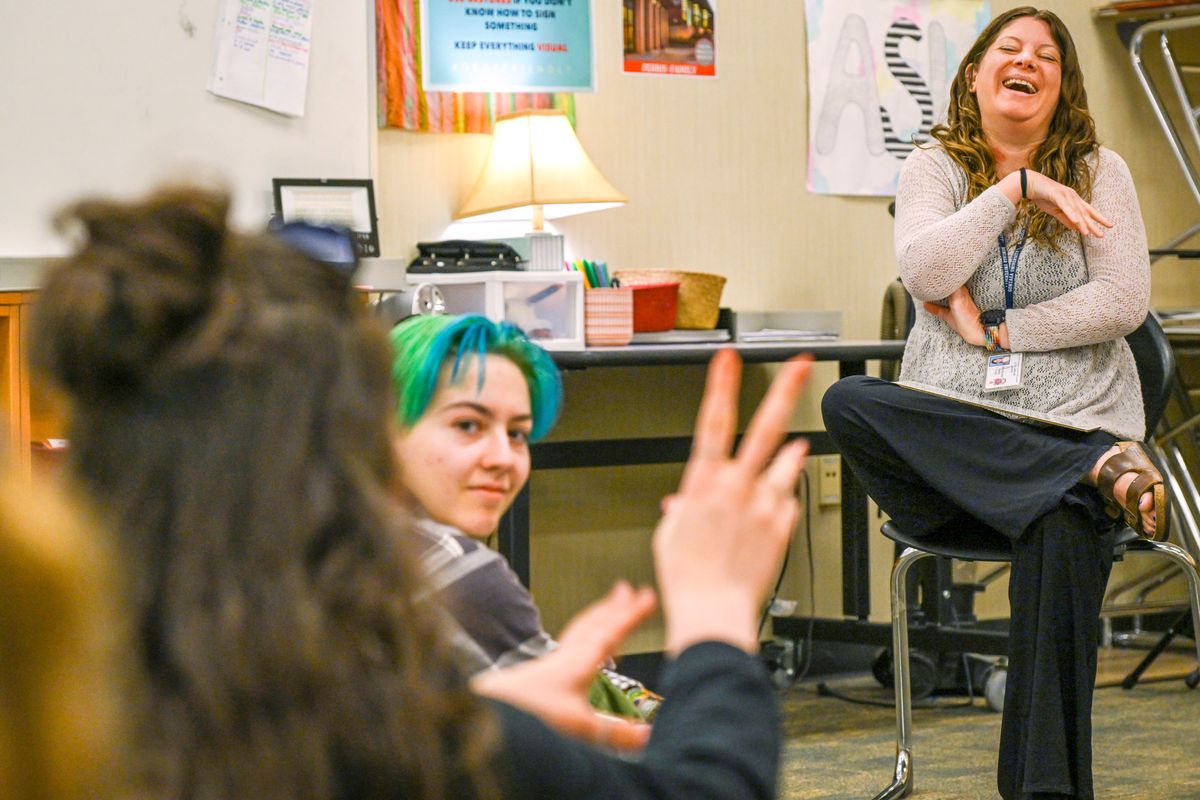
Bethany Hultz, who is deaf and teaches ASL at Ferris High School, relies on interpreters like James and O’Bleness when seeing live performances.
Growing up in a hearing family, Hultz learned ASL in fifth grade. Though she participated in a play while a student at the Delaware School for the Deaf and sang in choir, theater wasn’t something she was able to fully enjoy until much later because she didn’t then have the ASL knowledge to match that of the interpreters.
“I stopped going to the theater for a long time because I was like, ‘Oh, I don’t like it. It’s terrible,’ not realizing that it was a language thing,” she said in an interview interpreted by Jak Oritt.
After moving to Spokane, Hultz took her son to a production of “The Little Mermaid” at Ferris, which was ASL-interpreted, a show she said changed her life because she was fully able to access the show.
“The interpreting was spot on,” she said. “Sometimes it’s tough to watch the interpreter and also watch the show. I start getting drawn into the show, and then I’m missing everything that’s happening, or I start getting drawn into the interpreting and I’m missing what’s happening in the show, but I enjoyed it. It was my first theater experience that I really had enjoyed, and since then, I’ve made it more of a point to try to go to more things, because it was such a cool experience.”
Hultz looks for shows she can bring her children to, like “SpongeBob SquarePants: The Broadway Musical” at Spokane Children’s Theatre and “Hadestown” at Ferris, both of which were interpreted. Spokane Children’s Theatre’s next interpreted show is “Shrek the Musical” at 2 p.m. May 24.
Though Ferris productions are interpreted by interpreters like James and Oritt, Hultz said many of her students are involved in the drama department and are passionate about making their productions accessible to the deaf and hard-of-hearing community.
After realizing posters advertising a recent Ferris production didn’t let people know about the ASL-interpreted performances, Oritt said students made stickers with the information and placed them on every poster around the school.
When she attends live events, Hultz said she, for the most part, has little trouble finding seats in view of the interpreter. She’s been in town long enough that she knows who to talk to reserve the best seating.
The lighting of the interpreters has been fairly even, though, as she previously mentioned, she does sometimes miss moments onstage while looking at the interpreter or dialogue when she’s watching the action.
The biggest thing keeping Hultz away from the theater is the fact that many theaters don’t advertise when their ASL-interpreted shows will be. The ones Hultz ends up going to are ones that she’s told about directly with someone saying, “It’s this night. You need to show up.”
“A lot of time, they’ll have five, six, seven shows, one will be interpreted,” she said. “If I can’t go that night, then I’m going to miss that show. I know you can’t provide an interpreter every night, but it does make it a little bit trickier to be able to catch as many as we want to.”
Hultz can always request an interpreter for another performance, but that requires a significant lead time, she said, as the interpreter will need time to prepare, which isn’t always possible.
“It’s just how it is,” she said.
Oritt agrees this is an issue. He booked a job to interpret an upcoming Best of Broadway production last year yet he’s seen nothing advertising the date he will be at the show.
“I’ve seen that with other theaters as well,” he said. “I see so many theaters trying to be accommodating with interpreter access, but then they don’t talk about it. That makes no sense to me. We have interpreters, and we want deaf people to know about it.”
If she had enough notice, Hultz would be able to share those interpreted show dates with her students, some of whom want to become theater interpreters. Parents with deaf or hard-of-hearing children are also looking for opportunities for their children.
Hultz said a simple solution is to include notice of ASL-interpreted shows on all marketing materials related to a show, not just one announcement for the ASL-interpreted shows. She appreciates the interpreters for making theater accessible, but if the deaf and hard-of-hearing community isn’t made aware of when the interpreters are working, that accessible show becomes anything but.
“We want our deaf children to see this and go, ‘Oh my gosh, I can access this, and I could be a theater kid too,’ so to have that available is awesome,” Hultz said. “When I went to ‘SpongeBob,’ I saw a student that I knew from when I was a teacher of the deaf with his family, so there were several deaf kids there. More than likely people will take advantage of it if we know that it’s there.”