
Theater on the Verge’s ‘Hand to God’ explores heavy topics through humor, puppetry
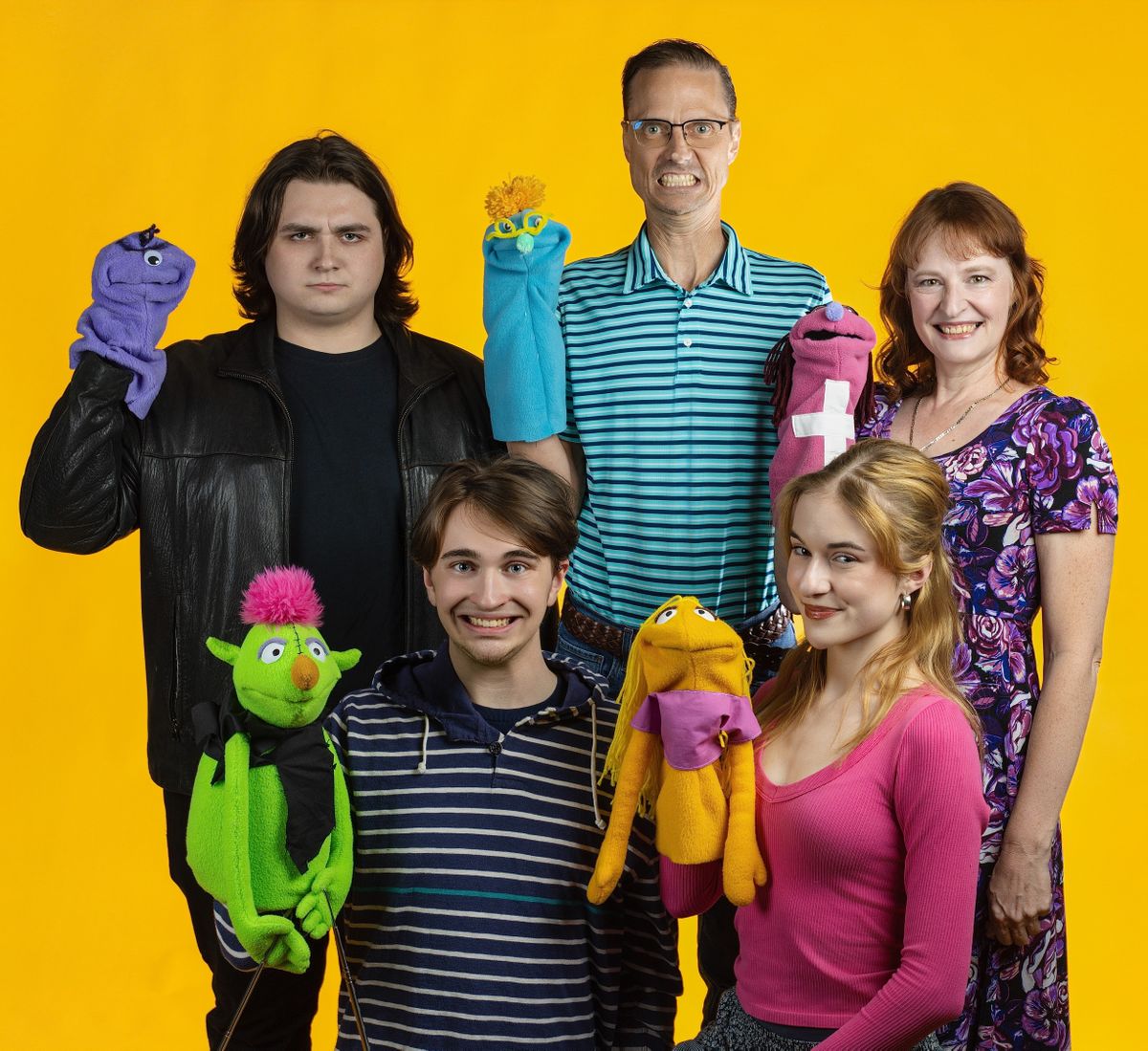
When the devil on your shoulder becomes the devil on your hand, in the form of a crass puppet named Tyrone, how do you get out from under its influence?
In “Hand to God,” written by Robert Askins, introverted teenager Jason (Declan Sheehan) is attending a puppet-making class in a church basement, taught by his mother Margery (Caryn Hoaglund). Dealing with the recent loss of his father and her husband, Jason and Margery are not in the best of spirits.
Also in class are the nerdy Jessica (Eleanor Weitz), who Jason has a crush on, and Timothy (Noah Graybeal), who bullies Jason and Jessica and is in love with Margery. Timothy only attends puppet class because he needs something to do while his mother is attending Alcoholics Anonymous meetings at the church.
In an awkward moment, Pastor Greg (Doug Dawson), the head of the small Texas church, successfully convinces Margery to direct a puppet show for the congregation and unsuccessfully convinces her to go out with him.
Later, Jason and Jessica are hitting it off until Tyrone tells Jessica how Jason feels about her, without mincing words. From there, Tyrone’s power over Jason starts to grow.
But who is really in control? Is Tyrone and/or Jason possessed or is Tyrone an alter ego?
After watching a run-through of Theater on the Verge’s “Hand to God,” I can say that the show is absolutely bonkers but also really sweet.
There’s puppets, sex and puppet sex. There’s also fighting and an attempted exorcism.
“Hand to God” is directed by Troy Nickerson and produced by Chris Jensen. The show features costumes by Tiffany Bubna, set design by Jeremy Whittington and lighting design by Kim Roberts.
Theater on the Verge’s production marks the play’s regional premiere. The show runs through June 6 at Hamilton Studio. Children 13 and younger will not be admitted to the show, and all minors must be accompanied by an adult.
Jensen learned about the show after Nickerson, who’d had it on his radar for a while, pitched it as a potential production for the company. Jensen read the opening monologue, which is performed by Tyrone. It hooked him right away and he told Nickerson the show was definitely promising.
After getting the rights to the show, Nickerson read the entire script and, in Jensen’s words, freaked out a little bit at just how dark the show is and wondered if they could pull it off. Nickerson and Jensen were both raised Catholic, with Jensen’s family eventually becoming Evangelical, and the pair found themselves running into sacrilegious moments that initially gave them pause.
“I was shocked,” Nickerson said. “I’m still a Catholic boy, and I have that history from Catholic school. At first, it was shocking to me, as it should be. And then, once I read it again and again and started seeing what the truth behind the shock was, it grew on me.”
Part of the reason the comedy works so well and something Nickerson is trying to explore in the show is that everyone is coming to puppet class with a lot of baggage and things they don’t feel they’re allowed to say in that setting.
“There’s this heaviness behind everything, and then Tyrone, the puppet, starts saying things you’re not supposed to say in there,” Jensen said. “It starts bringing out things in other people, almost giving them permission to start saying and doing the things that they otherwise might not. The play gives you permission to laugh at things that seem like we shouldn’t be laughing at, which is really lovely.”
Jensen worked with puppets while part of a youth ministry that traveled around Okanogan County putting on puppet shows during the summer. Nickerson made puppets for fun as a child.
To create the puppets used in “Hand to God,” Jensen and Nickerson reached out to Farren Obenland, who made puppets used in Spokane Civic Theatre’s production of “Rudolph the Red-Nosed Reindeer.”
Jensen called Obenland, just 18 years old, a wunderkind. The puppets he created are vibrant, expressive and able to withstand, put simply, a lot.
As the actor who interacts the most with his puppet, Sheehan was sent a puppet to practice with while finishing school at Ball State University in Indiana. He jumped into rehearsals in early May as soon as he was back in town.
“It’s rare to see a young person that can be such a good actor in a serious role but still have that Danny Kaye old-school character quality that you just don’t see in a lot of young actors,” Nickerson said.
Sheehan hadn’t heard of “Hand to God” before auditioning for the show while in town for his spring break but said it speaks to him. He was excited to tackle the technical challenges of the puppet and see how the show was more than just jokes.
Sheehan thinks many will look at him with Tyrone and think of Jekyll and Hyde, but in that instance, the actor is still one person. In “Hand to God,” Jason is always Jason and Tyrone is always Tyrone.
“Figuring out how to act for two has been an incredible challenge in this process, and every rehearsal I leave so drained because I’m putting everything into it,” he said. “I wouldn’t want to do it any other way, and he’s been such a joy to work with.”
“Oh, thank you,” Tyrone said.
“That was Tyrone, by the way,” Sheehan said. “He wanted to be part of this interview.”
Watching Sheehan go from Jason to Tyrone and back again is almost enough to give you whiplash. He’s able to so quickly change his posture and facial expressions, plus Tyrone has a New York/New Jersey accent and Jason has a light Texas drawl.
It’s very impressive and helps illustrate just how much control Tyrone has over Jason.
In rehearsals, Sheehan has become interested in exploring how we use tools and objects to represent our emotions. He’s done a lot of writing, for example, about the way he uses his hands throughout the show.
When he’s manipulating Tyrone, his hands are engaged the whole time. It has to be a conscious choice to let go of the rods attached to Tyrone that leave the puppet’s arms limp.
“When I have my own hand, what does that mean,” he said. “What agency do I now have that I didn’t have before? Figuring stuff out like that has also been so, so fun about this show.”
Hoaglund and Weitz were unfamiliar with the show before auditioning but seeing it was a production with Nickerson in the director’s chair was enough for them.
“There was some shocks of reading the script at auditions, and I was like, ‘OK, this is crazy,’ ” Weitz said. “I was like ‘YOLO’ in the truest form. ‘Let’s full send into the madness, because when else do you get to do that?’ ”
Like Jason may or may not be using Tyrone as a means of expressing himself, Weitz uses her clothing, saying she tries to dress however she needs to feel that day. Hoaglund is using the play itself as a tool to explore her feelings against organized religion.
“Once I got into this show, I had a lot of mixed emotions about doing this show, because I am a Christian, and I have a very strong Christian faith, but I hate organized religion with a fiery, fiery passion,” she said. “This show has been my tool, right, to deal with that for myself. For Caryn to deal with those emotions, this show has been a vehicle to be able to come to peace with this.”
Dawson, on the other hand, portrayed Pastor Greg in a production of “Hand to God” in San Antonio in 2018. He remembers admiring Askins’ writing when he first read the script and found Pastor Greg to be well-intentioned but lonely.
He’s trying to keep his church afloat and build community but he also has some ulterior motives.
“If you don’t look at that bad stuff and ignore it, it doesn’t go away,” Dawson said. “It grows, and so we see where there’s really good intentions here, and there’s a lot of brokenness that gets ignored.”
And when that brokenness gets ignored, it comes to the surface in some big ways.
The cast all expressed hope that audiences come to the show with an open mind and work to push through the shock value to get to the message.
Even with the at-times pearl-clutching humor, Jensen believes “Hand to God” takes faith, and people of faith, at their word.
Jensen anticipates a walkout or two during the show, and he understands the audience members who feel the need to step out. But having grown up in an environment similar to the one presented in “Hand to God,” he’s been enjoying finding humor in that environment.
“It’s something that caused me a lot of pain over the years, and I’ve come to terms with it in my own way and have gotten to a place of forgiveness around a lot of that,” he said. “To be able to come back to it and actually have fun with it is liberating.”