
Concert review: Classics NW ends its first season with musical exploration of beauty
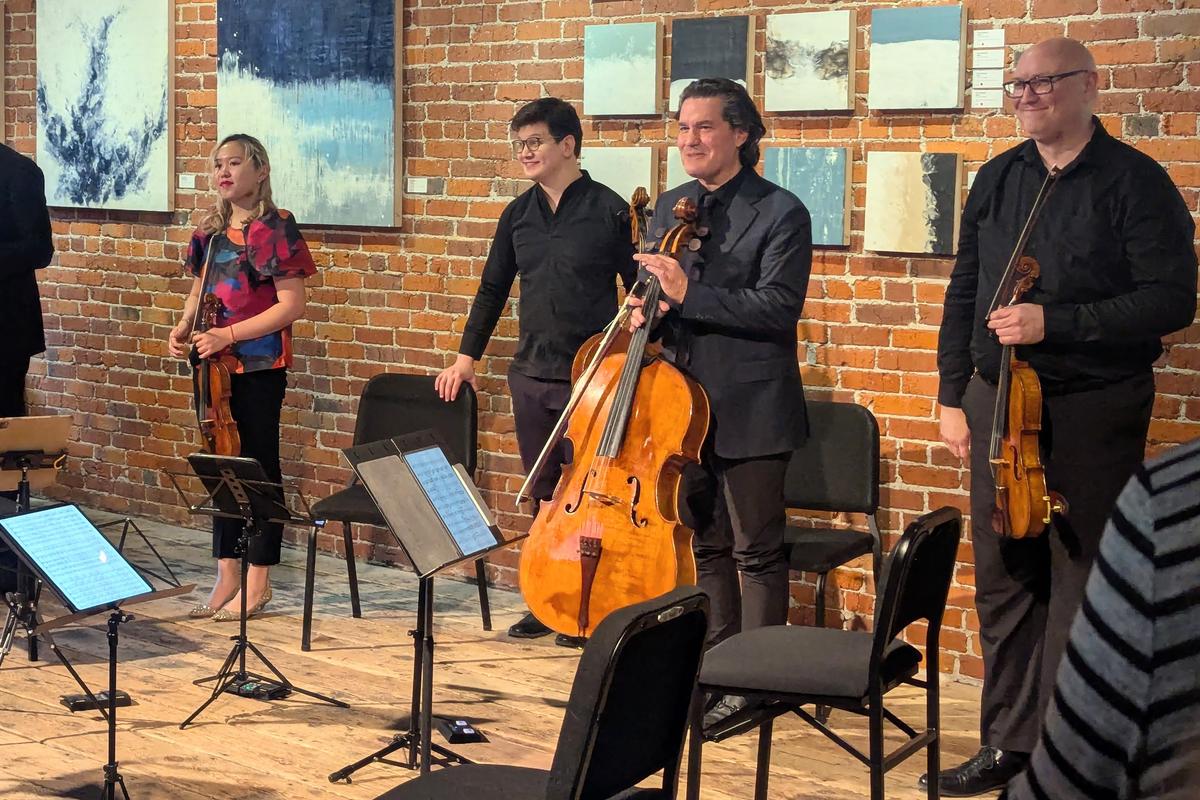
Perhaps it was the awareness that change was in the air. After decades of operating as the Northwest Bach Festival, Spokane’s year-round music festival was undergoing a change, both of name and as substance, to Classics Northwest, under its Music Director Zuill Bailey. Perhaps it was the appearance of Nick Carper, principal viola of the Spokane Symphony, who is admired by a cadre of followers. It cannot be denied, though, that the principal cause of the joyous and celebratory mood that permeated the weekend’s two final concerts in the 2025-26 season of Classics NW was the love of music that radiated from the Balourdet String Quartet, making its second appearance in Spokane. Its membership is happily unchanged: Angela Bae and Justin DeFilippis, violins, Benjamin Zannoni, viola and Russell Houston, cello.
The group’s two concerts in April of last year were characterized as much by their intense projection of emotion as by their mastery of all the technical, instrumental resources available to a string quartet at the very peak of its profession. One can report that both the emotional impact and virtuosic capability of the quartet are undiminished. If possible, they have only gained in their symbiotic ability to elevate an audience from where they sit to a higher plateau, from which they can view beauties of life which have become obscured by the ceaseless demands of the clock.
Both Saturday’s and Sunday’s programs, though diverse in the styles and periods from which they drew, were made up of music from the same categories: 1. String Quartets by Female Composers; 2. 19th century works for String Quartet; 3. String Sextets. In the first category were the String Quartet No. 2 (1994) by Eleanor Alberga (1949-) and the String Quartet in One Movement (1929) by Amy Beach (1867-1944). In the second category were the “Andante Cantabile” for cello and string quartet (1871) by Tchaikovsky, the second movement of Brahms’ String Quartet No. 3 in B-flat Op. 67 (1875), and Beethoven’s String Quartet No. 11 in F minor Op. 95 (1810).
To perform the string sextets, the Balourdet Quartet was augmented by the viola of Carper and the cello of Bailey. On Saturday audience member heard the glorious Sextet No. 1 in B-flat Op. 18 of Brahms (1860) and on Sunday, Tchaikovsky’s Sextet “Souvenir of Florence” in D minor Op. 70 (1890). Binding together such a varied and substantial program was the passionate commitment by the Balourdet Quartet and their colleagues to making every member of the audience feel as intensely as they do.
The sense of discovery was perhaps most evident in the quartets by Beach and Alberga. Beach was a pioneer not only in establishing a flourishing career as a woman in the male-dominated classical music establishment, but also as a visionary composer, open to the most advanced and enterprising trends in the music of her time.
Her only string quartet is brief but concentrated. It begins with a highly chromatic introduction of uncertain tonality, which is finally stabilized by the appearance of themes taken from the music of the Inuit. The power, simplicity and directness of indigenous cultures fuse with European techniques of musical development to create a vigorous and compelling central section, which is rounded off by a return of the meditative, questioning material of the opening section.
Alberga’s String Quartet No. 2 is plainly composed by a master of the most far-reaching and sophisticated techniques to have developed in the 65 years that followed the publication of Beach’s quartet. Alberga, a native of Jamaica, has long resided in England, where she has led a tremendously productive career as a composer, teacher and performer. It is plain from the performance of her second quartet that Alberga has immersed herself deeply in the quartets of Béla Bartok. She has not only achieved the technical mastery but also a degree of intellectual and spiritual integrity that stands comparison with those of the Hungarian master.
The Balourdet Quartet not only proved equal to Alberga’s extremely demanding string writing in the quartet, they – to borrow a phrase Rachmaninoff’s – “swallowed it whole.” The slashing bow strokes, complex polyrhythms, vertiginous passages at the upper extremities of the fingerboard, all were executed flawlessly, and never drew attention away from the rigorous exploration of the ideas and emotions which provided the music’s true reason for being.
To turn to the second category, Tchaikovsky’s “Andante Cantabile” was a star-turn for Bailey, who played Tchaikovsky’s gently melancholy themes with exquisite care, imbuing them with just the right balance of sentiment and stoicism. It was a great pleasure to hear him play out like the great soloist he is, with such full-throated ease – a degree of license in which he cannot take when striving to integrate himself into an ensemble.
This requires a greater degree of expressive modesty, as we saw when Bailey and Carper (who is a noted string stylist himself) joined the Balourdet Quartet in performing the two culminating works of the weekend’s concerts: the sextets of Brahms and Tchaikovsky. By programming these two blockbuster works, Bailey wanted to celebrate all that had been accomplished by the Northwest Bach Festival, while also creating a feeling of excitement and for what lay ahead for Classics NW: an even broader range of repertoire, embracing not only classics from the Classical tradition, but classics of other traditions, as well - folk, rock, musical theater – all music that is sufficiently well made, sincere and authentic to stand the test of time, “providing,” as Bailey said, “something for everyone in the region, while furthering our priority of making music accessible through education and community engagement.”
Both sextets are rich enough in melody and sonority to give tremendous pleasure and to create just the type of excitement Bailey intended. It is likely, however, that for many, the Brahms sextet fulfilled that goal more completely than did Tchaikovsky’s “Souvenir.” Tchaikovsky’s work is awash in gorgeous melody and infectious rhythm, but the Brahms sextet is the better-written piece. While Tchaikovsky pads the spaces separating one amazing melody from the next with repetitive sequences and formulaic modulations, Brahms employs his genius for development in constantly searching after and finding new beauties in every fragment of melody, and exploring endlessly the effects of combining one instrument with another. Brahms’ inspiration does not start and stop, but remains continuously active over long spans. This sort of integrity is experienced by an audience as taking a continuous journey of exploration and discovery, all the while ascending a steady incline of emotional involvement. The culmination of that journey was made audible on Saturday night with an explosion of applause at Barrister Winery that must have been audible in Ritzville.