Grilled to order
Barbecue guru and TV chef Steven Raichlen published a book several years ago titled “The Barbecue Bible.” It wasn’t. Sure, it had 500 recipes, but mostly for things beyond the average backyard barbecuer’s range, such as (actual recipe title) “Javanese Long Bean Salad Plate with Cabbage Wedges.”
Now Raichlen’s next cinder-block of a book, “BBQ USA” (Workman Publishing, $19.95) is out on the market. After owning it for six months, I can safely say:
“BBQ USA” is the barbecue bible. “BBQ USA” is one of the most useful barbecue cookbooks you can have on your bookshelf.
So, to sum up: Steven Raichlen’s “Barbecue Bible” ain’t the barbecue bible. Raichlen’s “BBQ USA” is.
“BBQ USA” would make an exceptionally fine Father’s Day gift for any dad who has ever stood at his grill, frowning at two burned chicken breasts.
This book is useful for its 425 recipes, some of which we will include at the end of this story. Yet it is also an incredible fount of information about some of the general principles of barbecuing, such as:
How to grill a boneless, skinless chicken breast – This simple problem has baffled home grillers for decades. A lot of chicken has been charred into leather over the years. “BBQ USA” has not just one, but three foolproof methods for doing chicken right:
1. Pounding the breasts thin with a mallet and then marinating and quick-searing them.
2. Brining them.
3. The most wonderful method of all, grilling them under a brick.
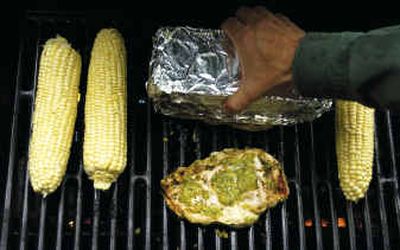
That’s right, a brick. I tried it last week and ended up with the moistest, most tender, most flavorful chicken breast I’ve ever grilled. You just set a brick (covered with foil) on top of the chicken breast and then cook it hot. The brick flattens the chicken out so you can cook it faster and hotter. It also keeps the moisture in.
If you don’t have a spare brick, it might be worth dismantling your house.
Yes, it works that well. See “Green Chile Chicken Under Bricks” recipe, below.
How to barbecue a “foolproof” chicken – “BBQ USA” has a number of recipes for whole or half chicken, including some delicious variations on the “beer-can chicken.” We fired up this book’s “Cajun Roastin’ Chicken on a Beer Can,” for a bunch of college students recently, and they sucked every last morsel of moist meat and spicy skin off of that bird. We had nothing left but a pile of naked bones. Get yourself a Cajun injector and try the recipe below.
But it also has a terrific all-around barbecue chicken recipe called “Foolproof Barbecued Chicken,” which calls for cooking half-chickens slowly over indirect heat. (Not completely foolproof, as I discovered, if you don’t make the fire hot enough.) See recipe below.
Raichlen also offers three other general tips for grilling chicken:
1. Work over a moderate, not hot, fire.
2. Don’t crowd the grill.
3. Apply sweet sauces at the end of cooking so they don’t burn.
How to easily grill vegetables – Have you ever tried to grill, for instance, asparagus? The spears roll around, fall through the grate and get done too much on one side and not at all on the other. Raichlen offers this simple tip: Skewer the spears into a kind of “raft.” Then you can turn them all over at once, in one piece.
How to get that Ivar’s Salmon House flavor – The secret here is a marvelous concoction called citrus butter, tangy with flavors of orange, lemon and lime juices. Try it with a Copper River king or sockeye filet. And if you have access to some alder wood, you’ll really have that famous Ivar’s quality. See “Alder Grilled Salmon with Citrus Butter,” below.
How to use ingredients in barbecue you never imagined – How about coffee grounds? See Coffee-Crusted Pork Tenderloins below, which were a super-caffeinated hit at a recent 20-person barbecue in my back yard.
And finally:
How barbecue got its name – Raichlen has a well-researched opening chapter that lays to rest the issue of the origins of barbecue and how it got its name. He quotes a young Spanish adventurer in 1526 who went to the Caribbean islands and wrote: “They roast the flesh (of deer and pigs) on sticks they place in the ground, like a grating or trivet, over a pit. They call these barbacoas, and place fire beneath, and in this manner they roast fish also.”
If that isn’t barbecue, then I don’t know my barbacoa.
Here are just a few home-tested recipes from the book:
Coffee Crusted Pork Tenderloins
Adapted from “BBQ USA”
1 1/2 pounds pork tenderloins
3 tablespoons ground coffee
1 tablespoon coarse salt (kosher or sea)
1 tablespoon dark brown sugar
2 teaspoons sweet paprika
1 teaspoon black pepper
1 teaspoon garlic powder
1 teaspoon onion powder
1/2 teaspoon ground cumin
1/2 teaspoon ground coriander
1/2 teaspoon unsweetened cocoa powder
2 tablespoons canola oil
Place the tenderloins in a baking dish. Place the coffee, salt, brown sugar, paprika, pepper, garlic and onion powders, cumin, coriander and cocoa into a small bowl and stir to mix. Sprinkle this rub all over the tenderloins, patting it into the meat with your fingertips. Drizzle the oil over the pork and rub it on well. Let the pork marinate in the refrigerator, covered, for at least four hours or as long as overnight.
Set up the grill for direct grilling and preheat to medium-high. (Use wood chips to make smoke if you have them). Brush and oil the grill grate. Place the pork tenderloins on the hot grate and grill until cooked through, about 3 to 4 minutes per side, or 12 to 16 minutes in all. This can vary greatly depending on your fire; a thermometer inserted in the meat should read 160 degrees.
Transfer to a cutting board and let rest for three minutes. Slice on the diagonal and serve.
Yield: 4 servings
Approximate nutrition per serving: 282 calories, 12.8 grams fat, (2.5 grams saturated, 42 percent fat calories), 35 grams protein, 4.9 grams carbohydrate, 97 milligrams cholesterol, .4 grams dietary fiber, 652 milligrams sodium.
Cajun Roastin’ Chicken on a Beer Can
Adapted from “BBQ USA”
1 can of beer
1/2 cup chicken stock
2 tablespoons salted butter
1 tablespoon brandy
7 teaspoons Cajun rub (or any Cajun or Creole spice blend)
1 teaspoon fresh lemon juice
1 roasting chicken, 6 to 7 pounds
3 tablespoons melted butter, for basting
Pour half the beer over hickory or other wood chips to soak. Set the rest of the beer can aside.
Combine the stock, butter, brandy, 1 teaspoon of the rub, and lemon juice in a pan and warm until the butter is melted. Stir and let cool.
Prepare the chicken by removing the packet of giblets, rinsing with water and patting dry. Sprinkle 1 tablespoon of the rub inside the body and neck cavities.
Take a kitchen syringe (a “Cajun injector”), fill it with the stock-butter mixture and inject it into the breast, thighs and drumsticks. Brush the outside of the bird with 1 tablespoon of melted butter and rub with the remaining tablespoon of Cajun rub.
Hold the bird upright and lower it onto the can so the can fits into the body cavity. Pull the legs forward to form a sort of tripod so the bird stands upright. Tuck the wings behind the chicken’s back.
Set up the grill for indirect grilling and place 1 cup of the wood chips on the coals or in a smoker pouch on a gas grill. Put a drip pan in the center, if using charcoal, and put the bird over it. If using gas, set the bird on a part of the grate away from the direct flame. Stand the bird upright, propped on its beer can.
Cover the grill and cook until golden brown and very crisp and the meat is cooked through, 1 3/4 to 2 hours, or until the internal temperature is 180 degrees. (This can take much less time with a very hot fire, and seemingly forever with a mediocre fire).
As it cooks, baste with the melted butter at 45 minute intervals. If the chicken skin starts to get too brown, cover it with aluminum foil. Replenish the charcoal and wood chips as needed.
Using tongs, hold the bird by the can and carefully transfer the chicken in an upright position to a platter. Let it rest for 5 minutes and then lift it off the can. (Don’t spill the hot beer on yourself). Carve and serve.
Yield: 6 servings
Nutrition per serving: Unable to calculate.
Foolproof Barbecued Chicken
Adapted from “BBQ USA”
1 chicken (3 1/2 to 4 pounds)
1 1/2 teaspoons coarse salt
1 1/2 teaspoons sweet paprika
1 1/2 teaspoons brown sugar
1 teaspoon black pepper
1/2 teaspoon garlic powder
1/2 teaspoon onion powder
1/4 teaspoon celery seed
Mop sauce (recipe follows)
Dr. Pepper Barbecue Sauce (recipe follows)
If using a whole chicken, remove giblets and cut the chicken in half. You can also use quarters or pieces. Rinse inside and out, blot dry, and place in a baking dish.
Combine the salt, paprika, brown sugar, pepper, onion and garlic powder and celery seed in a small bowl and mix. Set aside one tablespoon of the rub for the mop sauce. Sprinkle the remaining rub over the chicken on both sides, patting it into the meat with your fingertips. Let the chicken cure in the refrigerator, covered for 1 to 2 hours.
Set up the grill for indirect grilling. Use a large drip pan in the center if using charcoal. Throw some wood chips on the coals if you have them, or use a smoker pouch with a gas grill. Preheat to medium,
Place the chicken halves or pieces in the center of the hot grate, skin side up, away from the heat. Cover the grill and grill the chicken until cooked through, 40 to 60 minutes (this can vary widely depending on the temperature of your grill). Test for doneness with a meat thermometer; it should read 180 degrees in the thickest part of the thigh bone. Baste both sides of the chicken with the mop sauce after the first 20 minutes and every 10 minutes thereafter. During the last three minutes, brush with 1/2 cup of Dr. Pepper Barbecue Sauce. Move the chicken pieces directly over the fire to sizzle and brown the sauce on both sides.
Transfer to a platter and let rest 3 minutes. Serve with barbecue sauce.
Yield: 2 to 4 servings
Nutrition per serving: Unable to calculate
Mop Sauce
1/2 cup distilled white vinegar
1/4 cup Worcestershire sauce
1 tablespoon rub (reserved from above)
Combine the vinegar, Worcestershire sauce, and rub with 1/2 cup water and stir until salt and brown sugar dissolve.
Dr. Pepper Barbecue Sauce
Adapted from “BBQ USA”
1 large juicy lemon
1 clove garlic, peeled and lightly crushed
1 thin slice of onion
1 cup of Dr. Pepper (not diet)
3/4 cup ketchup
3 tablespoons of Worcestershire sauce
2 tablespoons of A1 steak sauce
1 tablespoon of your favorite hot sauce
1 tablespoon cider vinegar
1 teaspoon liquid smoke
1/2 teaspoon black pepper
Coarse salt
Cut the lemon in half and cut a 1/4 -inch slice out of one half. Juice the remaining lemon. You should have 2 to 3 tablespoons of juice.
Place the lemon slice, 2 tablespoons of lemon juice, garlic, onion slice, Dr. Pepper, ketchup, the three sauces, vinegar, liquid smoke and pepper in a pan and gradually bring to a boil.
Reduce heat and let simmer until thick and richly flavored, about 10 to 15 minutes. Taste for seasoning and add more of any ingredient as necessary and season to salt to taste. Strain into a bowl and cool to room temperature. Keeps for several months in the refrigerator.
Yield: About 2 cups
Nutrition per serving: Unable to calculate.
Green Chile Chicken Under Bricks
Adapted from “BBQ USA”
2 whole skinless, boneless chicken breasts or 4 half breasts
Coarse salt and black pepper
1 teaspoon cumin seed
3 cloves garlic, finely chopped
1 New Mexico green chili or 2 to 4 serrano or jalapeno peppers (or 1 Anaheim, or 1 small can of diced green chilies)
1/2 cup chopped fresh cilantro, plus 4 cilantro sprigs for garnish
1/4 cup fresh lime juice
1/4 cup extra-virgin olive oil
Plus two bricks, wrapped in aluminum foil.
If using whole chicken breasts, cut each in half. Rinse and pat dry and put in a baking dish.
Generously season the breasts on both sides with salt, pepper and cumin seeds. Sprinkle both sides with the garlic, chili and chopped cilantro. Pour the lime juice and olive oil over the chicken breasts, turning to coat both sides. Let the chicken marinate in the refrigerator, covered, for 30 minutes to 1 hour.
Set up the grill for direct grilling and preheat to high.
Brush and oil the grill grate. Arrange the breasts on the hot grate, placing them on a diagonal to the bars. Pour any remaining marinade over them.
Place one brick on top of each two breast halves. Grill 2 minutes and rotate a quarter turn to create an attractive crosshatch of grill marks, if desired. Grill another 2 minutes, turn the breasts over, and place the bricks on top again and grill until cooked through 4 to 6 minutes longer, turning to get the cross-hatching if you want. Total cooking time will be 8 to 10 minutes, although it can be much longer depending on the heat of your fire. Poke a breast in the thickest part with your finger; it should feel firm to the touch. Transfer to a plate.
Yield: 4 servings
Nutrition per serving: Unable to calculate.
Alder Grilled Salmon with Citrus Butter
Adapted from “BBQ USA”
4 pieces skinless salmon fillet (each about 6 ounces)
Coarse salt (kosher or sea)
Lemon pepper (available in commercial blends)
1 cup citrus butter
Alder wood or other hardwood chips or chunks, soaked in water
Run your fingers over the salmon fillets, feeling for bones. Using needlenose pliers or tweezers, pull out any you find. Rinse the salmon under cold running water, then blot dry with paper towels. Generously season on both sides with salt and lemon pepper.
Set up the grill for direct grilling and preheat to high. If using a gas grill, place wood chips or in smoker box or smoker pouch (a packet of aluminum foil with a hole in it will work). If using charcoal, toss the chips or chunks on the coals.
Brush and generously oil the grate. Arrange on the grate, placing them on the diagonal to the bars of the grate. Grill until cooked through, about 3 to 5 minutes per side. Rotate after 1 ½ minutes if you want a crosshatch pattern of grill marks. To test for doneness, press the fish with your finger. It should break into clean flakes.
Baste the fish with some of the citrus butter as it cooks. Transfer to a platter and drizzle more citrus butter over the top.
Yield: 4 servings
Nutrition per serving: Unable to calculate.
Citrus Butter
1 cup (two sticks) melted butter
1/3 cup orange juice
1/3 cup lemon juice
1/3 cup lime juice
Freshly ground black pepper
Clarify the butter by melting it in a saucepan and then pouring it into a measuring cup to cool for a few minutes. Skim off the impurities with a spoon. Pour the clear butter into a bowl, leaving the milky layer of water and sediment in the bottom of the cup.
Stir the orange, lemon and lime juices into the clarified butter and season with pepper to taste. Can be refrigerated, covered for several days. Reheat before using.
Yield: 2 cups self end