
Airwave communication
Think amateur radio and you might picture a guy sitting in a corner of his garage talking to another ham radio operator in Siberia.
Amateur radio operators still do that, but they also use computers, television, satellites, global positioning systems and other sophisticated technology to assist law enforcement and emergency personnel with communication during disasters and other emergencies.
There are 460 licensed amateur radio operators in Kootenai County. Sixty-two belong to the Kootenai Amateur Radio Society, a club that promotes amateur radio and keeps members apprised of the latest developments in technology.
“From that pool, some may decide they want to get involved in community service,” said Jack McElroy, vice president of KARS.
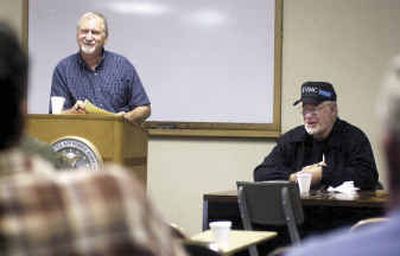
“When they say, ‘How can I use this (technology)’ we introduce them to this gentleman here,” he said.
“This gentleman” is Darrel White, an amateur radio operator and volunteer communications coordinator of the Kootenai County Office of Emergency Management, who oversees Radio Amateur Civil Emergency Services (RACES) and Amateur Radio Emergency Services (ARES). Those two organizations are composed of amateur radio operators who assist with communications in emergency and nonemergency situations.
RACES is a federally sponsored organization under the control of Kootenai County Office of Emergency Management. Because RACES only operates when an emergency has been declared, its members also belong to ARES, which provides the same type of communication support for nonemergency community events.
RACES/ARES volunteers will provide communication support for the Thunder Over the Prairie Air Show this weekend; a weapons of mass destruction drill next Saturday; and Ironman, June 23-25. There’s also an amateur radio “Field Day” involving ham radio operators in two continents June 25 and 26.
“We call it Super June,” White said.
Amateur radio plays an integral role in emergency and community communication because of the way the radio wave spectrum is divided up by the Federal Communications Commission. Everyone using the airwaves is assigned a small portion of the radio spectrum corresponding to a particular frequency.
Police, fire, taxi drivers, AM radio, cell phone users, Citizen’s Band and television stations each have a small portion of the spectrum. Each user can only “talk” to another user within the same frequency. Amateur radio users, however, have been assigned frequencies all along the spectrum so they can communicate with anyone.
“We have pieces of the radio spectrum sandwiched between other agencies. We have a broad range of modes of communication,” White explained.
“The federal government realizes the importance of amateur radio, not just because we’re all across the spectrum, but also because we’re all independent, scattered all over the country and are capable of operating without commercial power,” he said.
“We can talk within the state and across the U.S.,” added Randy Carlson, KARS president.
For this reason, amateur radio operators often serve as intermediaries among different agencies, relaying information from one organization to another.
For example, during the air show, amateur radio operators will staff the Office of Emergency Management’s Mobile Command Center, a communications center on wheels.
The operators will listen to the communications of various groups such as parking, security, ground operations, air operations and medical and relay information from one group to another.
“One group can talk to their group, but not to another … If someone in the parking lot keels over, they can contact us and we can tell emergency services,” White said.
“We’ll be the (communications) hub,” McElroy added.
The Ironman triathlon is another event in which the services of the radio hams will be needed. Besides monitoring and relaying communications during the competition, amateur radio volunteers will track the lead and last runner and biker using an Automatic Position Reporting System, a type of GPS. The system sends out a beacon that is viewed on a computer screen.
GPS tracking will allow Ironman organizers to know where the first and last competitors are at all times, White said. In fact, anyone in the country will be able to go online and watch.
GPS tracking will be an improvement over last year and will help to cut down on the radio traffic.
During last year’s Ironman competition, there were 1,000 “pieces of radio traffic” during the 18-hour competition. Compare that to the county’s 911 system, which handles about 640 radio transmissions during a 24-hour period.
“We were handling considerably more traffic in eight hours less time,” White said.
White said recruitment of amateur radio volunteers for Ironman was a challenge this year, because the date overlaps with the annual ham radio “Field Day,” which runs from about noon on June 25, through noon on June 27.
Field Day is an exercise in which ham radio operators in North and South America set up stations in the field without using commercial power and contact as many people as they can within a 24 hour period. They begin setting up on Friday and start broadcasting on Saturday.
“They operate all night long,” Carlson said. Sponsored by the American Radio Relay League, the purpose is “to ready amateur radio for emergency operations. It hones their skills to set up in a location that is away from where they would normally have their equipment.”
Another upcoming major event for is a weapons of mass destruction drill being conducted by the Office of Emergency Management and Panhandle Health District 1 next Saturday . Five northern counties will test their emergency response to a simulated biological threat. The exercise is required by the Department of Homeland Security.
“RACES/ARES will be operating. We’ll be providing communication support for operations. We are purposely not giving our people a lot of information because we want to see how quickly they can respond to an undisclosed location and set up,” White said.
Many hams, however, are into amateur radio just for the fun of it and KARS provides an outlet. The organization meets in the evening on the second Monday of the month and has speakers and presentations. They also enjoy social events such as pancake breakfasts, barbecues and even a skeet shoot competition.
For many, it’s a family affair with husbands and wives, fathers and daughters joining together. About a quarter of the membership is female.
Membership includes everyone from kids to retired people. Amateur radio operators come from all walks of life, although most do have technical backgrounds or love technology. For those who think ham radio represents old technology, Carlson reminds them that amateur radio brings together computers and radio.
“If a person is into computers and so-so about radio, there’s still a place for them in radio,” Carlson said.