Functional foods
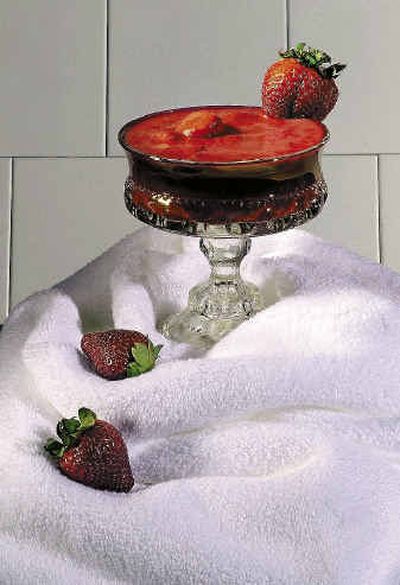
Here’s a nifty diet trick: Don’t eat the food at all. Use it for something else entirely. Got milk? Paint your garden furniture with it. Cornstarch? You’re halfway to a fine sculpturing clay for jewelry. Strawberries? Add salt and olive oil and you’ve got a foot exfoliant, which you could display in an elegant cut-glass goblet.
Carb-counters may be wondering what to do with all that extra honey they won’t be eating again. Mix it with that other carb no-no — oatmeal — for a revitalizing facial mask. Or blend it with a peeled and cored apple as a skin toner.
Weight Watchers devotees blanch at real mayonnaise. All those points-heavy eggs and oil — yikes. But combined with an avocado or a fragrant extract such as lavender oil, it becomes a nourishing meal for your hair.
Food: It isn’t just for eating anymore.
Nutritionists, politicians, insurance companies — all are worried about us eating our way into the record books as the fattest nation on Earth. So, in the spirit of lightening our collective load, consider food in a new way, as a tool for expressing your inner self. Meantime, keep all the calories conveniently outside your body — say, in a plastic tub, stored in the bathroom.
Using food for beauty products is big, big, big these days, says Lynne Frances Herro, an aesthetician who works out of Rouge, a hip downtown Milwaukee salon. Spa-industry magazines are full of stories about home beauty recipes — as are Internet sites, such as www.pioneerthinking.com.
“There definitely is a trend,” says Herro, who also sells her own line of homemade soaps, scrubs and other skin products. “There is a lot of interest in it. People are seeking out natural products.”
The growing market has spawned a new industry of commercially produced products that contain food or food extracts.
The problem with these, Herro says, is they all have preservatives in them to extend their shelf life.
Adding preservatives defeats the purpose of natural products, which should be fresh and, if the users are sensitive, free of allergens.
“The second greatest cause of (allergy) sensitivity for people is preservatives,” Herro says. “The first is fragrance.”
Commercial producers are often overly zealous about adding fragrances to their products, Herro says. And these manufacturers can’t duplicate the freshness of a beauty aid made at home with materials found in the fridge or pantry.
“The nice thing about whipping up your own, say, honey-and-oatmeal mask, is you know exactly what’s in it,” Herro says. “It’s the same as making your own food. When you make it yourself, you don’t put anything in that you don’t like or you can’t eat.”
Home beauty recipes have been around since before the ancient Greeks.
Remember the peaches-and-cream complexion? It really is achieved by making a mask of just peaches and cream whipped together. But our fascination in the last half of the 20th century with synthetic, laboratory-produced concoctions, and the heavy marketing of these products, has corroded our understanding and appreciation of nature’s bounty.
Take oatmeal, for example. “You can take your leftover oatmeal from breakfast and put it on your face as a soothing skin mask,” Herro says. “But are people really going to do that?”
Cynthia Krueger probably would.
She works in the personal wellness department of Outpost Natural Foods Cooperative. She makes her own sugar scrubs and she uses olive oil to condition her hair. Krueger has used oatmeal for her own soaps and is now considering it as an ingredient for her scrubs, too.
“Yeah, I’ve made some crazy stuff over the years,” says Krueger, who started making her own products because of her many allergies.
Her homemade hand and foot salve made of beeswax, olive oil and essential oils was enough of a hit with friends that she took to making it in muffin cups and giving it as a gift.
Krueger encourages experimenting with different materials to find an optimum balance that suits the individual. Essential oils are potent and should be used sparingly, she says. Ideally, they should be diluted in “carrier oils,” such as olive or almond oil.
For scrubs and lotions, start with oils that are solid at room temperature, such as coconut oil or cocoa butter. She’ll occasionally splurge on shea butter, rarer and more expensive than the others, but very soothing to the skin.
“When you’re making these things, a 50-50 ratio is a good rule of thumb,” Krueger says, meaning 50 percent solid oil and 50 percent of another ingredient, such as turbinado sugar or salt, which makes a bath scrub. “The only way you can really ruin something is by putting in something that stinks.”
Words to live by.
Anyone who ever made a papier-mache stegosaurus in second grade knows the value of playing with food.
Mixing up the gloopy flour-and-water paste in big plastic buckets was even more fun than ripping up yesterday’s newspapers.
Using food as a means of self-expression isn’t the exclusive purview of chefs.
Some artists paint with egg tempera, a mixture of water, pigment and egg yolks first used by the ancient Egyptians. And kids have been doing it in school art classes for years, with no more sophisticated media than a few raw potatoes cut into shapes or modeling clay made with salt or cornstarch.
Sandra Szymkowski has been teaching kids art for 30 years. As far as she is concerned, art class wouldn’t be the same without food.
At Milwaukee’s Golda Meir School, Mrs. S., as the kids call her, has successfully used pudding as finger paint, bread and pretzel dough to make edible sculptures, and crushed candy to make stained-glass ornaments.
“I think one of the biggest benefits is that the kids have access to materials at home,” Szymkowski says. “It puts art materials into the hands of people who wouldn’t otherwise have them.”
Szymkowski used to have the luxury of mixing up a batch of salt or cornstarch modeling clay in class with the students, an exercise that had the added benefit of giving the children a secondary lesson in food chemistry. But today’s tight scheduling and larger class sizes have forced her to curb this practice.
And she doesn’t use the old flour-and-water paste for papier-mache anymore.
“It doesn’t keep well,” Szymkowski explains.
But she still sends the modeling clay recipes home with kids and encourages parents to make them. The salt clay recipe is better for sculptures, she says; cornstarch clay dries very hard and is best for jewelry-making.
There is a generation of young parents who grew up never making clay in school, either. Sometimes, her recipe is their first experience making their own art material.
“I can’t tell you the number of times people have called me up and said, ‘I’m so glad you gave us that recipe!’ “
Nostalgia isn’t the only reason Dwayne Siever prefers milk paint.
The nontoxic blend of milk protein, or casein, water and lime makes a strong, superior covering especially for antiques, without masking the fine grains of old woods, he says. The recipe widely used today is little changed from the one devised by those clever chemists, the ancient Egyptians.
Siever is a Pennsylvania furniture restorer who now sells his own line of milk paints and pigments. He says milk paint has another desirable property: It doesn’t trap moisture, which can accelerate rotting, particularly in wood.
The main drawback to milk paint is it must be applied in several thin coats, a fussy process that can frustrate some home painters.
But milk paint has many qualities, he says.
“For one thing, you’re not adding to pollution. This is a paint you can mix up yourself and when you’re done with it, you can throw the excess in the garden without worrying about animals getting into it.”
Siever’s musings on milk paint turn philosophical; his conclusion is apt for any home recipe, whether it’s for nourishing our bodies, in the form of dinner, or our souls, in the form of a body scrub.
“I think there’s some enjoyment in making the products you’re going to use. It’s something you’ve made yourself. I think that’s very satisfying.”
Lynne Frances Herro, an aesthetician at Rouge, a Milwaukee salon, who also sells her own line of beauty products, adapted the following three recipes from one of her favorite books, Catherine Bardey’s “Secrets of the Spas” (Black Dog & Leventhal, 1999).
Lemon cleanses skin and improves microcirculation; the ancient Romans valued parsley as a skin tonic. Oatmeal is a natural softener.
Lemon, Ginger and Parsley Bath Soak
1/2 cup grated lemon peel
1/4 cup dried parsley
1/4 cup minced fresh ginger
2 tablespoons old-fashioned rolled oats
Combine ingredients and add to bath water.
Yield: Enough for 1 bath.
Avocado is high in vitamin E; carrot in vitamin A. Cream is high in calcium and protein.
Avocado, Carrot and Cream Mask
1 avocado, peeled, pitted and mashed
1 carrot, cooked and mashed
1/2 cup heavy whipping cream
3 tablespoons honey
Combine ingredients and spread over face and neck. Let sit for 15 to 20 minutes. Rinse with cool water.
Yield: 1 mask
Herro says this calming cucumber mask also can be used up to three times a day for sunburned skin — although she’d rather we all use sunscreen, even on cloudy days, and prevent burned skin altogether.
Cucumber Mask
1 small cucumber, peeled and seeded
4 tablespoons chamomile tea, steeped and strained
4 tablespoons green tea, steeped and strained
1 packet unflavored gelatin
2 tablespoons aloe vera gel
Puree cucumber in blender until smooth. Strain through a coffee filter or tea strainer and reserve juice. In small saucepan, combine chamomile tea, green tea and gelatin. Stir over low heat until gelatin has dissolved. Remove from heat and pour in glass bowl. Add cucumber juice and aloe vera gel. Refrigerate 25 minutes or until mask begins to thicken.
Apply to face and neck and allow to dry — about 20 minutes. Rinse with warm water and pat dry.
Yield: 1 mask
Grapefruit seed oil used in this recipe acts as a natural preservative, according to Cynthia Krueger of Outpost Natural Foods. The amount of essential oils used should be to individual preference.
Outpost and most health-food stores sell beeswax, food-grade essential oils and non-food-grade aromatherapy oils. It is wise when making these recipes to use Pyrex or old metal pots no longer used for cooking food. Pots and stirring spoons can be cleaned with very hot water and dish soap.
Cynthia’s Healing Hand and Foot Salve
1 bar (2 ounces) beeswax
1 1/2 cups extra-virgin olive oil
10 drops rosemary oil
10 drops calendula oil
10 drops tea tree oil
10 drops grapefruit seed oil
Using double boiler, melt beeswax in olive oil over low heat. Add essential oils and heat, stirring, about 2 minutes more. Let mixture cool slightly. Pour into aluminum muffin cups and let solidify.
Use within a month or store in fridge.
Yield: 9 salves
We tested this bath scrub with lavender oil for a soothing fragrance, but those with allergies or extra sensitive skin should omit the fragrance.
Cynthia’s Sugar Scrub
1 cup coconut oil, cocoa butter or shea butter
1 cup turbinado (raw) sugar (see note)
8 to 10 drops lavender oil (optional)
Using a double boiler over low heat, liquefy coconut oil, cocoa butter or shea butter. Add lavender oil and stir a few seconds. Remove from heat and add turbinado sugar. Transfer to plastic or glass container with storage lid. Stir occasionally as mixture solidifies to keep sugar evenly suspended in oil.
Use immediately or store in refrigerator. Keeps about 1 month.
Note: Turbinado sugar is a raw sugar usually sold in bulk in health food stores or over the Internet. It is grainier and darker than refined sugar. Kosher salt may be used as a substitute in this recipe.
Yield: 2 scrubs
Variations of this foot scrub can be found at www.spaindex.com, www.pioneerthinking.com and other home-spa Web sites. This is from www.bellaonline.com.
Strawberry Foot Exfoliant
8 ripe strawberries
3 tablespoons kosher salt or coarse sea salt
2 tablespoons olive oil
Lightly mash strawberries. Add olive and salt. Don’t overblend or mixture will be too runny. Rub over feet to smooth rough calluses. Rinse.
Yield: 1 food scrub
This recipe for cornstarch clay — teacher Sandra Szymkowski’s favorite — comes from www.argostarch.com.
Cornstarch Play Clay
1 cup cornstarch
2 cups (1 pound) baking soda
1 1/4 cups cold water
1 tablespoon vegetable oil
1 tablespoon liquid food coloring, or 1 to 2 teaspoons food color paste
In medium saucepan, stir cornstarch and baking soda. Add water and oil all at once and stir until smooth. Stirring constantly, cook over medium heat until mixture reaches the consistency of slightly dry mashed potatoes. (Mixture will come to a boil, then start to thicken, first in lumps and then in a thick mass; it should hold its shape.)
Remove from heat. Do not overcook clay; crafts may crack.
Turn out onto plate and cover with damp cloth and let cool.
Yield: About 2 pounds
Mrs. S’ Salt Dough
1 cup all-purpose flour
1/4 cup salt
2 tablespoons cream of tartar
1 cup water
2 teaspoons food coloring
1 tablespoon vegetable oil
Mix flour, salt and cream of tartar in a saucepan. Add water, food coloring and oil. Stir mixture over medium heat 3 to 5 minutes. When it forms a ball, remove from heat and roll on a floured surface. Continue to work until glob forms a smooth dough. Store in plastic bag or airtight container at room temperature.
Yield: Makes 1 large ball
Dwayne Siever, who sells his own milk paints and pigments at www.realmilkpaint.com, located these recipes for casein paint. His cottage cheese version is a durable, weather-resistant paint, but takes longer to make.
1870 Milk Paint Formula
1 quart non-fat milk (divided)
1 ounce hydrated lime (see note)
1 to 2 1/2 pounds of chalk for filler
Limeproof pigment powder (optional, for color)
Stir enough milk into hydrated lime to make a cream. Add remaining milk. Add chalk to desired consistency. Add pigment to desired color and mix well.
Apply paint in a thin coat with a natural bristle brush. Allow to dry sufficiently before applying next coat. Milk paint will not bubble, even if underlayer is not completely dry.
Allow project to dry 3 to 4 hours before using.
Note: Hydrated lime — lime that has been soaked in water and then dried — is sold at building centers and farm supply stores. Do not use quicklime; it will react with water and heat up. Lime is non-toxic and is often used to purify water or to raise the pH level of soil.
Chalk and pigment powder are available at the same stores.
Cottage Cheese/Dry Curd Paint
1 part hydrated lime
Water
5 parts cottage cheese or dry-curd cheese (see note)
Limeproof pigment powder (optional, for color)
Non-fat milk powder, if needed
Mix hydrated lime with enough water to form a paste. Add to cheese and stir well. Let sit for several hours while cheese lumps dissolve. Add powdered pigment to solution. If too thick, add water. If too thin, add non-fat milk powder.
For a finer paint, strain through nylon stocking or cheesecloth.
Note: Dry-curd cheese is cottage cheese without cream or whey. Make your own by straining cottage cheese through cheesecloth or yogurt strainer.