
On-the-job training
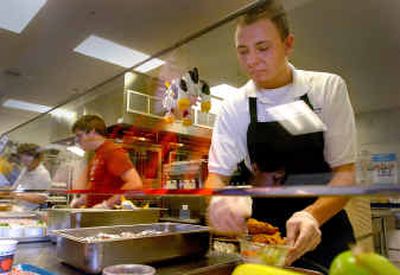
For the special education students who work in the Lake City High School kitchen, the job starts simply. The first task to master is hand-washing.
“I tell them wash your hands as long as it takes to say your ABCs,” kitchen manager Shirley Horther said.
The students progress from collecting trays and wiping cafeteria tables to making milkshakes and cutting fruit.
Barry Dulay worked his way into a permanent position. The slender 18-year-old with a crew cut spent four years of high school working in the kitchen through the school’s Community Based Instruction program. When he graduated, the kitchen crew couldn’t bear to say goodbye.
“It started out as a grade and credit,” Dulay said as he washed dishes in a large stainless steel sink. “Now I’m hired.”
The organizers of the program that helps special education students gain job experience are having an increasingly difficult time finding employers to help train students like Dulay to be independent workers. Teacher Andy Covington said she believes the root of the problem is the increase of big-box stores and demise of locally owned mom-and-pop businesses.
Corporate-owned businesses have stringent rules, Covington said. Unlike local hardware stores or small grocers, Covington said, many large businesses have personnel policies that don’t allow unpaid workers. Because the students in the Community Based Instruction program participate during the school day and receive credit, Covington said the students aren’t allowed to collect a paycheck.
The skills students learn are important, Covington said. They learn how to work with others, follow directions and be responsible.
“It really makes my job easier,” said Brad Bruhn, a vocational rehabilitation counselor for the state of Idaho.
He works in an office in Lake City High School’s special education classroom, helping students find jobs once they graduate. For those who have some on-the-job experience, Bruhn said, the transition from student to working adult is easier.
Some employers are hesitant to take on the added responsibility of a special education student, Covington said. But because the program is school-based, she said, the school accepts all liability for the student. A school bus brings them to and from work, and a job coach is provided for students who need one.
Learning skills
Chris Pivarunas, an 18-year-old with autism, works at Burger King in Hayden.
“I wash dishes, and I grill some hamburgers, and I grill the buns,” said Pivarunas, as he stacked dishes at the side of the sink. “It’s marvelous.”
He worked quietly on his own for most of his one-hour shift Wednesday. His job coach, a special education aide named John, only stepped in when Pivarunas looked to him for help as he was filling the sink with water that was too hot.
For his work, Pivarunas gets an occasional free meal. He also gets “paid” by his teachers at Lake City. Students in the program get something the teachers call “economy money.” Just like a real job, they have a payday and deposit the money into their own classroom checking account.
Each week, the class goes out to eat. Students learn to budget their “funny money” and save for a year-end auction of items the teachers buy.
Denny Voight, manager of the Dollar Tree in Coeur d’Alene, is so impressed with the work student Jeff Jensen has done that he’s trying to find a way to get him on the payroll as a part-time employee, working a couple of hours in the evenings or on weekends.
“Jeff is so well advanced,” Voight said. “I can give him a project and just say, ‘Fill it.’ “
The idea of having an actual job brings a smile to the lanky 17-year-old’s face.
“I like it,” he said as he stacked Red Vines in wire baskets at the end of an aisle. “Everybody here is nice. It’s just a nice place to work.”
Last year, Amber Kuntz worked at the Dollar Tree. They dubbed her “Queen of the Scotch Tape” because she enjoyed stacking rolls of tape on the shelves.
The 19-year-old with Down syndrome was popular among employees at the Fashion Bug, too. Manager Cassandra Carrigan-Andreasen said she asked Kuntz what her favorite job was.
“She liked to organize the panties,” Carrigan-Andreasen said. Other employees dreaded sorting the tangled mess on the panty tables. “That’s a nightmare. She was such a blessing for us.”
‘It’s awesome’
Employers who have worked with the students say having the experience has benefits beyond free labor.
“Amber made it a lot of fun,” Carrigan-Andreasen said. “It gave us somebody new and somebody different than us to try and teach our job.”
She said she enjoyed watching Kuntz blossom. At first, she said, Kuntz was shy and quiet. As she grew more confident, she began greeting customers and “was dancing in the aisles.”
Job coach Joyce Peterson said the boost in confidence is common among students who have participated in the Community Based Instruction program. Even Dulay was reserved at first, she said.
Now he buzzes with a contagious energy – a constant smile that makes those who work with him in the kitchen smile, too.
“When I first got Barry, he was so slow at everything,” Horther said. But with a little patience and time, Dulay and others in the program become reliable employees. “Once they get it, they’re fabulous.”
Dulay also works at Safeway – a job that developed from his experience there during high school. He started bagging groceries and was recently promoted to the bakery. He gets up at 4 a.m. and works on doughnuts and bagels. By 9 a.m., he’s in the kitchen at Lake City, measuring flour for the day’s bread.
“It makes me feel really well,” Dulay said. “It’s nice to come back and see everybody. It’s a great team.”
He makes enough between the two jobs to pay for his cell phone and car insurance. He’s hoping to be able to move out on his own soon.
Peterson and Covington proudly share stories of several students who have left the Community Based Instruction program and found lasting jobs.
One student has worked in the laundry room at Kootenai Medical Center since graduating in the late 1980s. Another student was trained as a Certified Nursing Assistant and was also hired by KMC. A handful of students have stayed with Safeway.
Kuntz’s mom, Diane Wolfe, said her daughter has told her that she wants to live on her own in an apartment after she graduates. Wolfe said the work experience she’s had so far has gotten her a step closer to independent living.
“I think it’s awesome the school does this,” Wolfe said. “They’re actually training them and getting them used to doing the same thing over and over so when they get a job, they’ll know what to do. I hope it continues.”