Tour de Fresh

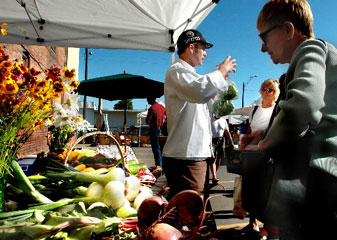
Forget trying to plan elaborate dishes based on what you hope to find at farmers’ markets. The secret to enjoying the fresh, local produce available at markets is to improvise.
That’s the message chef David Blaine shared with a group of food lovers on a recent Shop with the Chef tour of the Spokane Farmers’ Market.
“I like to go to the market with a simple idea that can be embellished,” said the Latah Creek Bistro chef.
If you are focused on getting a particular ingredient to go with a specific recipe, you might overlook many other fresh, at-their-peak items that could make ordinary dishes outstanding.
With that in mind, Blaine set out to show his guests how market produce can turn a basic potato salad and buttery cake into dishes worth talking about – and devouring.
Blaine hosted the first Shop with the Chef event open to the public earlier this month. In July, Chef Shilo Pierce from the restaurant Luna took a group of women from the Women’s, Infant’s and Children’s program on a similar tour. The Shop with the Chef series is sponsored by Washington State University Cooperative Extension and the Spokane Farmers’ Market.
“Potato salad is the perfect summer food,” Blaine said. “It handles improvisation well, even clumsy improvisation.”
For the recipe he shared with his tour, Blaine used a mixed bag of yellow, purple and red potatoes. Fresh yellow and green beans in season caught his eye, along with arugula. To add zing to the dressing, he opted for fresh tarragon, green onion and a little bit of garlic.
That’s what was fresh and looking good that day. Now, two weeks later, it could be something different, but Blaine insists the potato salad is still a good choice because it’ll work with tomatoes, squash and other items coming on at markets.
“I’m not afraid to mix up vegetables,” Blaine said, adding that tossing in some smoked salmon or trout is another option. He admitted that arugula, a spicy green, “is not for everyone,” as evidenced by the leaves pushed aside on the sampling plates of a few people on his tour. In that case, look for a different green or herb, even basil.
“There’s a world of greens that does not look like lettuce,” he said.
That’s what chef Pierce wanted his group to see on their tour of the market. Pierce said people tend to be stuck on salads, so he talked about different ways to prepare greens such as chard, kale and mustard and collard greens, including braising and sautéing.
Blaine said he hates to serve romaine or red leaf lettuce in summer because those greens are what we’re “stuck” with all winter. “It’s like if you eat raspberries yearround, flown in from the southern hemisphere, you lose the thrill when it’s (local) raspberry season,” Blaine said.
“The fun thing about shopping the markets is you can buy a little of this and little of that and try different things,” he said. “I like soups, and soups are so easy to put together. You can just start throwing things in a soup.”
Like melons. Some of the first of the season appeared at the market on tour day, and Blaine did a double take. “Oh, I’m dreaming of melon soup,” he said.
If he hadn’t already made a cake for his tour to sample, he’d probably have whipped something up with melons. But for his second recipe, which he calls August Cake, he used apricots and huckleberries. The original recipe used raspberries, but by the time the tour date arrived, raspberries were just about gone from the market, pushed aside by peaches, apricots and huckleberries.
“The cake is basic. You can put anything on top,” he said. “It’s one of the few things I’m willing to turn the oven on for in summer.” The apricots he used were still ripening, he said, “but when you bake them, it doesn’t matter.”
The ideas flowed with ease as Blaine strolled by each market vendor’s booth. “I was contemplating panzanella salad,” he said as he passed a bread maker’s booth. “I see this big, crusty bread, and that’s all I can think of.”
A little farther along, haricot verts, very thin green beans, made him stop. He offered this tip: Steer clear of them if they’re longer than 3 or 4 inches. Otherwise they are “super tender and super flavorful,” he said.
Next it was the dark leafy bok choy. “Oh, I love bok choy,” Blaine said, at which point he stopped to tell his group there is no need to shop elsewhere. “If you get into the habit of coming to the market, you can get everything you would get at the grocery store,” he said, noting that many markets also have vendors selling locally raised meat, fish and poultry.
And, Blaine said, “If you want to learn how to be an improvisational cook, sign up for a CSA.” Community Supported Agriculture programs provide members with a box full of farm-fresh produce on a regular basis.
Before wrapping up the tour, Blaine noted, “There’s a lot of really cool squash. You can throw squash in anything.”
And corn is playing a starring role these days. “I’m cooking with corn like crazy right now,” he said. “I make corn pudding. If you’ve never had corn pudding, go home and make it right now. It’s the best.”
Pierce suggested that market shoppers look for different ways to use the produce they are familiar with. Substitute one root vegetable for another. For example, make a carrot puree instead of mashed potatoes.
One thing people need to realize about market produce is it has so much flavor on its own and doesn’t need a lot of work to make it taste great, said Sylvia Wilson, the chef at Mizuna, who will be hosting the next open-to-the-public Shop with the Chef event Sept. 28 from 9 to 10 a.m. at the Spokane Farmers’ Market.
“Anything you do with it is almost foolproof because everything down there is freshly picked,” she said.
Preparing it is as simple as grilling it with a little olive oil, salt and pepper. “You can go more elaborate, but you don’t have to,” Wilson said.
Eat those grilled veggies by themselves or toss them into pastas and salads. “Whatever people normally like to make will taste that much better (with fresh, local produce),” she said.
“Right now you can get amazing tomatoes,” Wilson said, adding that they are her favorite market item because they burst with flavor. She suggested roasting some tomatoes and peppers in the oven and blending them to make a roasted tomato and pepper pasta sauce. “It’s that simple.”
Shopping the market is fun, the chefs agreed.
“I love going down there and not knowing what I’m going to come home with,” Pierce said.
Summer Potato Salad
From Chef David Blaine, Latah Creek Bistro
1 ½ pounds potatoes cut into 1-inch pieces
½ pound green and yellow beans
½ pound arugula, for garnish
Dressing:
2 tablespoons mayonnaise
1 tablespoon red wine vinegar
1 clove garlic
1 tablespoon seasonal herbs (such as tarragon and green onions), chopped
1 teaspoon stone ground mustard
Pinch salt
Pinch black pepper
Place cut potatoes in a plastic bag or parchment bag and microwave on high, checking the firmness after each 1- to 2-minute interval (see note). To check for doneness, press a potato piece with a fork. If it begins to smash, it’s ready.
Follow the same method for cooking the beans but shorten the duration to 20 to 30 seconds.
Chill both the potatoes and beans in the refrigerator for a couple of hours.
While the potatoes and beans are chilling, make the dressing by combining all of the ingredients and mixing until well combined. Keep the dressing cold until ready to combine with the vegetables. Toss the dressing and vegetables serve with a few arugula leaves on top or the side.
Note: Blaine said the potatoes take about 6 minutes in his microwave but suggests checking them every minute or so because microwaves can be very different.
Yield: 4 servings
Approximate nutrition per serving: 195 calories, 6.3 grams fat (1 gram saturated, 29 percent fat calories), 6.7 grams protein, 29 grams carbohydrate, 3.5 milligrams cholesterol, 5.8 grams dietary fiber, 156 milligrams sodium
August Cake
From Chef David Blaine, Latah Creek Bistro
1 cup granulated sugar
½ cup (1 stick) butter, softened
2 large eggs
1 cup all-purpose flour
1 teaspoon baking powder
Pinch salt
1 cup seasonal fruit (such as apricots and huckleberries)
1 tablespoon lemon juice
1 tablespoon flour
Preheat oven to 350 degrees. Grease an 8-or 9-inch springform pan.
With an electric mixer, cream sugar and butter until white and fluffy, about 5 to 6 minutes. Add eggs, one at a time, blending well after each.
In a separate bowl, combine flour, baking powder and salt and mix to evenly distribute. Add dry ingredients to butter mixture and blend on medium just until ingredients are incorporated.
Spread batter (it will be thick) into the bottom of prepared pan.
Toss the fruit with the lemon juice and flour, then spread the fruit in a doughnut shape over the top of the cake batter, sprinkling only a few pieces in the center.
Bake for about 50 minutes and let cool thoroughly before removing from pan.
Yield: 8 servings
Approximate nutrition per serving: 288 calories, 13 grams fat (7.6 grams saturated, 40 percent fat calories), 3.6 grams protein, 40 grams carbohydrate, 84 milligrams cholesterol, less than 1 gram dietary fiber, 116 milligrams sodium.
Corn Pudding
From Chef David Blaine, Latah Creek Bistro
12 tablespoons unsalted butter
1 cup granulated sugar
8 cups (about 10 ears) white corn, roasted and scraped from the cob (see note)
½ cup milk
5 tablespoons all-purpose flour
1 tablespoon baking powder
1 teaspoon kosher salt
Corn-friendly seasonings (see note)
4 eggs, separated
Cream butter and sugar in food processor. Add corn and pulse for 20 to 30 seconds. Add milk, flour, baking powder and salt and pulse to mix. Stir in desired seasoning
Whisk by hand the egg yolks and stir into the corn mixture. Beat egg whites with electric mixer and fold into corn mixture. Pour into 9-by-9-inch pan. (Can be made a day ahead to this point and refrigerated until ready to bake.)
Bake at 350 degrees for about 45 minutes until mixture rises, browns on top and pulls slightly away from sides. Let cool before serving. Goes well with spicy dishes.
Note: Blaine soaks the corn in its husks and then grills them (in the husk) to steam the corn. Corn can be grilled without husks, but be careful not to let it burn. Remove husks and silks before scraping corn from cob. Examples of corn-friendly seasonings include nutmeg, cayenne, chili powder, curry powder, paprika, etc.
Yield: About 8 servings
Approximate nutrition per serving: 485 calories, 22 grams fat (12 grams saturated, 41 percent fat calories), 9.5 grams protein, 71 grams carbohydrate, 140 milligrams cholesterol, 4.7 grams dietary fiber, 539 milligrams sodium.
Panzanella
From The Culinary Institute of America’s “Gourmet Meals in Minutes.”
Panzanella is an Italian bread and tomato salad made with garlic, basil, parsley, olive oil and vinegar. While this recipe calls for toasting the bread, other variations including soaking the bread in water before tossing it with the remaining ingredients.
1 baguette, 24 inch, preferably two days old
½ cup plus 3 tablespoons extra-virgin olive oil
1 tablespoon butter
¼ cup garlic, chopped
2 pounds tomatoes
½ cup balsamic vinegar
2 teaspoons salt, or to taste
1 teaspoon freshly ground black pepper, or to taste
1 bunch basil
½ cup parsley, roughly chopped
Cut the baguette into 1-inch by 1-inch cubes. Toast in a 350-degree oven for 1 to 2 minutes or until crisp and dry, stirring occasionally if necessary. Place the butter and 2 tablespoons of the olive oil into a 10-inch sauté pan over medium low heat. Allow the butter to melt and then add the garlic. Sauté the garlic for 2 to 3 minutes, until it is translucent, but not brown. Toss the cooked garlic, butter and oil with the diced bread.
Slice the tomatoes and place in a large bowl. Add the vinegar, remaining olive oil, salt and pepper.
Layer one-quarter of the basil leaves on top of each other and roll into a tight bunch. Thinly slice the bunch of leaves crosswise to create long strips or basil approximately 1/8 -inch thick. Repeat with remaining basil leaves. Just before serving, toss the bread, basil and parsley with the tomatoes. Adjust the seasoning with additional salt and pepper if necessary.
Yield: 8 servings
Approximate nutrition per serving: 200 calories, 16 grams fat (3 grams saturated, 71 percent fat calories), 2 grams protein, 13 grams carbohydrate, 4 milligrams cholesterol, 2 grams dietary fiber, 639 milligrams sodium.