
Practice makes perfect
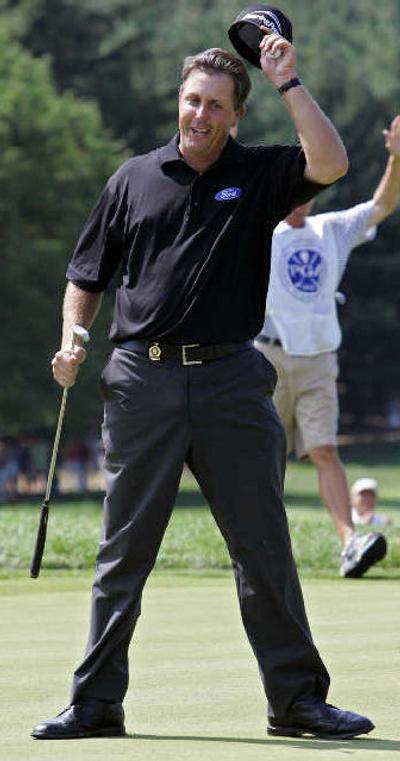
SPRINGFIELD, N.J. – He was a legend in his own backyard. That was before Phil Mickelson became a top-flight junior, an ascendant amateur, the next Nicklaus, a husband, father, the best player never to win a major and, at long last, a Masters champion.
Back then, he was a toddler dragging a cut-down golf club behind him instead of a blanket. From morning until night, Mickelson would scatter golf balls around the 35-yard hole his father, Phil, built in the backyard of their split-level home in the Del Cerro neighborhood east of downtown San Diego, and try to hole every one.
Monday morning, as the elder Mickelson made his way toward the 18th green at Baltusrol Golf Club to hug the just-crowned PGA Championship winner, somebody stopped him and asked how many times he’d seen the flop shot from 50 feet out of deep rough that had sealed his son’s second major championship.
The father looked away earnestly for a moment, as though he might actually be counting. Then he stopped and turned back, breaking into a wide grin.
“Quite a few,” he said, finally. “Let’s just leave it that.”
Quite a few.
Phil used to give the boy nickels and dimes, occasionally a quarter, for each hole-in-one. After a while, it got too expensive. But this up-and-down?
Priceless.
“We had some pretty thick rough in our backyard and that’s exactly what I was thinking on 18, that this is no different from what I’ve done in my backyard since I was kid,” Mickelson recalled.
“I hit it very confidently and aggressively and the ball popped out perfectly. There’s still an element of guesswork, but when it hit the green, it took a bounce and rolled up to within a 3-foot circle, which I felt very confident in.”
Before that, though, Mickelson had to find the ball. That was a little harder than it sounds.
He had spent Sunday night sleeping on the lead at 4-under, after a band of storms rolled through earlier in the day and forced PGA officials to suspend play with six twosomes still on the course. Mickelson came back to tap in a 3-footer for par at No. 14, made another at 15, but bogeyed the 16th to fall into a three-way tie with Steve Elkington and Thomas Bjorn. It wasn’t until the last hole that, when he stood in the 18th fairway with 247 yards left to the flag, that he learned both of them had made par up ahead.
“It was kind of an emotional boost,” Mickelson said, “because now I feel as though it’s my tournament to win, as opposed to fighting for a playoff.”
He cut loose with a 3-wood, then leaned forward in tandem with caddie Bones Mackay and traced the arc of the shot’s flight. After the ball disappeared into the thick rough fronting the green, what worried them on the march up the 18th was not so much its position or the lie, but making sure neither stepped on it during a search and incurred a one-stroke penalty.
So Mackay hatched a plan to have on-course TV reporter David Feherty, a former player himself, do some scouting. Feherty located the ball, but it was so deep down in the thick Kentucky bluegrass that by the time Mickelson headed back from surveying the putting surface, he’d lost it a second time. Mackay gingerly made his way to the back of the knob, pointed it out one more time and handed his boss a 60-degree wedge.
“The lie was OK, not bad, but it was sitting down a little,” Mickelson said.
Today, he has millions in the bank, an estate in Rancho Santa Fe, Calif., and a jet parked nearby. He’s been around the world a dozen times, met presidents and kings and indulged just about every childhood dream. Yet, for all that, the still perfectly manicured 35-yard hole behind his parents’ home remains Mickelson’s touchstone.
At that critical moment on Monday, he settled over the ball and flashed back to how many times he had taken the same swing before – a thousand? 10,000? 10 times that? – then looked up as the clubhead framed the picture.
“Seeing it come out the way it did,” Mickelson said, “was a great feeling.”