
Masters’ winter blast
AUGUSTA, Ga. – Break out the Day-Glo golf balls, hand-warmers and the winter rules.
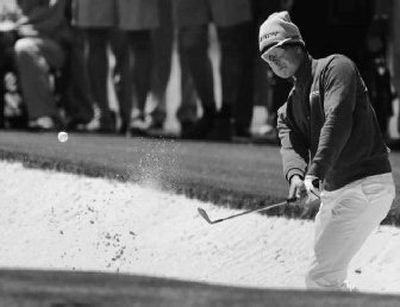
Chilly temperatures and a brisk north wind made the Masters feel more like it was transplanted to Augusta, Maine. Spectators bundled up in their winter finest Saturday, and players dug out every last bit of clothing they had stashed in their golf bags. Henrik Stenson even teed off in a stocking cap – at 1 p.m., no less.
And he’s Swedish.
“The only other time I remember the weather like this is when I’m here playing for Thanksgiving and Christmas,” said Charles Howell III, an Augusta native.
The temperature at the Masters was 43 at noon, and it hovered around 50 degrees the rest of the afternoon. Overnight lows are expected to drop to less than 30. Add wind gusting to 23 mph and it felt like the upper-30s to low-to-mid-40s at Augusta National.
That’s a good 30 degrees less than normal, and the cold took its toll on the golf as well as the golfers and the gallery. The field averaged 77.35 strokes, the highest-scoring round since Augusta switched to Bentgrass greens in 1981, and no one finished the day under par for the tournament. The leader was Stuart Appleby of Australia at 2 over par, one stroke better than Tiger Woods and Justin Rose of England.
The weather’s not expected to be much better today, with a high near 57 and more wind.
So much for warm Southern hospitality.
“We looked out this morning and thought it was going to be beautiful,” said Simon Burgess, an Englishman by way of Portugal who was shivering in shorts and a light sweater. “It’s bloody freezing.”
The Masters is normally spring break for the golfing set – sun-splashed days that are warm, if not hot; a pleasant breeze that’s the perfect complement to a pimento cheese sandwich.
Shirt-sleeves are the uniform for players, with maybe a light sweater vest for those trying to show a bit of style. Spectators wear shorts. The women come in skirts or show off their little sundresses. While the golf is the main attraction, getting an early start on the year’s tan doesn’t hurt.
Rain can put a damper on things – the third round didn’t finish until Sunday morning last year because of thunderstorms – but it’s one thing to have muddy shoes, another to not feel your feet.
“This seems like another tournament altogether,” said Rich Cheney of Rocky Mount, N.C., who was at his fourth Masters. “Kind of British Open conditions.”
Players were layered in sweaters, wind shirts and jackets. There was even a mock turtleneck or two. The wind played havoc with almost every shot and made Augusta’s already quick greens even slicker.
“Do I look like I’m out in my shorts and T-shirt?” Englishman Lee Westwood asked. “When I got out of the house this morning, I said to (his agent), ‘It’s like walking out of the Old Course Hotel at the Dunhill Links.’ It was that cold.”
Palmer’s win gains color
Before showing today’s final round, CBS will allow viewers to relive the final round of the 1960 Masters.
As it happened, and in color.
The one-hour broadcast will be a colorized version of CBS’s coverage that day, letting Arnold Palmer’s second Masters triumph unfold as it did April 10, 1960.
It’s the brainchild of CBS golf anchor Jim Nantz, who unearthed the original footage and financed the colorization out of his pocket.
TV cameras that day captured Palmer’s swashbuckling style, in which a birdie-birdie finish overtook Ken Venturi. Combined with a charging U.S. Open win two months later, it proved a watershed in golf’s popularization.
“Sure, Palmer won in ‘58,” Nantz said. “But to birdie the last two holes here and win in that fashion – then in his next major, to drive the green at Cherry Hills and shoot 65. That had to be it.”
It’s the second Masters lead-in project for Nantz, who last year produced a 20-year retrospective of Jack Nicklaus’ stirring 1986 Masters triumph. This time, though, he wanted to let the original speak for itself.
He hooked up with Legend Films, a San Diego company that specializes in colorization technology. The project involved some 62,000 frames and 10,000 man-hours to convert an untechnological original.
“You just took a movie camera and aimed it at a TV screen,” Nantz said. “That’s how it went in the archives.”
CBS showed only two holes that day, creating the odd (by today’s standards) scene of play-by-play man Jim McKay telling viewers they should see Palmer “coming into range of our cameras soon.”
The broadcast also shows a 47-year-old Ben Hogan on the 18th hole, Nicklaus as a 20-year-old amateur playing with Sam Snead and Masters founder Bobby Jones hosting the trophy presentation.
Goosen’s never down
Retief Goosen began the day tied for 46th, still in the Masters only by the grace of the 10-shot cut rule. By day’s end, the South African was tied for eighth.
That’s what a 2-under 70 was worth in the frigid winds – two shots better than anyone else. It could have been better except for a closing bogey.
“It was a disappointing finish,” said Goosen, twice a U.S. Open champion. “It would have been nice to get a couple in in the last few holes. I would have been right back in it.”
Goosen was speaking before the leaders teed off. One could only imagine what he was thinking as he watched Brett Wetterich, Stuart Appleby and the rest limp home.
Mickelson makes up ground
Nor was Phil Mickelson counting himself out of winning back-to-back green jackets. A 73 matched the fourth-best score of the day and left him four shots off the pace.
“I don’t feel like it’s unrealistic,” said Mickelson, who made up three shots on the lead. “I’ve seen people come from seven shots back.”