Golden arch enemies
Not too many committees recess for a “pesto break.” Or sip blueberry juice and lemon water while nibbling on wild salmon, berries and cheese.
But this is a group that loves food – and likes to take it slow.
They are about 20 area foodies – business people, chefs, farmers, students – who have been gathering for the past few months to start a new Slow Food chapter in Spokane.
If you’ve driven past the Golden Arches on the highway, you’ve no doubt heard of (and probably dined on) fast-food. So, what is “slow food?”
“It’s everything that fast food isn’t,” says Jerusha Klemperer, assistant to the executive director for Brooklyn-based Slow Food USA. “We’re an ‘eco-gastronomic’ organization. We’re trying to catalyze a cultural shift away from the industrialized commercial food system.”
Think of it this way: Consider a Dorito. Do you know who grew the corn to make that chip? Do you know where the milk came from to make the cheese flavoring? And do you even know (or want to know) what disodium phosphate or sodium caseinate really is?
Now consider a head of butter lettuce picked up at an area farmers’ market. When you buy it, you’re likely placing your dollars in the same hand that grew those greens.
That is the essence of the Slow Food movement, a worldwide organization that encourages people to eat foods that are seasonal, local and sustainably grown. The organization also urges people to reconnect with the kitchen and with the dinner table.
“Nobody eats at their desk here,” Klemperer says. “We have a table and we’ve got plates and silverware. For a few moments, everyone will break and eat at the table.”
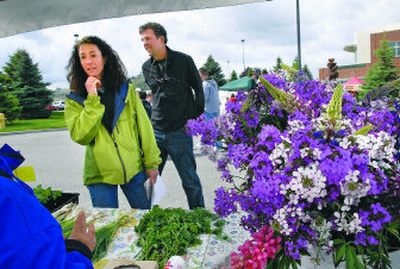
On a recent cool and windy Saturday morning, members of the Slow Food Spokane River chapter (called a “convivium” in Slow Food-ese) gathered at opening day of the Liberty Lake Farmers’ Market. The bustling market takes place in the shadow of a Taco Bell, a stone’s throw from a McDonald’s, Burger King, Carl’s Jr., Taco Time and three takeout pizza places.
Glenn Morris, who moved to the Spokane Valley last fall from Colorado, staffed the Slow Food booth at the market, handing out pamphlets to interested passers-by. Morris became involved with Slow Food after being concerned about how food production affects the environment.
“It seems like a very smart thing,” he says. “We as a society have been taking the cheapest and most expedient route and that doesn’t always lead to long-term success.”
Morris tries to find out where his food comes from. He eats what’s in season, so he won’t be consuming foods that have traveled thousands of miles to his plate.
Jennifer Hall does the same thing. She’s the Slow Food group’s chief organizer in Spokane, when she’s not working as director of marketing and community investment for Greenstone, a Liberty Lake-based developer.
She has been involved in like-minded organizations in Seattle and served as executive director of Chefs Collaborative, a national group that promotes sustainable cuisine and artisanal cooking.
“On a personal level, it’s for me, reminding people of the importance of food in their life,” Hall says. “Be it organic or local or whatever, there is a history of people sharing food at the table. I think that’s a missing element in our societal fabric.”
Through these grass-roots efforts, Hall also hopes to ensure that a future crop of cooks – real cooks – is making its way to the kitchen.
“Where is the next generation of chefs, particularly those who know where food comes from?” she asks.
Angie Fultz left Seattle a couple of years ago, burned out from working 80-hour weeks at Microsoft. She and her husband moved here, took a class on sustainable farming and have since started their own farm, Just Natural Farm, in Colbert. They grow 80 different vegetables and also raise pigs, chicken and goats.
Just Natural Farm sells its products at the farm and at the Spokane Park ‘n’ Swap, which takes place Saturdays and Sundays at the old Newport Cinemas on the Newport Highway.
“The problem that a lot of people face is they understand the problem,” Fultz says. “They don’t understand what they can do to solve it. … You’re really trying to conserve natural resources, in addition to taking care of the Earth and enriching the soil and reducing your footprint on the planet.”
But people don’t have to start their own farm to follow the Slow Food movement.
“People think it’s such a complete change of lifestyle,” Hall says. “It’s like an all-or-nothing equation.”
Instead, take some baby steps. Gather the family and cook a meal at home instead of dashing through the drive-through. Shop at a farmers’ market whenever you can. Pay attention to the labels on produce and look for foods grown as close to home as possible. Don’t buy strawberries in January.
And don’t be afraid to stop everything, grab a real plate and take a “pesto break” – especially when it’s made from homegrown basil like the kind Deborah DiBernardo served at the Slow Food meeting at her house recently.
“I hate to toot my horn, but this is darn fine pesto,” DiBernardo says.
Here are some recipes that rely on fresh, seasonal ingredients:
Cardamom-Scented Grass-Fed Steak with Herb Vinaigrette
From “The Ethical Gourmet: How to Enjoy Great Food That is Humanely Raised, Sustainable, Nonendangered, and That Replenishes the Earth” by Jay Weinstein.
Grass-fed beef should be cooked slow and low. Serve small portions of this dish over rice pilaf.
4 cardamom pods, crushed
4 garlic cloves, lightly crushed
2 bay leaves
2 star anise, crushed, or 1/2 teaspoon anise seeds
2 tablespoons red wine vinegar
1/4 cup white wine
1 tablespoon honey or molasses
1/4 cup soy sauce
1 pound rib-eye steak from grass-fed or pasture-raised beef
3 tablespoons olive oil
1 tablespoon Champagne vinegar or white wine vinegar
1/4 cup chopped tender fresh herbs, such as chives, flat-leaf parsley, chervil and/or tarragon
Salt and freshly ground black pepper
Combine the cardamom, garlic, bay leaves, star anise, vinegar, wine, honey and soy sauce. Stir until honey is dissolved. Place the beef in an airtight bag or container with the marinade. Marinate for 8 hours, turning once.
Scrape the marinade from the beef; pat dry. Heat 1 tablespoon of the olive oil in a skillet over medium-low heat 30 seconds, until hot but not shimmering. Place the beef in the center of the pan. Cook slowly for 10 minutes without disturbing. Turn; cook 5 minutes more. Transfer the meat to a board and let it rest for 5 minutes.
Whisk together the remaining 2 tablespoons olive oil, the Champagne vinegar and herbs. Season with salt and pepper. Slice the beef thinly, and serve dressed with the vinaigrette.
Yield: Four servings
Approximate nutrition per serving: 350 calories, 24 grams fat (7 grams saturated, 62 percent fat calories), 32 grams protein, less than one gram carbohydrate, no dietary fiber, 90 milligrams cholesterol, 100 milligrams sodium.
Vegetarian Chili
From “The Ethical Gourmet.”
Make this dish a day ahead and serve by itself or over rice.
1/4 cup olive oil
2 cups chopped onions
1 cup chopped carrots
3 cups chopped green, red and yellow bell peppers
2 teaspoons salt
1 tablespoon chopped garlic
2 chopped, seeded jalapenos
1 tablespoon ground ancho chili or 1/2 teaspoon crushed red pepper
1 chipotle chili in adobo sauce, chopped
1 tablespoon cumin seeds, toasted briefly in a dry pan and then ground, or 4 teaspoons ground cumin, toasted in dry pan until fragrant
One 28-ounce can plum tomatoes, roughly chopped, juice included
One 16-ounce can each red kidney, cannellini and black beans, rinsed and drained, or 1 1/2 cups cooked beans of each variety
1 cup tomato juice
Sour cream (optional)
Finely chopped red onion
Chopped fresh cilantro
Heat the oil in a heavy-bottomed Dutch oven or soup pot. Add the onions, carrots, bell peppers and salt; cook 15 minutes over medium heat, stirring occasionally, until the onions are soft.
Add the garlic, jalapenos, ancho chili, chipotle and cumin, cook 5 minutes more. Stir in the tomatoes, beans and tomato juice. Simmer about 45 minutes. Serve garnished with sour cream (if using), red onion and cilantro.
Yield: 12 servings
Approximate nutrition per serving (without garnish): 190 calories, 5 grams fat (less than one gram saturated, 25 percent fat calories), 8 grams protein, 29 grams carbohydrate, 9 grams dietary fiber, no cholesterol, 958 milligrams sodium.
Yellow Tomato Gazpacho
From “Sunday Suppers at Lucques: Seasonal Recipes from Market to Table” by Suzanne Goin.
Make sure you prepare this soup in a blender; a food processor doesn’t work as well.
2 1/2 pounds ripe yellow tomatoes
3 Persian cucumbers or 1 hot-house cucumber
1/2 jalapeño, seeded, and cut in half
4 sprigs cilantro, plus 12 cilantro leaves
2 cloves garlic, coarsely chopped
2 tablespoons red wine vinegar
1/3 cup extra-virgin olive oil
3 tablespoons diced red or orange sweet pepper
3 tablespoons diced red onions
18 small cherry tomatoes cut in half
High-quality extra-virgin olive oil, for drizzling
Kosher salt and freshly ground black pepper
Blanch the yellow tomatoes in boiling water for 30 seconds. Cool the tomatoes in a bowl of ice water for a few minutes, then use your fingers to slip off the skins. Remove the cores and chop the tomatoes coarsely, saving all the juice. Reserve the ice water.
Seed and dice three tablespoons of unpeeled cucumber for the garnish. Set aside. Peel and coarsely chop the remaining cucumbers.
You will need to make the soup in batches. Place half the yellow tomatoes, coarsely chopped cucumber, jalapeno, cilantro sprigs, garlic, vinegar and olive oil in a blender with 1 1/2 teaspoons salt and some pepper. Process at the lowest speed until broken down. Turn the speed up to high and puree until the soup is completely smooth. If the soup is too thick, add a little reserved ice water. Strain the soup and taste for seasoning. Repeat with the rest of the soup ingredients. Chill the soup in the refrigerator; it should be served very cold.
Toss the diced pepper, diced onion and diced cucumber together in a small bowl.
Pour the gazpacho into six chilled soup bowls and scatter the pepper mixture over the soup. Season the cherry tomatoes with salt and pepper and place three cherry tomato halves and two cilantro leaves at the center of each bowl. Finish each soup with a drizzle of good olive oil. To serve family-style, place the soup in a chilled tureen or pitcher and garnish with the tomato halves and cilantro; pass the diced vegetables on the side.
Yield: Six servings
Approximate nutrition per serving: 214 calories, 19 grams fat (3 grams saturated, 78 percent fat calories), 3 grams protein, 10 grams carbohydrate, 2 grams dietary fiber, no cholesterol, 430 milligrams sodium.
Vanilla Semifreddo with Rhubarb Compote
From “Sunday Suppers at Lucques.
This semifreddo (Italian for “partially frozen”) needs to be made at least 4 hours ahead (preferably the day before) so it has time to set.
About 1 tablespoon flavorless oil for greasing the pan
1 1/3 cups heavy cream
1/2 vanilla bean
3 extra-large eggs, separated
1/4 teaspoon pure vanilla extract
2/3 cup granulated sugar
Rhubarb compote (recipe follows)
Lightly oil a 9-inch round cake pan and line it with plastic wrap, tucking the wrap into the corners and smoothing it out completely with your hands. Let the excess wrap drape over the sides of the pan.
In a stand mixer fitted with the whisk attachment, whip the cream at medium speed, until it forms stiff peaks. Transfer the whipped cream to another bowl, cover and chill. Wash and dry the mixing bowl and whisk attachment.
Split the vanilla bean in half lengthwise. Use a paring knife to scrape the seeds and pulp into the mixing bowl. Add the egg yolks, vanilla extract and half of the sugar and mix at high speed with the whisk attachment about 3 minutes, until the mixture is thick and light-colored and has doubled in volume. Transfer to a large bowl and set aside. Wash and dry the mixing bowl and attachment.
Whip the egg whites at medium speed, about 1 minute, until frothy. Turn the speed up to high and slowly pour in the remaining 1/3 cup sugar. Whip on high speed about 4 minutes, until stiff peaks have formed.
Fold the chilled whipped cream into the yolk mixture. Then gently fold in the egg whites, a third at a time. Pour the mixture into the prepared cake pan and tap the pan on the counter three times. Place a piece of plastic wrap over the surface, smoothing it with your hands. Fold the draping plastic wrap over the edges and freeze for at least 4 hours.
Take the semifreddo out of the freezer 10 minutes before serving. Spoon a little rhubarb compote onto six plates. Cut six slices from the semifreddo and place them on the plates over the compote. Spoon a little more compote over the top of each slice and pass remaining compote at the table.
Yield: Six servings
Approximate nutrition per serving: 400 calories, 22 grams fat (13 grams saturated, 50 percent fat calories), 5 grams protein, 44 grams carbohydrate, 1 gram dietary fiber, 195 milligrams cholesterol, 60 milligrams sodium.
Rhubarb Compote
1 pound rhubarb
1/2 vanilla bean
1/2 cup granulated sugar
1/4 cup white wine
3/4 teaspoon cornstarch
Cut the rhubarb stalks in half lengthwise, and slice crosswise into 1/2-inch long pieces.
Split the vanilla bean in half lengthwise and use a paring knife to scrape the seeds and pulp into a medium pan. Add the vanilla pod, sugar and 2 tablespoons water. Without stirring, bring the ingredients to a boil over medium heat. Continue cooking for about 8 minutes, swirling the pan once in a while, until you have a deep golden brown caramel. Immediately toss in half the rhubarb and all the wine. The caramel will seize up and harden slightly. Turn the heat down to medium and stir constantly with a wooden spoon, breaking up the rhubarb, until it’s jammy. Stir in the rest of the rhubarb and 1/2 cup water. Cook a few minutes until the rhubarb is tender but not mushy. Remove the pan from the heat, and strain the rhubarb over a bowl. Return the liquid to the pan and bring it to a boil over medium-high heat.
Meanwhile, stir 1 tablespoon water into the cornstarch. Whisk this slurry into the liquid and let it come back to a boil, stirring continuously. Cook over medium heat a few minutes, until the liquid is shiny and thickened. Pour the liquid back into the bowl and stir in the rhubarb. Chill before serving.