
Tight-knit Palouse group
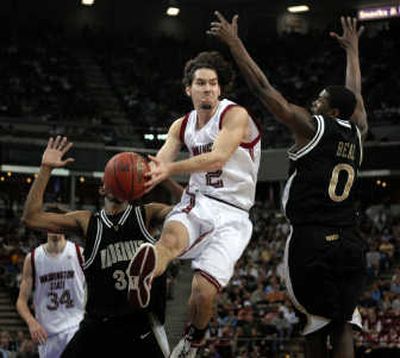
PULLMAN – Late August is typically pretty warm in Pullman, and 2004 was no different. School had started at Washington State. A half-dozen freshmen, joined by just one thing, met each other at Orton Hall, a dorm on the south side of campus. Again, a typical occurrence in the Palouse.
The six would gather in Orton’s 12th-floor lounge, talking, playing pingpong, talking, avoiding the heat in their rooms, talking, getting to know each other.
Nothing could have been more typical.
But though the situation may have been typical, these six students were not.
They were the future of the WSU basketball program, a half-dozen players who would grow up while playing hoops for the Cougars and who would help grow a national reputation for the school.
The seeds, it would seem, were sowed in that Orton lounge.
“We were all stuck,” Daven Harmeling said. “It was really hot, we were all going out and buying fans … I remember all of us just hanging out together every night. … It was cool, getting to know each other, because Derrick (Low is) from Hawaii, Chris Henry’s from California, I’m from Colorado, Robbie (Cowgill is) from Texas. All these different cultures and influences all came together and they clicked right away and it was fun.
“It’s kind of crazy how close we got right away.”
•••••
The six have shrunk to five (guard Josh Akognon transferred to Cal State Fullerton after leading WSU in scoring as a sophomore), with three – Low, Cowgill and Kyle Weaver – starting and leading last year’s magical 26-8 season. Harmeling, a redshirt junior, is first off the bench. Another redshirt junior, Henry, backs up inside.
The size of the class is atypical in college basketball, where two, three, occasionally four players are brought in each season to bolster an established program.
But WSU was anything but established when the group was coming out of high school. In fact, ask any of the group what they knew about Washington State when they were being recruited and you get a similar answer.
“Absolutely nothing,” Harmeling said.
“I didn’t even know anything about the state of Washington before I came to Washington State,” Weaver said.
“Nothing at all,” Low said.
“Nothing,” Cowgill said. “I remember having seen the logo, that’s about it.”
None was highly recruited. None was an NBA prospect.
As hard as it might be to believe, that was part of the plan for then head coach Dick Bennett – and by extension his son and, at the time, top assistant coach Tony.
“We picked a group of guys who we thought would be around for four years,” Dick Bennett said. “We knew we were going to lose early, there was no question about that, because we were in the kind of conference where you just don’t win with freshmen and sophomores, unless they are McDonald’s All-Americans.”
The number in the class was also a part of the plan, which probably isn’t nearly as hard to believe considering the Cougars were 13-16 in Bennett’s first season.
“Like every place I’ve been, we wanted to make it a big one full of guys who were good, solid citizens,” he said. “Maybe not NBA prospects, but guys who would be around for four years.”
•••••
The first two years on campus were tough for the six as losing was their constant companion. The combined record: 23-33.
“My sophomore year there were points,” where it was almost too much, Cowgill said. “If you are competitor you hate losing, and I hate losing. You start to question a little bit. You ask yourself, ‘How are we going to get this turned around?’ And ‘Do we have what it takes?’ “
They did, but it just took a while for the groundwork to be laid.
“When we came to visit,” Low said, “(Dick) took us to his still-being-built house and told us ‘See this house? First you have to have the foundation. You guys are the foundation to this program.’ “
The hard work, the coaching, the other pieces of the puzzle added as the seasons went by. They all had a part in the slow improvement that was coming. But the group had an innate ability Dick Bennett felt was at the core of their future success.
“I don’t think, quite frankly, there is any substitute for the ability to think on your feet,” he said. “The ability to be in the present, and to make that adjustment on the fly, I believe is what separates the great ones from the rest.
“There are some (players) who are really talented, but they become mechanical. You can say a lot about our kids in terms of what they lack, but none of them are mechanical. … They are all rather spontaneous.”
•••••
The elder Bennett left after the 2005-06 season, as did Akognon.
Still, the pieces were in place for rookie head coach Tony Bennett, though no one knew it at the beginning of last year. The Cougars were again picked to finish last in the Pac-10.
Even Dick didn’t see what was coming.
“I didn’t anticipate they would kind of go off the charts last year,” he said. “I thought they would have a chance to be pretty good and win some games. I thought they would have to win a lot of close games, but I never, in my wildest dreams, expected them to do that well.”
The young coach – Tony was 37 when he assumed the reins from Dick – and his losing-sharpened group cut through the non-conference season with a lone loss, then opened the Pac-10 with a tight defeat at UCLA but bounced back with a late win at USC.
The Cougars were on their way to their best season in more than 20 years, a season that didn’t end until the NCAA tournament’s second round.
“Last year we knew who we were going into the year,” the younger Bennett said. “They knew we had been close. Now we have some upperclassmen with experience. We’ve been knocking on the door, so being picked 10th didn’t bother them. They knew who they were.”
•••••
That knowledge was just part of the successful formula. So was having an intelligent, high-character group of players who felt they had something to prove.
“That was a challenge to me, as a player, to come into a program and try to build it up,” Weaver said. “To be part of something that was down and build it up, to have it where it is now, I think it means a little bit more to us guys.”
Despite last year’s success, the group still feels there are unfinished goals.
“If we don’t take another step forward this year, it will be a huge disappointment,” Harmeling said.
“Those guys really bought in, when they came, to try to turn Washington State basketball around,” Tony Bennett said. “It’s a burning desire for them to take that into this year and to just really leave their stamp on this program.
“You talk about their legacy? Well, I don’t think they want to be known as the guys who were one-hit wonders, to use a musical term.”