
Brothers recall war service
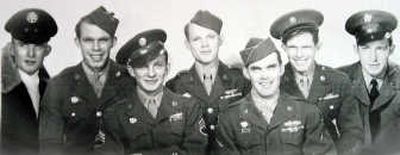
Long before the television show, North Idaho offered its own “Band of Brothers” to our nation during World War II.
Within the first year of the war, four Peterson brothers were drafted from the Silver Valley mining town of Wardner, and two years later a fifth brother joined the fight.
All five – Lester, Edward, George, Walter and William – were just kids. So were the youngest Charles and Paul, who were too young for World War II, but still enlisted and put their time in the service. Amazingly, all survived, and it wasn’t until they came home could they share the stories of their adventures.
•Paul and William both came close to meeting Bob Hope. Paul carried his luggage, and William saw him when he landed on one of the Philippine Islands. Hope got out of the plane and walked on its wing and said, “I don’t know whose nose is bigger, mine or the plane,” laughs William. But neither brother got to see the show.
•Edward served in Europe. “I started as the company bugler, and I have no idea how they knew I could play,” he said. He then made corporal, and through time became sergeant. His company first landed in England, where the troops received shots and clothes and then shipped off to France.
From there, they pushed into Germany, where a bullet entered his right lung in 1945. Edward carried a Bible in his right pocket, which he likes to believe deflected the bullet enough to spare him his life.
•Walter had shrapnel in his leg and was healing in a hospital in England. After some transferring around, he came to Edward’s company to be on his squad.
Walter saw Edward’s bag on another soldier’s back and learned what happened to his brother. He took Edward’s bag and brought it home.
It was not until Walter delivered his bag, sometime after the war ended, that Edward learned how close he came to serving with his brother.
•When Charles entered the service in Korea, he received a Bible from his mom. The same Bible, frayed at the edges, that was Edward’s six years earlier. Inscribed in the front was a message: “Dear Son, be a good soldier, keep your chin up. God is always with you and I’ll pray for you night and day.”
•William and his brother Lester, were drafted together. They rode a railroad box car “that held either 40 men or three mules,” Edward recalled of the train ride that all the brothers experienced when entering the service. Lester remembers the box cars packed full of men all from the Silver Valley area, all heading into war.
In Seattle, the brothers were split up. Lester went into the post artillery and William into the field artillery. William’s tour started off in the Philippine Islands in 1941, where Gen. Douglas McArthur was in command. Seven hundred miles out to sea, they learned the life-changing news: Pearl Harbor had been bombed. Their ship promptly turned around and landed back in the States for patrol duty.
“This was the most frightening time for me, it was the scaredest I’ve ever been, patrolling in-between the box cars and being forgotten about until morning,” William said.
From there, he was transferred to the 146th Artillery where he went to Australia first, then to New Guinea, with the local headhunters. Willaim recalls, “We were setting up our cook tent and out of the brush comes these natives, carrying a basket. They put it down in front of our tent and opened it up and dumped the contents on the ground. Three cut-off heads rolled out.”
The natives received money for each Japanese head they brought in. This was Willaim’s job, to work with the natives, to gather bamboo and set up camp. “If everyone would look at everyone as human beings, we would all be better off.”
Although William takes his war experience in stride, Edward remembers when a car would backfire, William would hit the ground. He was severely shell shocked for a time after the war.
William’s best memory is coming home and marrying his high school sweetheart, Florence. Sixty-two years later, they have four grown children and numerous grandchildren.
His biggest regret was landing back in the States after victory had been declared. “All these beautiful ladies were lined up with donuts and drinks that they wanted to give to us,” he recalls. “We were not allowed to stop. We had to keep marching for this is how we were trained. I know it must have hurt their feelings.”
Three brothers have since died.
Lester, or Jim, as he is known by family and friends, entered in the service in 1941 in Tacoma. He was decorated with the Asia-Pacific theater ribbon, Good Conduct ribbon and the American Defense ribbon. He was discharged in 1945.
George was a corporal and served with a supply unit. In the Asia-Pacific theater. He entered in Oct. 1942 and was decorated with the Asiatic-Pacific theater ribbon, the World War II Victory Medal and a good conduct medal.
Walter, or “Woggy,” entered in May 1944 and served with the 310th Infantry Regiment in Europe. His decorations include the European-African-Middle Eastern Theater Service Ribbon, Purple Heart, Distinguished Unit Badge, the World War II Victory Medal and a good conduct medal.
Charles served in the U.S. Army stationed with the 2nd Infantry Division assigned to the 37th Field Artillery in South Korea, as a truck driver, and fought at Heartbreak Ridge. His job was to load artillery shells and rations gas to keep the troops supplied.
“Crossing the narrow rocky mountain that separated North and South Korea was no easy feat,” recalls Charles. “There was little cover, and as ‘Operation Touchdown’ moved into place Oct. 5, 1951, the enemy mined and cratered the road more heavily than ever before, which put me and my trucking buddies in a hairy position.”
Paul, was the only brother who joined the Air Force and was the only brother that served during peacetime from 1958 to 1961 in Labrador.
Six brothers fought and saw combat; five received ribbons and medals. Edward who lost a lung has not received one medal or ribbon or even the good conduct medal. His papers were stored in St. Louis, where the building burned down. Still to this day, he says, “I have no idea what should be awarded to me if anything.”
It is really important to Edward to be able to recover what was lost. He has heard through the grapevine that there might be another place that stored duplicate files. The Petersons keep an extensive history of themselves that they share with the public.
Charles owns Memorabilia Museum, across from City Hall, where he spent 20 years as mayor. In the museum he shares his knowledge about the little mining town of Wardner and tells his tale of seven brothers who served their country.