Grass-roots gardening
From Northeast Spokane to North Idaho, neighbors and friends are banding together in gardens, swapping tips and sharing in the bounty of their small harvest
Mary, Mary, quite contrary,
How does a community garden grow?
With volunteer teams and grassroots dreams
And seeds planted with hope in each row.
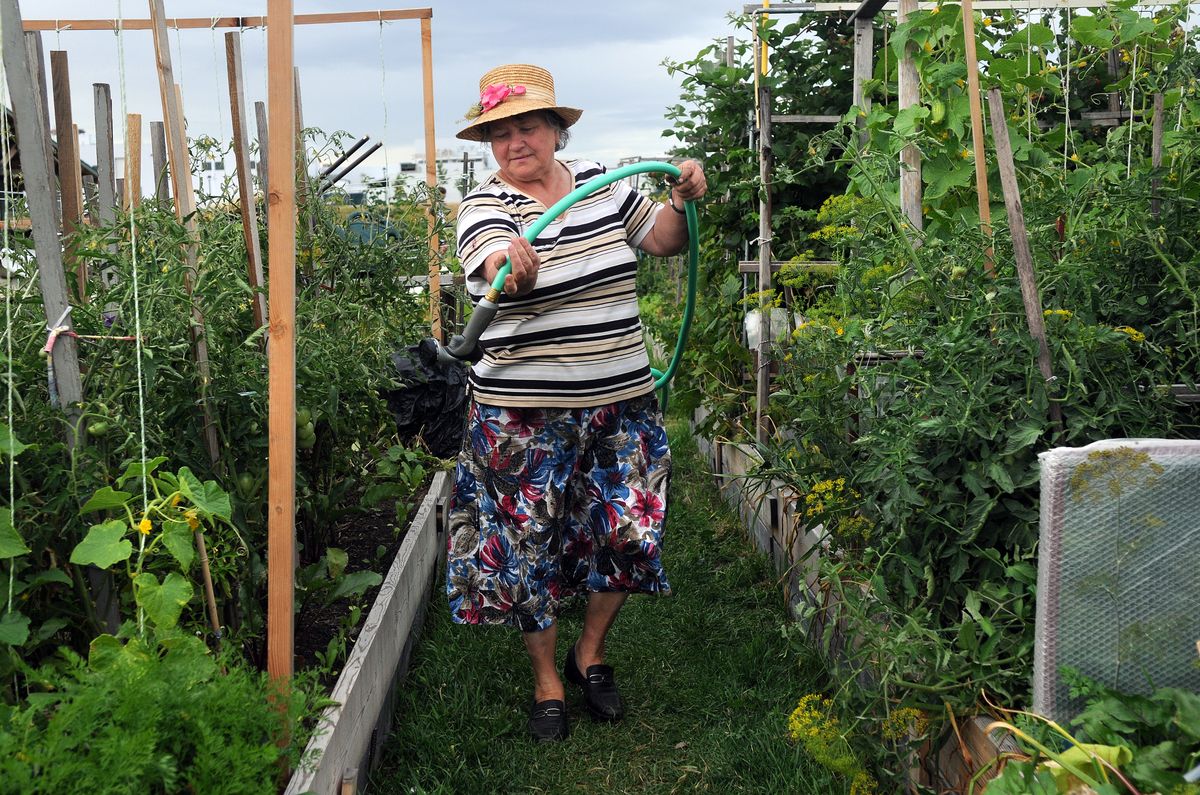
On a small plot of land on the corner of a Hillyard park that was once a brown field, Maria Dimova grows food to feed her family.
She cultivates an array of vegetables and fruit – beets for borscht; carrots, onions, cabbages and potatoes for soups and other traditional Slavic meals; and fresh, tangy raspberries for her grandchildren.
In the tiny greenhouse made of heavy plastic and wood scraps that her 16-year-old grandson, Ilia, assembled on top of the raised bed, Dimova grows hearty tomatoes and sweet cucumbers that she mixes into her salads.
“This is my hobby,” says Dimova, a widowed mother of five who immigrated to Spokane 15 years ago from Odessa, Ukraine. “This is for my family. I love this garden.”
During the summer months, the 66-year-old visits her plot at least once a day along with other Slavic immigrants who grow all their vegetables at the Northeast Community Garden at Andrew Rypien Field.
The fenced area on Lacey Street and Liberty Avenue is one of at least 10 community gardens located throughout Spokane. In North Idaho, students, apartment dwellers and others who don’t have the space to grow their own food gather at places like the Moscow Community Garden to plant vegetables, learn about composting and meet other gardeners.
With the increasing appetite for fresh, locally grown food, more people are joining their neighbors and friends to plant side-by-side, learn from each other and together, enjoy the bounty of their local harvest.
“These are people who care about each other – about their health and what they eat,” said Paula Reilly, an Americorps volunteer who works in community development at the Northeast Community Center. “They are the most prolific gardeners – their produce could fill a supermarket on a consistent basis.”
Nearly all the gardeners at the Hillyard site are Slavic immigrants who grow an array of vegetables and fruits including heirloom tomatoes from their native countries of Russia, Ukraine and other countries that were once part of the former Soviet Union. The gardeners also make an effort to minimize waste. Like Dimova’s greenhouse, many of the structures they’ve created are built from old windows, scrap metal, worn office chairs, yarn, strips of cloth and other recycled material. “This is a generation that starved during World War II – they know how to extract something useful out of everything,” said Reilly. “What some might consider junk or rubbish, they’ll use and turn into amazing pieces. They’re very creative.”
The community garden has 48 plots – all raised beds about 8-by-24 feet in size. The garden started out on the Northeast Community Center’s property on Cook Street but was expanded and relocated to Rypien Field last year through the volunteer efforts of the Slavic community, local gardeners and the Northeast Community Center.
The Hillyard garden has grown so popular that it now has a waiting list. It also has become the gathering place for the Russian-speaking community and for venue for major events such as the Slavic Harvest Festival.
“It’s more than just fruits and vegetables,” explained Tatyana Bistrevsky, program assistant at Washington State University Extension and one of the people who headed the efforts to create a community garden in Rypien Field. “It’s about going back to nature and realizing that they are part of this earth.” It also provides them with the opportunity to socialize, share stories and visit with each other, explained Bistrevsky.
Other urban community gardens have sprouted throughout Spokane. Besides growing their own food, folks are using the space as a way to foster fellowship.
There’s Riverfront Farm, a program that brings together urban farmers, neighborhood activists and at-risk youths as they grow vegetables on several lots in the West Central Neighborhood. On the South Hill, an effort known as Fertile Grounds Community Garden has taken seed at the Court Arthur apartment complex on East 30th Avenue. Other community gardens – including Twin Owls, near a hilltop in the Glenrose Hills of southeast Spokane County, and a patch located at Emmanuel Lutheran Church in Browne’s Addition – also have become part of an informal umbrella group known as Spokane Community Gardens.
“Community gardens provide nutritious food at low cost, promote skills that encourage self-reliance, revitalize neighborhoods, stimulate positive social interaction, provide opportunities for recreation and exercise, and uniquely improve the quality of life and well-being of participants,” according to its Web site, www.spokanegardens.com.
Within the city limits, one of the bigger community gardens in terms of space is at Hemlock Street and Fairview Avenue in north Spokane. Established several years ago on vacant land owned by the nonprofit Transitional Programs for Women, the garden that some call “Fairview” for short consists of more than 40 raised-bed plots. They’re used by a diverse group of people from families and individuals in the neighborhood to homeless women, as well as activists with Food Not Bombs, an organization that serves free vegan food to the poor.
“Anybody can come and garden,” said Kathy Callum, who helps supervise the garden along with her partner, Bob Sloma.
Gardeners at Fairview range in age from 8 years old to 80-something, she said. Some of the raised beds also are wheelchair accessible.
Like others at Fairview Gardens, Callum grows potatoes, garlic, beets and all the usual crops. She has plenty of raspberries that she hands out to children, and she also dabbles in heirlooms including an ancient form of beer barley and five kinds of garlic with colorful names such as Korean Red, Inchellium and Music.
Working alongside each other, Callum and other gardeners often share the extra food they harvest. The experience of community gardening also gives people a chance to try out some of the less common herbs and vegetables. Callum said she recently got her first taste of stevia, a naturally sweet herb, thanks to one of the Master Gardeners at Fairview. She also passes around some of the heirloom varieties that she collects from Seed Savers Exchange, a nonprofit that saves and shares heirloom seeds to preserve biodiversity and uphold ancient traditions.
“It’s fun to see people learn about new vegetables,” she said. “It’s a way to sample everything.”
In Mead, students at Villa Vista Language Academy have shared the school’s one-acre garden space with Don Hanson, a Spokane gardener and agricultural engineer.
As the 4- to 6-year-olds learned about the environment and how to grow food earlier this year, Hanson assembled an irrigation system and tilled each of the students’ 5-by-6-foot plots. In the unused garden space, Hanson ended up starting his own garden that he now calls Green Jazz. Along with the students and teachers at the Spanish immersion preschool, Hanson planted corn, beets, carrots, peas, potatoes, a variety of lettuce, squash, zucchini and other vegetables.
With the abundance of produce, Hanson and Villa Vista owner Laura Hamilton decided to open Green Jazz to the public. For a nominal fee, people can now come to the school and harvest vegetables on weekends and in the evenings during the week.
“It’s a lot of food, and we won’t be able to eat it all,” said Hanson, who grew up working on farms in Whitman County and later used his skills as a Peace Corps volunteer in Honduras. “The produce is also fresher than you can get anywhere else. There’s just no comparison to the taste of food that’s locally grown.”
Other community gardens also are in the works including a project on East Sprague known as One World Spokane.
Scheduled to open in September, OWS will be made up of a nonprofit community kitchen as well as an organic garden. In exchange for a donation or volunteer community service, anyone will be able to come to OWS and receive a healthy, organic meal, said organizer Keith Raschko.
The garden at Pittsburg Street and First Avenue will help supply vegetables and fruit that will be used for meals in the community kitchen. It will be a sister restaurant to One World Everybody Eats in Salt Lake City, where customers eat whatever the chef feels like cooking and people choose their portions and price.
The community kitchen and garden is a way to encourage people to savor their meals, reduce food waste and feed everyone with healthy, organic food, said Raschko.
“It’s not a soup kitchen and it’s not a handout,” he explained. “No matter how much you make or what you have, you can come and eat and everyone eats together. … It’s all about building community.”
From the Old Country
Sloma, Callum and their son, 8-year-old Jozes Sloma, use their harvest to prepare some old traditional recipes that were passed down from generation to generation in Sloma’s Polish family. In the past, they’ve grown loveage – a perennial herb that’s a cross between celery and parsley – to prepare a dish from “Food and Drink in Medieval Poland: Rediscovering a Cuisine of the Past,” edited by food historian William Woys Weaver. Sloma’s mother and father both immigrated to the United States after World War II. Like others from their native country, Sloma’s parents grew up on small subsistence farms and were familiar with various garden and orchard practices. Sloma and Callum make sauerkraut from garden vegetables that includes a fermentation process that Sloma learned from his grandmother.
The following dish is a favorite recipe that uses herbs and garlic from their garden. “I was introduced to this dish by a close friend of mine whose father was one of my anthropology professors in college back east,” Sloma wrote.
Linguine with College Professor Clam Sauce
Linguine (see note)
1-2 tablespoons extra-virgin olive oil
1-2 tablespoons butter, salted or unsalted
4-6 cloves garlic minced
1-2 tablespoons dry parmesan, reggiano or asiago cheese
2 bunches of parsley, preferably moss curled (wash, discard stems, chop leaves coarsely)
3 (6-ounce) cans of chopped whole clams
Prepare pasta in boiling water with dash of salt and tiny bit of olive oil or as directed on package. On high heat, sauté garlic in pan with olive oil and a little melted butter until golden brown. Be careful not to over cook or burn.
Reduce heat to about a simmer, add clams. Add cheese, and stir until largely dissolved. You can add 2 to 4 tablespoons of water, if you desire more clam broth. Add chopped parsley. Keep in pan until parsley is completely wilted. The clam sauce should be done by the time the pasta is ready, if not, you can keep it warm on stovetop at the lowest setting. Serve clam sauce over the selected pasta.
Note: Fresh linguine is best for this dish, but any pasta may be used.
Yield: 4 to 6 servings
Approximate nutrition per serving, clam sauce and 4-ounces fresh pasta, based on 6: 326 calories, 8 grams fat (2.5 grams saturated, 22 percent fat calories), 29 grams protein, 34 grams carbohydrate, 101 milligrams cholesterol, 2 grams dietary fiber.
Ukrainian Borscht
Ukrainian borscht is a cross between a soup and stew, explained Tatyana Bistrevsky, who helped organize the Northeast Community Garden in Hillyard. Many of the Slavic immigrants who have plots at the garden use their vegetables to cook this traditional dish. This recipe is from the Bistrevsky family.
2-3 pounds of meat (chicken, beef or pork)
Beets, optional (see note)
1 whole onion, peeled
1 teaspoon salt
1 green bell pepper
5 medium-sized potatoes
1/2 head cabbage
Garlic, to taste
2 bay leaves
Dill
For the sauce:
2 tablespoons canola oil (Bistrevksy uses a mixture of different oils – canola, sunflower, sun-dried tomato and garlic)
1 green bell pepper, chopped
1 onion, peeled and chopped
1 carrot, grated
1 (15-ounce) can of tomato sauce or fresh tomatoes that are boiled with the meat and then added into the simmering vegetables
Black pepper, to taste
Garlic, to taste
Salt, to taste
In a 5 to 6 quart pot, cover meat with water and bring to a boil over high heat. Reduce to a simmer and skim off foam. Add one whole onion and 1 teaspoon of salt. Add beets, if using. See note below. Boil over medium-low heat for about 1 hour or until meat is ready. While meat is cooking, prepare sauce.
To make the sauce: In a large skillet heat oil and slightly brown the chopped pepper, onion and carrots. Then add tomatoes or tomato sauce, spices (pepper, garlic, salt) and sauté for 10 to 15 minutes, adding a little bit of broth from the main pot.
When meat is ready, remove onion from the broth and throw it away, take the meat out, strip it off the bones, and cut into small cubes. (Place in bowl and add into the borsch at the end, right after the sauce). Add the green bell pepper, cut in half. Peel the potatoes and cut into small cubes. Add to boiled broth and cook for about 5 to 7 minutes. Shred cabbage into thin strips, and add to cooking potatoes in the pot. Cook cabbage for 1 minute.
Immediately after that add prepared sauce, reserved meat, garlic, bay leaves, dill and salt to taste and turn off the stove. Let the borscht stand for a half of hour before serving.
Serve the borscht with sour cream.
Note: Bistrevsky’s family doesn’t like beets so she doesn’t use it in her borscht. If you use beets, slice them into small pieces and start cooking them right after you first skim the foam from the broth. Another method, she said, is to simmer it separately in a skillet with a bit of oil, adding a little bit of the broth and sprinkling it with vinegar. Add to borscht together with sauce.
Yield: 6 to 8 servings
Approximate nutrition per serving: Unable to calculate.